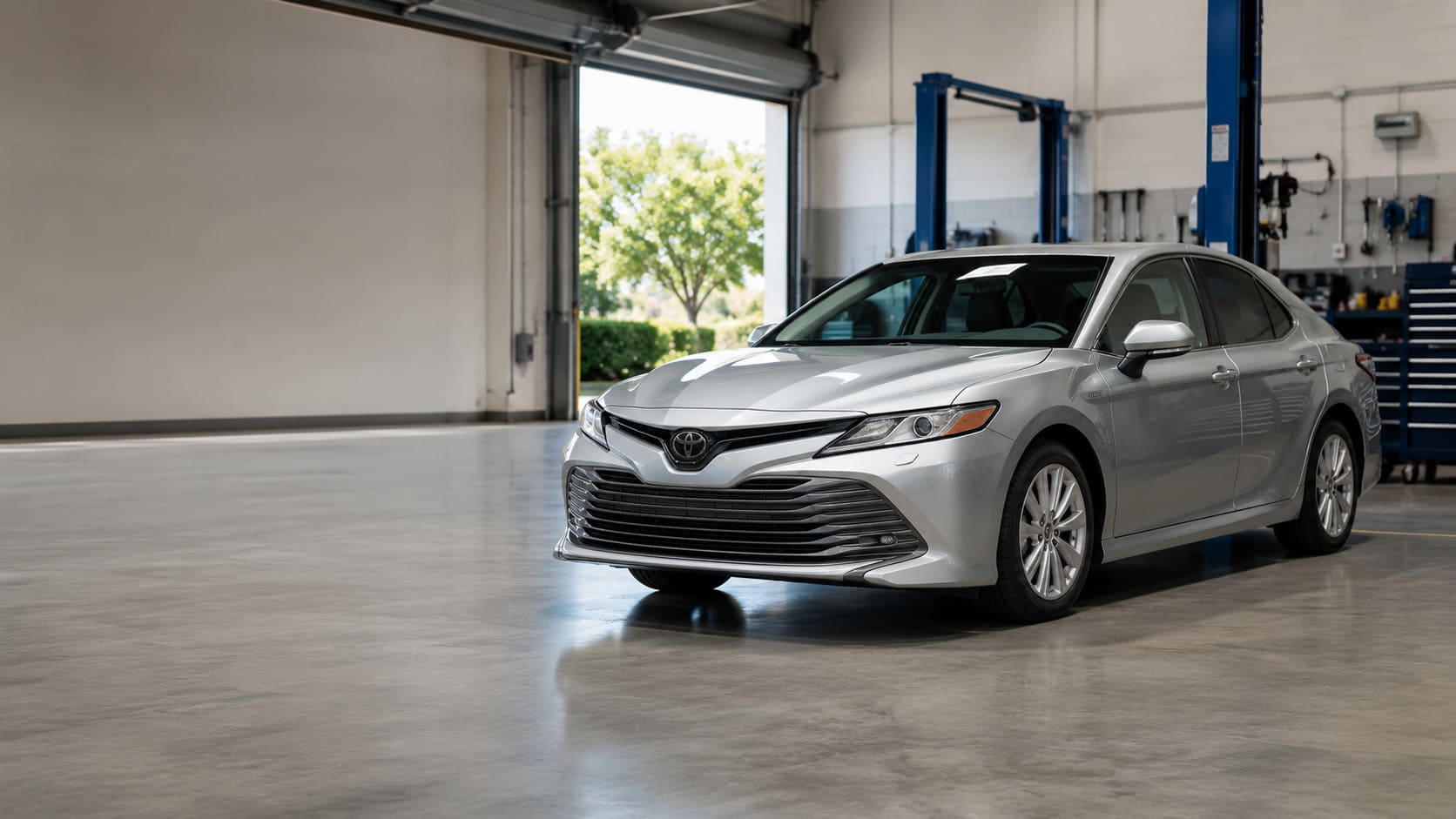
Toyotas are among the cheapest cars to keep running in South Florida, and most problems are predictable wear rather than surprises. The issues worth knowing are oil burning on 2006-2011 2.4-liter engines, V6 water pumps and oil lines, Prius EGR and inverter trouble, and the V35A engine recall on 2022-2024 Tundras. Run your VIN for open recalls first, because several big Toyota campaigns are free fixes.
Toyota sells more cars in Palm Beach County than almost anyone, so parts are on the shelf at every parts counter on Federal Highway and nearly every independent shop has done the common jobs hundreds of times. That matters for your wallet. RepairPal puts the average Toyota at about $441 a year in unscheduled repairs, against roughly $652 for all brands, and Consumer Reports ranks Toyota first for new-car reliability and third for maintenance and repair cost.
The flip side of a durable reputation is that owners skip maintenance because the car never complains. A Camry or RAV4 with on-time oil changes will often pass 200,000 miles on the original engine and transmission. One that has run 15,000 miles between changes in Boca traffic is the one that shows up with sludge or a weeping water pump.
Popular Toyota models in South Florida
- Camry (2018-2024 and 2025+ hybrid-only): The most common Toyota on Boca roads, with a very durable 2.5-liter four. 2018-2020 cars were in the Denso fuel pump recall. From 2025 every Camry is a hybrid.
- RAV4 and RAV4 Hybrid (2019+): The best-selling Toyota crossover. 2019-2020 gas models were in the fuel pump recall. Early RAV4 Hybrids drew complaints and a class action that the tank would not accept a full fill, so check how many gallons yours actually takes.
- Corolla (2014+): Simple and cheap to run. 2020 and later 2.0-liter cars use a CVT with a mechanical launch gear that has held up well. Fluid changes still matter in heat.
- Highlander (2008+): The 3.5-liter V6 (2GR family) is strong, but water pumps and oil cooler lines are known wear points on older ones. 2017-2019 models were in the fuel pump recall.
- Prius (2010-2015 third generation): Still common as a commuter car. Watch for EGR cooler clogging, head gasket failure and inverter recalls. Hybrid battery age is the big unknown on used ones.
- Tacoma (2016-2023): Holds value like few trucks do. Older 2005-2010 trucks had a frame rust settlement, which matters if you buy one that lived up north.
- Tundra (2022+): The non-hybrid twin-turbo V6 trucks are covered by an engine replacement recall for 2022-2023 builds, later expanded to some 2024s.
Known Toyota problems to watch for
Oil burning on the 2.4-liter 2AZ-FE four-cylinder
Piston rings on this engine could stick and let oil past, so some cars burned a quart every 1,000-1,200 miles. Toyota ran Warranty Enhancement Program ZE7, which tested consumption and replaced pistons and rings on cars that failed, but that program has ended. Today the choice on a high-mileage car is a piston and ring job, usually $2,500-$4,000, a used engine, or simply topping up and checking the dipstick every fill-up. Running it low is what ruins these engines.
Guide: Blue smoke from the exhaust: is my car burning oil?Sticky or melting dashboards
Toyota acknowledged that dashboards on these cars could turn soft, shiny and sticky after years of heat and humidity, and extended dashboard coverage to 10 years. South Florida was one of the worst areas. Most of these cars are now past the extension, so the fix is a good used dash or a fitted cover. The glare from a shiny dash is a real visibility problem.
Guide: How do I keep the Florida sun from cracking or melting my dashboard?2GR-FE V6 oil hose, oil cooler lines and water pump
The early V6 used a rubber section in the oil line to the VVT-i actuator that could split and dump oil fast; Toyota replaced it with an all-metal line under a service campaign. Separate coverage addressed seeping oil cooler pipes on Sienna, Highlander and Venza. The water pump is a normal wear item around 90,000-120,000 miles; look for pink crust under the pulley.
Guide: Sweet smell from my car, like maple syrup: is it a coolant leak?Prius inverter shutdowns and EGR related head gasket failures
Two recalls (14V-053 and 18V-684) addressed inverter power-module transistors that could overheat and put the car in limp mode or shut the hybrid system off. Separately, the EGR cooler and passages on this 1.8-liter engine clog with carbon, causing misfires, and are widely linked to head gasket failure, though there is no recall for that. EGR cleaning runs $400-$900 and is cheap insurance past 120,000 miles.
Guide: Why does my engine idle rough or shake at a stop?Denso low-pressure fuel pump recall
The impeller in the in-tank pump can swell and stick, so the engine runs rough, will not start, or stalls while driving, which is dangerous at highway speed on I-95. Dealers replace the pump free. If your car has stumbled or stalled even once, check the VIN before anyone charges you for diagnosis.
Guide: Check engine light on but the car drives fine: what does it mean?V35A twin-turbo V6 main bearing failures
Machining debris left in some engines can damage the crankshaft main bearings. Symptoms are a knock, rough running, a no-start or a stall. Under the first recall dealers replace the engine. The later expansion starts with a bearing inspection using drive data. Do not buy a used 2022-2024 Tundra without a recall printout showing the work was done.
Frame rust on older Toyota trucks
A class action settlement paid for frame inspections and replacements on trucks whose frames rotted through, mostly in road-salt states. These trucks have aged out of that coverage. Plenty of used Tacomas here came south with snowbirds, so look at the frame behind the cab and around the rear spring hangers before buying.
Guide: Does salt air near the beach rust your car, and how do you stop it?Maintenance schedule highlights
| Every 5,000 miles or 6 months | Tire rotation, multipoint inspection, brake check. On cars driven under Toyota's special operating conditions (short trips, lots of idling, towing) this is also the oil change interval. |
| Every 10,000 miles or 12 months | Synthetic oil and filter for most 2018+ models, using the grade on the oil cap (0W-16 or 0W-20). Inspect wipers, cabin filter and coolant level. |
| Every 15,000-30,000 miles | Cabin air filter replacement (sooner if the A/C smells musty), engine air filter inspection, brake fluid and hose inspection. |
| 30,000 miles | Engine air filter replacement, inspect drive belt, ball joints, boots and exhaust. On hybrids, clean the hybrid battery cooling intake filter or grille, which pet hair and dust clog. |
| 60,000 miles | Inspect automatic transmission or CVT fluid. Toyota calls many of these fluids long-life, but a drain-and-fill around 60,000 miles is cheap protection in hot stop-and-go driving. |
| 100,000 miles or 10 years | First Super Long Life coolant replacement, then every 50,000 miles. On hybrids this includes the separate inverter cooling loop on many models. |
| 120,000 miles | Iridium spark plugs. On transverse V6 models the intake plenum has to come off for the rear bank, which is why the bill is higher. |
Always confirm against your owner's manual or maintenance minder for your exact model and year.
Typical Toyota repair costs
| Job | Typical cost | Notes |
|---|---|---|
| Synthetic oil change (0W-16 or 0W-20) | $70-$120 | Dealer service drives often run $90-$150 with inspection. |
| Front brake pads and rotors, Camry or RAV4 | $350-$600 | Hybrids wear front pads far more slowly thanks to regenerative braking. |
| 12-volt battery, gas model | $180-$300 | |
| 12-volt AGM battery, hybrid | $250-$420 | |
| A/C compressor replacement, Camry or RAV4 | $1,200-$2,200 | Includes evacuate and recharge. |
| Water pump, 3.5-liter V6 | $650-$1,100 | Usually done with a new drive belt and coolant. |
| Spark plugs, four-cylinder / V6 | $200-$350 / $400-$650 | |
| Prius hybrid battery, new / reconditioned | $3,000-$4,500 / $1,600-$2,600 | Dealer pricing for a new pack is at the top of the range. |
| Transmission fluid drain-and-fill | $150-$300 | Toyota WS fluid needs a level check procedure at a set temperature; it is not a quick-lube job. |
Typical South Florida ranges for parts and labor, for budgeting only. Your quote depends on the vehicle and the shop.
Dealer or independent shop?
While your Toyota is under the 3-year/36,000-mile basic or 5-year/60,000-mile powertrain warranty, warranty repairs belong at the dealer. Routine maintenance does not. Federal law lets you have maintenance done anywhere as long as you use the right fluids and keep receipts.
Recalls and warranty enhancements are dealer-only and free, so they are the first stop for anything on the recall lists above. For out-of-warranty work, independent shops in Palm Beach County commonly bill around $130-$180 an hour against roughly $190-$260 at dealers, and Toyota jobs are so common that a good independent is often faster. Hybrid inverter and battery diagnosis is the main area where you want a shop that actually owns a Toyota-capable scan tool and does hybrids every week.
Ask any shop whether it uses Toyota-spec fluids. WS transmission fluid, Super Long Life coolant and the correct low-viscosity oil are not interchangeable with universal products.
Owning a Toyota in South Florida
Heat is what ages a Toyota here, not miles. A Camry parked on an open lot off Glades Road can see cabin temperatures well over 140 degrees, which is exactly how the sticky dashboards happened and why 12-volt batteries in Boca often last three years instead of five. Test the battery every spring, use a windshield shade, and treat a slow crank as a warning rather than a quirk.
Hybrids add a twist. The traction battery is cooled by cabin air pulled through a small intake, usually beside or under a rear seat. Run the A/C, keep that intake clear of beach bags and dog hair, and the pack stays cooler and lasts longer. A hybrid that sits in a garage for the summer while its owner is up north should be started and run to READY for 30 minutes every few weeks, or the 12-volt battery will be flat on return.
If you park near the beach in Highland Beach or along the Intracoastal, rinse the underbody and brake components every few weeks. Salt air eats rotor hats, brake hardware and exhaust hangers on Toyotas just as it does on any other car. And if a hurricane puts water above the rocker panels, do not try to start the car; on a hybrid, water and high voltage are a serious combination.
Repair shops near Boca Raton
- Boca Auto Fix4301 Oak Circle, Boca Raton, FL, 33431
- Element, Pickup trucks and trailer repair3120D Northwest 16th Terrace, Pompano Beach, FL, 33064
- Europen Auto Service CentreParkland, FL
- Ferrari of Boca Raton6403 W Rogers Cir, Boca Raton, FL, 33487
- FirestonePompano Beach, FL
- Firestone1259 North Federal Highway, Boca Raton, FL, 33432
Toyota FAQ
Do I have to go to a Toyota dealer to keep my warranty?
No. Maintenance can be done by any shop as long as the work follows Toyota's schedule and uses the specified fluids. Keep every receipt with the date, mileage and part numbers. Recalls and warranty repairs themselves still have to be done by a Toyota dealer, at no charge.
Is a 10,000-mile oil change interval safe in Boca traffic?
Toyota allows it for normal use with synthetic oil, but short trips, long idling at lights and summer heat are exactly what its special operating conditions describe. Many Boca owners split the difference and change oil every 5,000-7,500 miles, which costs little and is cheap insurance for the engine.
How long does a Toyota hybrid battery last?
Many last 10-15 years and well past 150,000 miles. For 2020 and later models Toyota covers the hybrid battery for 10 years or 150,000 miles, transferable to later owners. Older models carry 8 years or 100,000 miles. Heat shortens battery life, so keep the cooling intake clean.
How do I know if my Toyota has an open recall?
Enter the 17-character VIN from the lower windshield or door jamb at NHTSA's recall lookup or on Toyota's owner site. It shows only open, unrepaired recalls for that exact vehicle. Check again before buying any used Toyota, because recalls follow the car, not the owner.
Guides for Toyota owners
Toyota services
Open recalls are repaired free at any franchised Toyota dealer. Check your VIN at nhtsa.gov/recalls or see recent recalls.
- NHTSA recall 24V-381: Toyota Tundra and Lexus LX 600 V35A engine debris
- NHTSA recall 20V-682: Toyota and Lexus Denso fuel pump expansion
- NBC 6 South Florida: melting dashboards to be replaced
- RepairPal: Toyota reliability rating and annual repair cost
- Consumer Reports: Toyota brand overview and rankings
General information, not a diagnosis. A car problem can have causes a guide cannot see, so have anything safety-related inspected in person. Read our editorial policy.