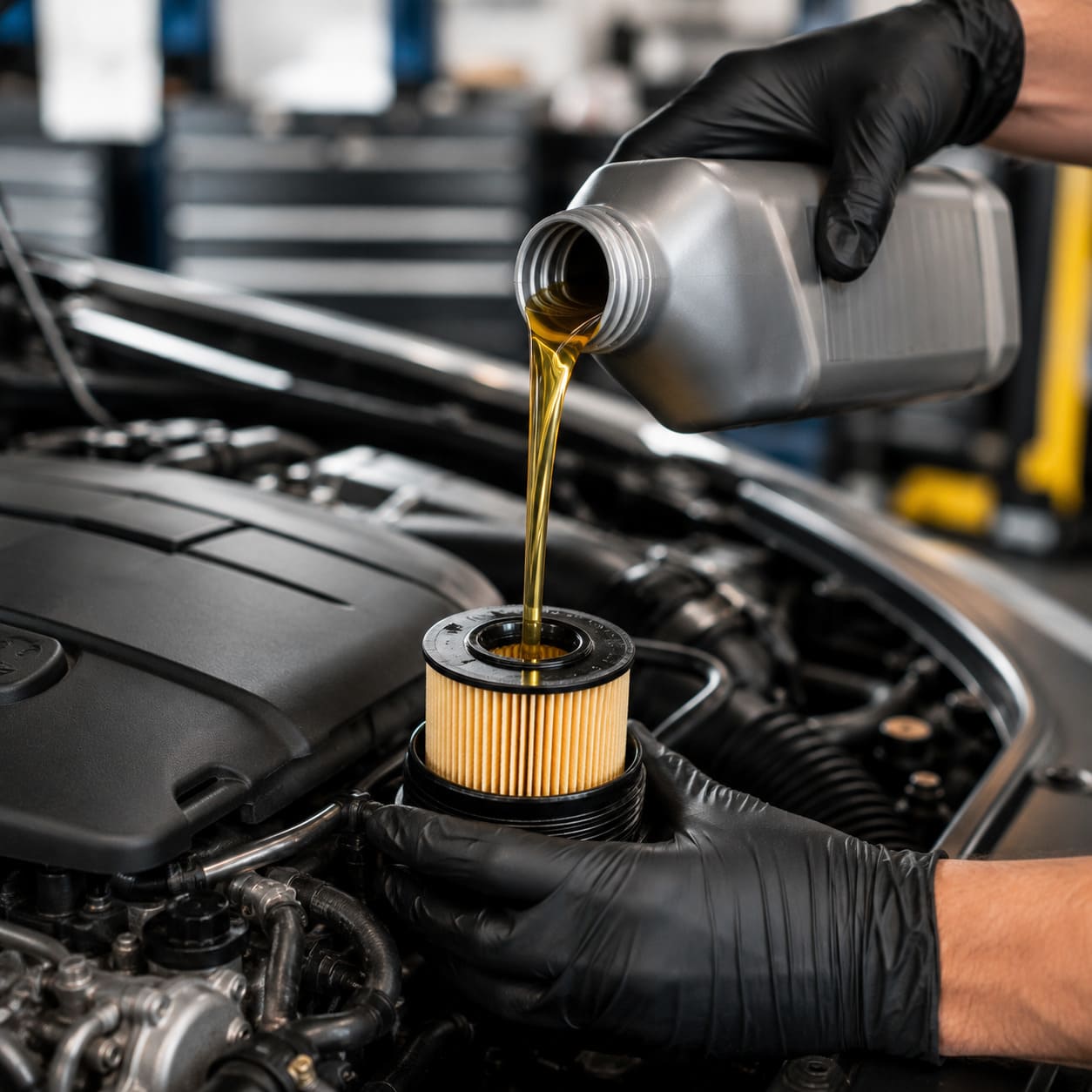
A full-synthetic oil change in the Boca Raton area typically runs $80 to $140 for most cars, and $130 to $220 for European engines that take more oil and a dealer-approved spec. Go by the interval in your owner's manual or oil-life monitor, shortened toward the 'severe service' column if you mostly drive short trips in summer heat. The cheapest quote is fine as long as it uses the exact oil specification printed in your manual.
An oil change is the one job almost every driver buys several times a year, which is exactly why it is used as a loss leader. Quick-lube lanes, dealers, tire chains and independent shops all advertise it cheaply because the car is now on a lift and someone can walk you through a list of extra services. Knowing what the base job is worth, and what your engine actually needs, is most of the battle.
The single most important detail is the oil specification, not the brand. Many modern engines call for 0W-20 or 0W-16 to meet fuel economy targets, and German makes often require an approval code such as VW 504 00, MB 229.71 or BMW Longlife-17 FE+. A shop that pours generic 5W-30 into an engine designed for something else can trigger warning lights, cost you 1 to 2 percent in fuel economy, and give a manufacturer grounds to question a warranty claim.
You do not have to go to the dealer to keep the factory warranty. Federal rules say a dealer cannot deny coverage just because routine maintenance was done somewhere else. What protects you is a receipt that shows the date, mileage, oil type and quantity, and filter part number. Keep every one.
What the job includes
- Draining the old oil from the pan, replacing the drain plug crush washer where the design uses one, and torquing the plug to spec.
- A new oil filter, either spin-on or a cartridge element with fresh O-rings, matched to your engine.
- Refilling with the viscosity and approval spec listed in your owner's manual, with the quantity written on the invoice.
- Checking the level on the dipstick or the electronic oil gauge after the engine has run and settled.
- Resetting the oil-life or service reminder so the next interval starts from zero.
- A quick look under the car for leaks at the drain plug, filter, valve cover and oil pan gasket.
- Topping off washer fluid and setting tire pressures to the door-jamb spec, which many shops include at no charge.
What oil change costs in Boca Raton
| Job | Typical cost | Notes |
|---|---|---|
| Conventional or high-mileage oil, small 4-cylinder | $45-$80 | Only if your manual allows non-synthetic. Fewer engines do every year. |
| Full synthetic, most Japanese, Korean and domestic sedans | $80-$140 | 5 quarts or so plus a spin-on filter. Coupons often bring this under $90. |
| Full synthetic, V6 or V8 truck and SUV | $110-$170 | 6 to 8 quarts. Some trucks have skid plates that add labor. |
| European engine with factory-approved oil | $130-$220 | Approved oils cost more, and many engines hold 7 to 8 quarts. |
| Dealer oil service on a luxury brand | $160-$300 | Often bundled with an inspection and cabin air filter. |
| Engine air filter add-on | $25-$75 | Ask to see the old one. Replace if it is visibly dark or full of debris. |
| Cabin air filter add-on | $40-$100 | A 5-minute job on many cars. Parts cost $15 to $35 online. |
| Engine oil flush add-on | $40-$90 | Rarely needed on an engine that has had regular changes. |
Typical South Florida ranges for parts and labor, for budgeting only. Your quote depends on the vehicle and the shop.
Oil Change shops near Boca Raton
- Ferrari of Boca Raton6403 W Rogers Cir, Boca Raton, FL, 33487
- Jiffy LubeDelray Beach, FL
- Tire Kingdom23193 Sandalfoot Plaza Drive, Boca Raton, FL, 33428
How to choose a shop
- Ask the shop which oil they will use before the car goes on the lift. A good answer names the viscosity and the approval or standard, for example 0W-20 meeting API SP and ILSAC GF-6, or a specific European approval number. 'Our house synthetic' is not an answer.
- Check that the shop is registered with the Florida Department of Agriculture and Consumer Services. Florida requires every paid repair business to register, and the registration number must appear on the invoice. You can look it up online or by calling 1-800-HELP-FLA.
- For the simple job, ASE certification matters less than for brakes or diagnostics, but the best signal is a shop that writes oil type, quarts and filter part number on the receipt without being asked. That record is what you need for warranty and resale.
- If you own a car still under factory warranty with a strict oil approval, a dealer or an independent specialist that stocks the approved oil is the safer choice than a general quick-lube lane that may carry only a few bulk grades.
Red flags and upsells to question
- An engine flush pitched on a car with a clean service history. It adds cost and can loosen deposits into the oil pickup on neglected engines.
- A 3,000-mile sticker on a car whose manual or oil-life monitor says 7,500 or 10,000 miles. The sticker benefits the shop, not your engine.
- Being told your air filter is dirty without being shown it. Ask them to hold it up next to a new one.
- Fluid 'flushes' for coolant, power steering, transmission and brakes sold all at once during a basic oil visit, without reference to the mileage intervals in your manual.
- No oil spec on the invoice. If the paperwork just says 'synthetic oil change', you cannot prove the right oil went in.
- An overfilled or underfilled engine on the drive home. Check the dipstick yourself the next morning on level ground.
The Florida factor
Most owner's manuals list two schedules, and Boca Raton driving often fits the severe one: frequent trips under 10 miles, idling in traffic on Glades Road or Palmetto Park Road, and long stretches with outside air in the 90s. Short trips never let the oil get hot enough long enough to boil off moisture and fuel, and Florida humidity adds more condensation. If your car has an oil-life monitor, it already accounts for much of this, so trust it over a fixed sticker.
Seasonal residents should change the oil right before leaving for the summer, not when they return. Used oil carries acids and moisture that sit on bearings and cam surfaces for months while the car is parked in a hot garage. Many manuals also set a time limit, typically 12 months, regardless of mileage, which low-mile snowbird cars hit long before the odometer interval.
If you change your own oil, Florida lets you drop used motor oil and filters at many auto parts stores and county collection sites for free. Pouring it out or putting it in household trash is illegal, and one gallon can contaminate a large volume of groundwater in a state that drinks from a shallow aquifer.
Frequently asked questions
How often should I change synthetic oil in South Florida?
Follow the oil-life monitor or the severe-service column in your manual. For many modern cars driven mostly around town that works out to roughly every 5,000 to 7,500 miles, or once a year if you drive very little.
Does a quick-lube oil change void my warranty?
No. A dealer cannot deny warranty coverage just because an independent shop or quick-lube did the work. Keep receipts that show the date, mileage and the oil specification used.
Is the oil brand important?
Less than the specification. Any oil that carries the viscosity and the approval code your manual lists is acceptable. Brand loyalty matters far less than changing it on time.
Do I need a written estimate for an oil change in Florida?
Florida's written-estimate rule applies when a repair will exceed $150. Most oil changes come in under that, but if add-ons push the bill higher, you are entitled to a written estimate first.
Why did the shop recommend a different viscosity than my manual?
Sometimes an older, high-mileage engine benefits from a high-mileage blend, but the viscosity should still match the manual. If a shop wants to change it, ask why and ask them to note it on the invoice.
Guides related to oil change
- RepairPal: Oil change cost estimate
- FTC: Auto warranties and auto service contracts
- fueleconomy.gov: Keeping your vehicle in shape
- Florida Statutes 559.905: Written motor vehicle repair estimate
General information, not a diagnosis. A car problem can have causes a guide cannot see, so have anything safety-related inspected in person. Read our editorial policy.