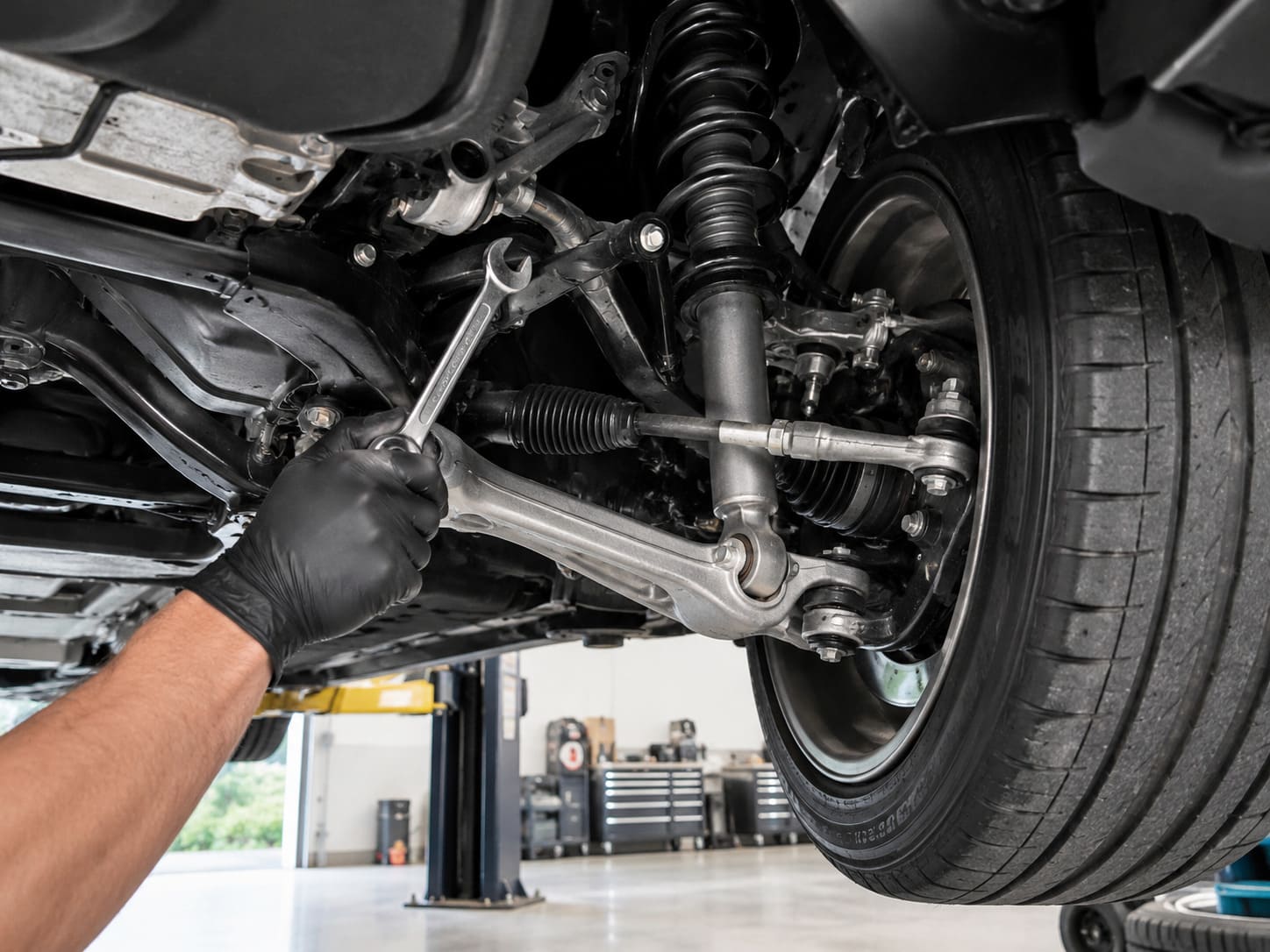
Common suspension repairs around Boca Raton run about $300 to $550 for a tie rod end with alignment, $450 to $900 for a front control arm, and $800 to $1,600 for a pair of front struts. Ask the shop to show you the play or leak with the car on the lift, and expect an alignment to be included or quoted whenever steering or front suspension parts are replaced.
Suspension parts wear slowly, so most drivers do not notice the change until a tech points it out. That makes this an area where honest shops and upsellers look the same from the counter. The difference is evidence: a loose ball joint or tie rod has visible, measurable play, a leaking strut is wet with oil, and a worn bushing is cracked or torn. If you cannot be shown it, be cautious about paying for it.
Struts and shocks control how the springs move. They rarely fail suddenly, but once they are tired the car bounces after bumps, dives hard under braking and wears tires in a scalloped pattern. Steering parts, such as tie rods, ball joints and the rack, are a safety issue when they loosen, because a separated ball joint or tie rod can cause loss of steering control.
Many newer cars use a single front lower control arm with the ball joint and bushings built in, so the whole arm is replaced rather than pressed apart. That raises the part price but cuts labor, and it is a normal recommendation, not a sign of overselling.
What the job includes
- A road test over rough pavement to reproduce the clunk, wander or vibration you describe, ideally with you in the car.
- Lifting the car and checking ball joints, tie rod ends, control arm bushings, sway bar links and wheel bearings for play by hand and with a pry bar.
- Inspecting struts and shocks for oil leaks, broken springs, worn mounts and torn dust boots.
- Checking the power steering rack or electric steering system for leaks, torn boots and noise.
- Replacing worn parts in pairs on the same axle where it affects handling, such as struts.
- A four-wheel alignment after any part that changes geometry, with a printout of the before and after angles.
- Re-torquing suspension bolts with the car at ride height, which prevents premature bushing wear.
What steering & suspension costs in Boca Raton
| Job | Typical cost | Notes |
|---|---|---|
| Sway bar end links, pair | $150-$350 | A common cause of light clunks over small bumps. |
| Outer tie rod end, one side, with alignment | $300-$550 | Alignment is required afterward. |
| Front lower control arm, one side | $450-$900 | Usually includes the ball joint and bushings as one part. |
| Ball joint, press-in type, one side | $300-$650 | Labor heavy on trucks and some SUVs. |
| Wheel hub bearing, one corner | $350-$700 | Bolt-on hub units are quicker than press-in bearings. |
| Front strut assemblies, pair, with alignment | $800-$1,600 | Complete 'quick strut' assemblies save labor over rebuilding. |
| Rear shocks, pair | $300-$700 | Simpler than struts on most vehicles. |
| Power steering rack replacement | $1,200-$2,800 | Electric racks on newer cars sit at the high end. |
| Four-wheel alignment | $120-$250 | Add camera calibration if the car has lane-keeping assist. |
Typical South Florida ranges for parts and labor, for budgeting only. Your quote depends on the vehicle and the shop.
Steering & Suspension shops near Boca Raton
We are still adding shops for this service. Browse the directory or use the quote form.
See all shops for this serviceHow to choose a shop
- Look for a technician with ASE A4 (Suspension and Steering) certification and a shop with a current alignment rack. Suspension work and alignment go together, and a shop that has to send the car elsewhere for alignment adds delay and a second bill.
- Ask the shop to show you the worn part on the lift. Good techs will rock the wheel to show tie rod or ball joint play, or point to an oily strut body. Photos or a short video sent to your phone are common now, and they are a good sign.
- Get a quote that lists each part with a brand and whether it is OE, OE-equivalent or economy aftermarket. Cheap control arms and links can wear out in a year or two. Ask what warranty the part and the labor carry; 12 months or 12,000 miles on labor is common, with some parts covered longer.
- Florida's repair statute requires the shop to offer a written estimate for anything over $150, and the final invoice must say what is guaranteed and for how long, list each part as new, used or rebuilt, and show the shop's state registration number. Keep that invoice.
Red flags and upsells to question
- 'You need all four struts' with no road test, leak or bounce evidence. Struts are usually replaced in pairs on one axle, front or rear, not automatically all four.
- A suspension repair that changes toe or camber, such as a tie rod or control arm, with no alignment on the quote.
- A quote for ball joints and tie rods on both sides when only one side has play.
- An alignment sold to fix a vibration. Vibration usually points to wheel balance, a bent wheel or a tire problem, not alignment.
- No printout after an alignment, or angles still out of spec with no explanation.
- Lifetime-warranty parts sold at a premium where the warranty covers the part only, so you pay labor again each time it fails.
The Florida factor
Boca Raton roads are flat, but they are not gentle. Raised crosswalks, speed tables in residential neighborhoods, parking garage ramps and the expansion joints on I-95 overpasses all load the front suspension, and construction patches on Glades Road and Yamato Road can hide sharp edges. A single hard hit can bend a tie rod or knock an alignment out, so pay attention if the steering wheel is suddenly off center.
Heat and salt both shorten rubber and metal parts. Control arm bushings, strut mounts and sway bar link boots dry out and crack faster under constant sun and high underbody temperatures, and salt air near the coast and the Intracoastal attacks bolts, springs and sway bar links. Seized fasteners are a real labor factor on coastal cars, so expect a shop to quote extra time for rusted bolts on an older vehicle.
Hurricane season adds flood risk. If a car has sat in water above the wheel hubs, the wheel bearings can take in water and start to hum within weeks. Mention any flood exposure when you describe a new noise.
Frequently asked questions
How do I know if my struts are worn?
Signs include the car bouncing more than once after a bump, nose-diving under braking, swaying in turns, oil on the strut body, and cupped tire wear. Many makers suggest inspection around 50,000 miles.
Do I need an alignment after replacing struts?
On most front struts, yes, because removing and installing them can change camber and toe. Rear shocks usually do not affect alignment.
Is a clunk over bumps dangerous?
It can be harmless, such as a worn sway bar link, or serious, such as a loose ball joint. Get it inspected soon and stop driving if the steering feels loose or the car wanders.
What causes a humming noise that changes with speed?
A wheel bearing is a common cause, especially if the noise changes when you turn left or right. Tire wear can sound similar, so the shop should check both.
Why are my tires wearing on the inside edge?
Usually an alignment problem, often caused by worn bushings or a bent part. Fixing the cause before buying new tires saves money.
Guides related to steering & suspension
- RepairPal: Shock or strut replacement cost
- RepairPal: Control arm replacement cost
- RepairPal: Tie rod replacement cost
- RepairPal: Wheel bearing replacement cost
- Florida Statutes 559.911: Invoice required of repair shop
General information, not a diagnosis. A car problem can have causes a guide cannot see, so have anything safety-related inspected in person. Read our editorial policy.