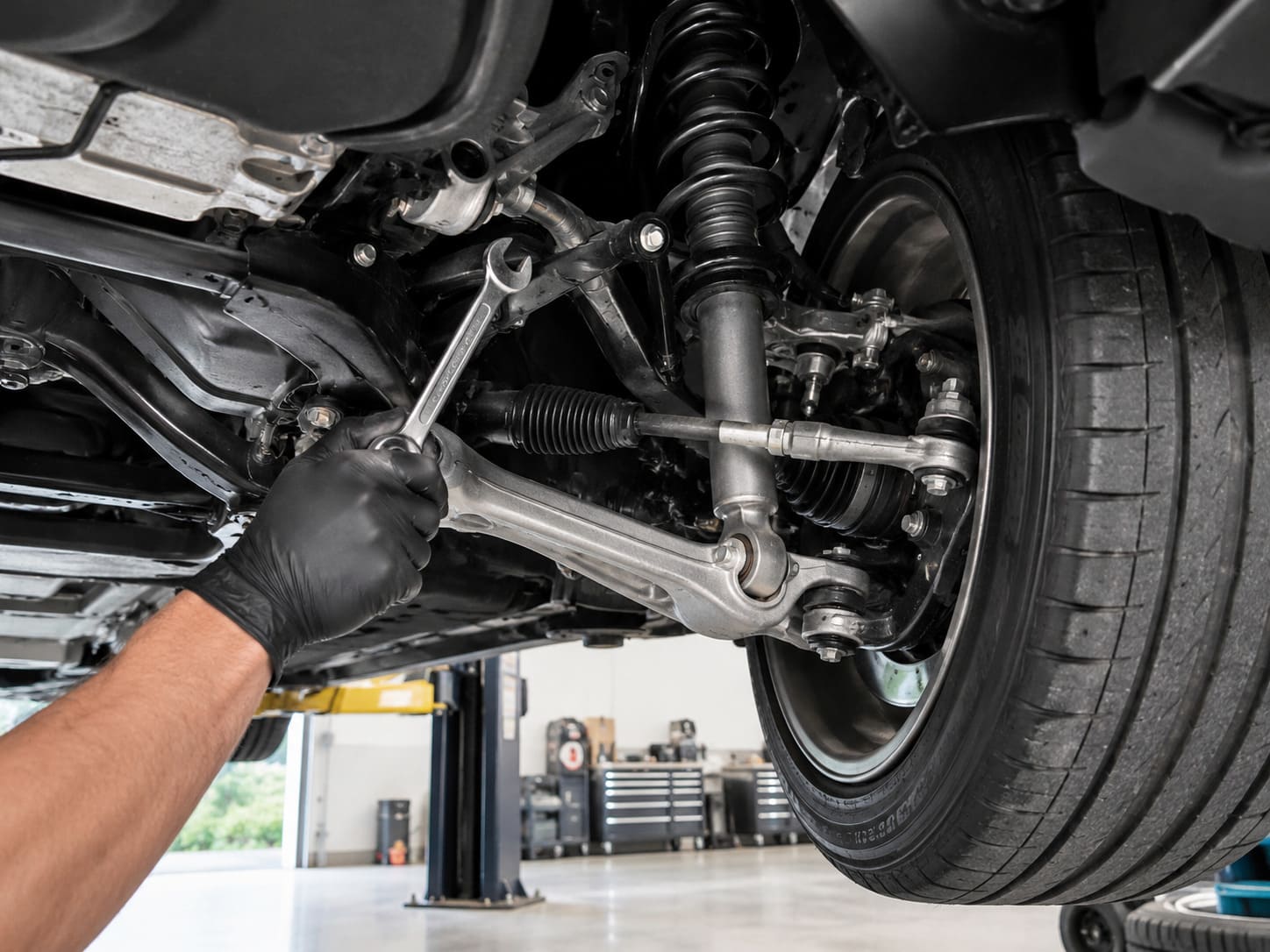
A hum or growl that rises and falls with road speed, not engine speed, is most often a worn wheel bearing or uneven tire wear. A bearing usually changes pitch when you swerve gently left and right, getting louder when weight shifts onto the bad side. Get it diagnosed within a few weeks; a bearing that keeps deteriorating can eventually develop play, affect the ABS sensor, and in extreme cases let the wheel wobble.
Each wheel turns on a sealed bearing, a ring of steel balls or tapered rollers packed in grease inside a hub. When the seal lets water and grit in, or the grease breaks down, the rolling surfaces pit. Pitted surfaces hum. Over thousands of miles the hum gets louder, turns into a growl, and the bearing starts to develop play.
The tricky part is that tires make similar sounds. Cupped or feathered tread, aggressive all-terrain tires, or a tire with a shifted belt can all drone at speed. A good diagnosis rules out tires before replacing a bearing, because a bearing job costs several hundred dollars and does nothing for a noisy tire.
The key difference is what the noise follows. Engine noise follows the tachometer. Bearing and tire noise follow the speedometer. Bearing noise usually changes with cornering load, tire noise usually changes with road surface.
Symptoms
- A low hum or drone that starts around 30-40 mph and gets louder as you speed up
- Noise that changes when you gently swerve or take a long curve
- A sound like driving on a rumble strip or an airplane in the distance
- Slight looseness or vagueness in the steering on the highway
- ABS or traction control light appearing along with the noise
Likely causes and what they cost
1. Worn front or rear wheel bearing
$300-$550 per wheel for bolt-on hubs; $450-$800 for pressed-in bearings; dealer prices 30-50 percent higherA pitted bearing hums with speed and gets louder when the car's weight shifts onto it. Swerving gently right loads the left wheels, so a louder hum when moving right often means a left bearing. Front-wheel-drive cars wear front bearings more; rear bearings are common on some all-wheel-drive models.
The fix: Replace the hub bearing. Many modern cars use a bolt-on hub assembly; others have a bearing pressed into the steering knuckle, which needs a press and more labor.
2. Cupped or unevenly worn tires
free to $40 for a rotation; $120-$250 per tire; $100-$180 for alignmentWorn shocks or skipped rotations can leave scalloped dips around a tire's tread. These drum at speed and sound almost exactly like a bearing. Feathered edges from bad alignment do the same.
The fix: Rotate or replace the tires, then address the root cause, such as worn shocks or alignment.
3. Aggressive or noisy tire tread
no repair needed; tire choice at replacementAll-terrain and some performance tires are simply louder, especially as they wear. If the noise started right after new tires, the tires are the first suspect.
The fix: Live with it, or switch to a quieter touring tire at the next replacement.
4. CV joint or driveline noise
$300-$700 for a CV axle; $400-$2,000+ for differential workA worn outer CV joint usually clicks in tight turns rather than hums, but an inner joint or a worn differential can drone under load. Differential noise often changes between accelerating and coasting.
The fix: Replace the CV axle or service the differential.
5. Brake dust shield or caliper rubbing
$50-$150A dust shield bent toward the rotor can make a scraping hum that varies with speed. It often follows tire or brake work.
The fix: Bend the shield back or replace it.
Costs are typical South Florida ranges for parts and labor, for budgeting only.
What you can check yourself
- 1Pin the noise to road speed
On a quiet road, note the speed where the hum starts. Shift into neutral briefly while coasting, only if your car allows it safely. If the noise stays the same with engine revs dropping, it is not the engine or transmission.
- 2Do a gentle swerve test
On an empty straight road at about 40 mph, make slow, gentle lane-width weaves. Louder when steering right suggests a left-side bearing, louder when steering left suggests the right. No change at all points more toward tires.
- 3Run your hand over the tread
With the car parked, run your palm around the tread of each tire, both directions. Saw-tooth edges or wavy dips you can feel mean the tire may be the noise source. Watch for wires or sharp objects in the tread.
- 4Change the road surface
Drive the same speed on smooth new asphalt and on older concrete. A tire hum changes a lot with surface; a bearing hum stays roughly the same.
- 5Leave the lift test to a shop
Checking for play means raising the wheel and rocking it top to bottom. Do not do this on a jack alone. If you do raise the car, use proper jack stands on the frame points and never put any part of your body under it.
When to take it to a shop
- The hum has been getting louder over a few weeks
- You hear grinding, clicking or a rhythmic knock along with the hum
- The steering feels loose, or the car wanders on the highway
- An ABS or traction light came on with the noise
- You recently drove through deep water and the noise started soon after
The Florida factor
Floodwater is the classic bearing killer in South Florida. Bearings are sealed, but a hub that sits in a foot of water on a flooded street after a tropical storm can pull water past the seal as the hot hub cools. The bearing seems fine for weeks, then starts to hum as rust pits the races. If your car went through deep water during hurricane season, a new hum in the following months is a strong clue.
Long, steady highway miles are when you hear it. A drive up I-95 to West Palm or down the Turnpike to Miami, with the windows up and the radio off, is the best diagnostic test you can do. City driving on Glades Road at 40 mph may hide it completely.
Seasonal residents' cars that sat for months can also develop flat spots in tires that hum for the first few miles, then fade. That is not a bearing. A hum that fades after 10-15 minutes is usually tires warming back up; one that persists or gets worse is mechanical.
Notes for specific makes
- Subaru: Subaru wheel bearings, particularly rear bearings on older Foresters, Imprezas and Outbacks, have a long reputation for humming at highway speed. Subaru's schedules have called for bearing inspection around 60,000 miles. The flat-four engine's normal rumble can be confused with it; bearing noise follows road speed, engine rumble follows revs.
- Honda: Many Honda front bearings are pressed into the steering knuckle rather than bolted on, which raises labor. RepairPal's national estimates for an Accord or CR-V wheel bearing are roughly $400-$600, compared with about $200-$250 for a bolt-on F-150 hub.
- Ford: Ford trucks and SUVs mostly use bolt-on hub assemblies, which keeps cost lower. Oversized wheels and tires, common on lifted trucks, put more load on the hub and shorten bearing life.
- Tesla: EVs are quiet, so a bearing or tire hum is easier to notice than in a gas car. Tesla's heavy weight and instant torque also wear tires quickly, so rule out cupped or worn tires before assuming a bearing.
Steering & Suspension shops near Boca Raton
We are still adding shops for this service. Browse the directory or use the quote form.
See all shops for this serviceFrequently asked questions
How long can I drive on a bad wheel bearing?
It depends on how far gone it is. A faint hum may last thousands of miles; a growl with play may not. Bearings can fail suddenly once they start to break up, so do not plan a long trip on one.
Should I replace wheel bearings in pairs?
Not required. Bearings fail individually. If the car has high mileage and the other side is also noisy, doing both at once can save labor.
Can a bad wheel bearing affect my brakes?
Yes. A loose bearing lets the rotor wobble, which can cause pad knock-back, a long pedal and uneven wear. Many bearings also carry the ABS sensor ring, so a failing one can set the ABS light.
Why does my car still hum after a new bearing?
Either the wrong wheel was diagnosed, or the noise was tires all along. A good shop will use a chassis-ear microphone or a careful road test to pinpoint the corner before replacing parts.
Related guides
More on this job: Steering & Suspension in Boca Raton, costs and how to choose a shop
- RepairPal: Wheel bearing replacement cost
- AutomotiveTechInfo: Bearing the load, Subaru wheel bearings
- RepairPal: Wheel bearing noise
General information, not a diagnosis. A car problem can have causes a guide cannot see, so have anything safety-related inspected in person. Read our editorial policy.