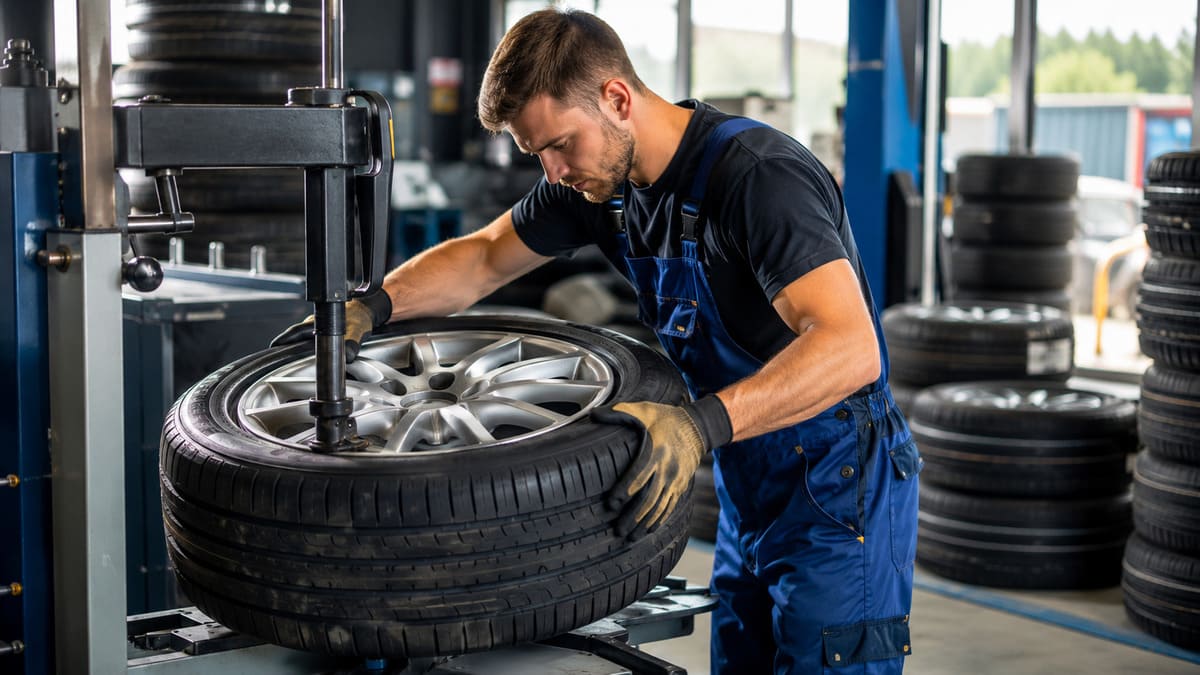
A steering wheel that shakes in a band around 55 to 70 mph and smooths out above or below it is most often a front wheel that is out of balance. The next most likely causes are a tire with a flat spot or internal damage and a wheel bent by a pothole. A shake that only appears when braking is warped or uneven brake rotors, a different problem.
Where you feel the shake tells you which end of the car to look at. Vibration in the steering wheel almost always comes from the front wheels and tires. Vibration you feel through the seat, the floor or the center console more often comes from the rear wheels, the driveshaft on rear-drive vehicles or the tires on the back axle.
The speed pattern matters too. A wheel and tire assembly that is a quarter ounce heavy on one side spins fast enough at highway speed to set the front suspension resonating. That resonance usually peaks in a band about 10 to 15 mph wide, which is why a balance problem feels like it appears at 60 and disappears at 75. A bent wheel or a separating tire tends to keep getting worse the faster you go.
Write down the speed where the shake starts and stops, whether you feel it in the wheel or the seat, and whether it changes when you accelerate, coast or brake. A technician can use those three facts to skip most of the guesswork.
Symptoms
- Steering wheel shimmies side to side between roughly 55 and 70 mph
- The vibration fades if you go faster or slower
- Shake started right after new tires, a flat repair or a rotation
- Vibration is worse in the first few miles of the day and eases as the car warms
- You feel it in the seat or floor rather than the wheel
- A rhythmic thump that speeds up with the car
Likely causes and what they cost
1. Front wheel out of balance
$15-$30 per wheel for a standard balance; $25-$45 per wheel for road-force balancingEach wheel and tire is balanced with small weights clipped or stuck to the rim. Weights fall off after curb contact or a car wash, and tires wear unevenly over time, so a car that was smooth at installation can develop a shimmy months later.
The fix: Each wheel is spun on a balancer and weights are added to cancel the heavy spot. If an ordinary balance does not cure it, a road-force balancer presses a roller against the tire to find stiff spots and can match-mount the tire to the wheel.
2. Flat-spotted or out-of-round tire
free if it warms out; $120-$300 per tire to replaceA car that sits for weeks can develop flat spots where the tires rest on the ground. Most work out after 10 to 20 miles of driving, but tires that sat for months, or sat underinflated in heat, can keep the flat permanently. A tire can also be built slightly out of round.
The fix: Drive 20 miles at normal speeds to see if it fades. If not, a road-force balance shows whether the tire is out of round, and the tire is replaced if it cannot be corrected.
3. Bent wheel from a pothole or curb
$125-$250 to straighten one wheel; $250-$700 for a replacement factory alloyAluminum alloy wheels, especially large diameters with short sidewall tires, bend at the inner lip when they hit a sharp edge. The bend is often invisible from outside the car but shows clearly as a wobble on a balancing machine.
The fix: Minor bends can be straightened by a wheel repair specialist. Cracked wheels or severe bends need a replacement wheel.
4. Tire with a shifted or separating belt
$120-$300 per tire installed and balancedAn impact or long-term underinflation can break internal cords and let a steel belt move. The tire develops a bulge or a high spot, the vibration grows quickly and the tire can fail. This one is a safety issue, not a comfort issue.
The fix: Replace the tire immediately. Inspect the others, since the same impact may have damaged a second tire.
5. Worn tie rod ends, ball joints or control arm bushings
$200-$400 for a tie rod end with alignment; $300-$650 for a ball joint per sideA front suspension with play in it cannot damp out a small imbalance, so a vibration that would be invisible on a tight car becomes a shake. Worn parts also let the wheels wander, so you may notice both a shimmy and vague steering.
The fix: The loose component is replaced and the car is aligned afterward.
6. Wheel not centered on the hub
$15-$40 for rings; free to $30 to retorqueAftermarket wheels with a larger center bore need hub-centric rings to sit perfectly centered. Without them, or with lug nuts tightened unevenly by an impact gun, the wheel can mount slightly off-center. Loose lug nuts produce a similar shake and are dangerous.
The fix: Install the correct hub-centric rings and torque the lug nuts in a star pattern to the factory specification.
Costs are typical South Florida ranges for parts and labor, for budgeting only.
What you can check yourself
- 1Map the speed band
On a safe stretch of highway, note the speed where the vibration begins, peaks and fades. A narrow band suggests balance. A shake that grows steadily with speed suggests a tire or wheel defect.
- 2Inspect each tire for bulges
Park on level ground, turn the front wheels fully left, then right, and look at the full tread and both sidewalls. Run your hand lightly around the tread. A bulge, a wavy section or exposed cords means stop driving on that tire.
- 3Look inside the wheel barrels
With a flashlight, look at the inner rim of each front wheel. Check for a missing stick-on weight, a clean rectangle where one used to be, caked mud or a visible dent in the lip.
- 4Check lug nut tightness
With the car parked, in Park with the parking brake set, use the factory lug wrench to confirm each nut is snug. Do not stand on the wrench or overtighten. Any loose nut is a stop-driving issue until all are torqued to spec.
- 5Compare after a warm-up
If the shake is bad for the first few miles of the day and fades, flat-spotting from sitting is the likely cause. Note that for the shop.
When to take it to a shop
- The vibration remains after you confirm the tires look normal and lug nuts are tight
- You can see a bulge, wave or cord in any tire
- The shake began after hitting a pothole or curb
- The vibration is getting worse over days or is now felt at lower speeds too
- Balancing was just done and the shake came back within a week
The Florida factor
Seasonal residents run into flat spots more than anyone. A car parked in a condo garage from April to November often shakes on its first I-95 run back, and if it sat on soft tires in a hot garage the flat can be permanent. Before leaving for the summer, inflate tires to the top of the placard range and, if you can, have someone move the car a few feet every few weeks.
Mud is a sneaky culprit here. Driving through a flooded street after a summer downpour, or parking on a grass overflow lot at an event, can pack wet sand and clay inside the wheel barrel. It dries in the sun, sticks to one side and throws off the balance. A pressure washer aimed inside each wheel sometimes cures a new shimmy for the cost of a car wash.
Highway speeds on the Florida Turnpike and I-95 sit right in the 65 to 75 mph range where front-end resonance is strongest, so a slight imbalance that you would never notice around town becomes obvious on the drive to Fort Lauderdale or West Palm.
Notes for specific makes
- Jeep: Solid-axle Wranglers can develop violent front-end oscillation, called death wobble, after hitting a bump at highway speed. In 2019 FCA offered a redesigned steering damper for 2018-2019 Wrangler JL owners under a customer satisfaction program, but loose track bars, tie rods and ball joints are common root causes too. If it happens, slow down firmly; do not just ride it out.
- BMW: Many BMWs ship on run-flat tires with very stiff sidewalls, which flat-spot more readily after sitting and transmit imbalance more sharply. Road-force balancing is worth the small extra cost on these cars.
- Mercedes-Benz: Large-diameter AMG and sport-package wheels with low-profile tires bend easily on potholes. A shimmy after an impact on these cars is often a bent inner lip rather than a balance weight.
Tires & Wheels shops near Boca Raton
- Amway Tire Center Inc.1750 South Dixie Highway, Pompano Beach, FL, 33060
- Discount Tire125 State Road 7, Coconut Creek, FL
- Jones Tires1361 Southwest 1st Way, Deerfield Beach, FL, 33441
- The Tire Choice22923 Sandalfoot Plaza Drive, Boca Raton, FL, 33428
- The Tire ChoiceParkland, FL
- Tire ChoiceDelray Beach, FL
Frequently asked questions
Can an alignment fix a steering wheel vibration?
Usually not. Alignment fixes pulling and uneven wear. Vibration is almost always balance, a tire or a wheel. A shop that recommends alignment alone for a shimmy should explain why.
Why does my car shake at 65 but not at 80?
That is the signature of an imbalance. The front suspension has a natural frequency, and the wheel's heavy spot matches it at one speed band. Above or below that band, the shake fades even though the imbalance is still there.
Is road-force balancing worth it?
If a regular balance did not fix the shake, yes. It finds tire stiffness variations that a standard balancer cannot see, and it can often fix the problem by rotating the tire on the wheel instead of replacing it.
How do I know if it is the brakes instead?
Brake-related shake shows up when you press the pedal, often as pulsing in the pedal too. If the steering vibrates while cruising with your foot off the brake, it is not the brakes.
Related guides
More on this job: Tires & Wheels in Boca Raton, costs and how to choose a shop
- RepairPal: Tire and Wheel Assembly Rotate and Balance Cost Estimate
- Michelin: When to Replace Tires, Wear, Age and Safety Signs
- TFLcar: FCA to install steering dampers on 2018-2019 Jeep Wrangler for death wobble
General information, not a diagnosis. A car problem can have causes a guide cannot see, so have anything safety-related inspected in person. Read our editorial policy.