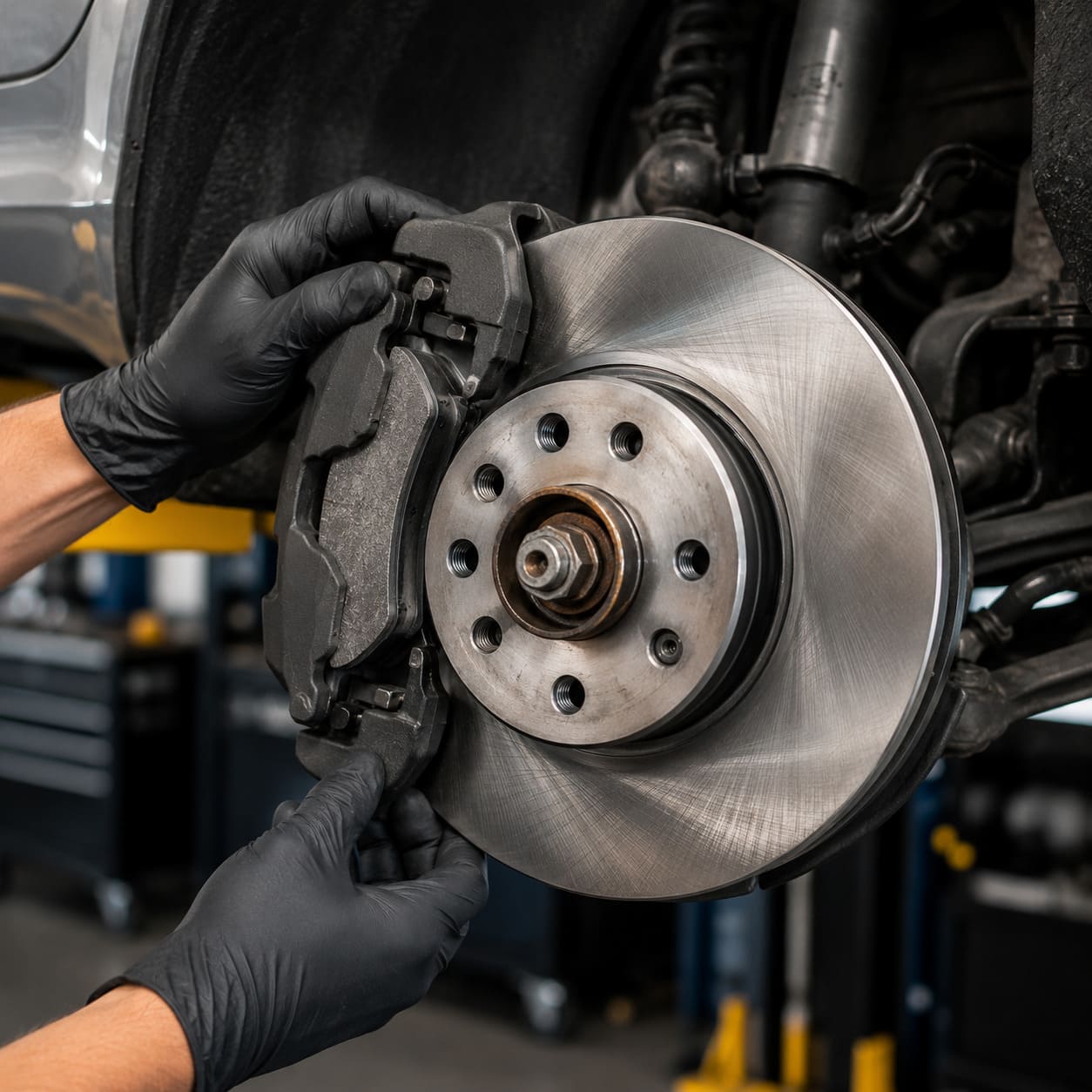
A steering wheel that shimmies when you brake, especially from highway speed, almost always means the front rotors have become slightly uneven in thickness. The pads grip harder on the thick spots and less on the thin ones, and that pulse comes back through the steering. It is rarely an emergency, but get it checked in the next few weeks, because the cause behind it, such as uneven lug nut torque or a sticking caliper, will keep ruining rotors until it is fixed.
Most people call this 'warped rotors', and most shops will too. In reality, rotors rarely bend like a potato chip. What happens is called disc thickness variation: one part of the rotor ends up a few thousandths of an inch thicker than another. Brake trade sources put the point where drivers start to feel it at roughly 10-20 microns, which is less than the thickness of a sheet of printer paper.
That variation usually starts with lateral runout, meaning the rotor wobbles very slightly as it spins. The wobble makes the pad brush one spot of the rotor on every turn even when you are not braking, and over thousands of miles that spot wears thinner. Rust or dirt on the hub face, lug nuts tightened unevenly with an impact gun, a worn wheel bearing, or a sticky caliper can all create that wobble.
This is why a cheap 'new rotors only' fix sometimes comes back within months. The rotors were replaced, but whatever caused the runout was left in place.
Symptoms
- Steering wheel shimmies side to side when you brake from 45 mph or more
- Brake pedal pulses up and down under your foot during a stop
- The whole car shudders when slowing on an off-ramp, but drives smoothly otherwise
- Shake that is worse when the brakes are hot after several hard stops
- Vibration that started a few weeks after new tires or a brake job
Likely causes and what they cost
1. Front rotor thickness variation
$350-$650 per axle for pads and rotors on mainstream cars; $150-$300 to resurfaceUneven rotor thickness makes braking force rise and fall once per wheel revolution. The front brakes do most of the work and connect to the steering, so the pulse shows up in the wheel. It is usually most noticeable stopping from highway speed.
The fix: Replace the front rotors and pads, or resurface the rotors on a brake lathe if they are thick enough. A good shop also measures runout with a dial indicator and cleans the hub face before installing.
2. Uneven or excessive lug nut torque
free to $40 for a re-torque; rotor work as aboveLug nuts hammered on with an impact gun, or tightened in a circle rather than a star pattern, can distort the rotor hat slightly and create runout. It is a frequent reason for shake that appears a few weeks after a tire rotation or new tires.
The fix: Loosen and re-torque the lug nuts by hand to the factory spec in a star pattern. If the rotors already have thickness variation, they will also need resurfacing or replacement.
3. Rust or debris on the hub face
usually included in a quality brake job; $40-$80 per axle extra if billed separatelyA thin layer of rust or scale between the hub and the rotor makes the rotor sit at a slight angle. Even a few thousandths of an inch is enough to start the wear pattern that leads to a pulsing pedal.
The fix: Clean the hub flange to bare metal with a hub cleaning disc or wire brush whenever rotors are replaced, then check runout.
4. Uneven pad deposits
$150-$300 per axle to resurface; $350-$650 with new pads and rotorsIf you hold the brake hard at a stop with very hot brakes, the pad can leave a patch of friction material on the rotor in the shape of the pad. That patch grips differently from the rest of the rotor and causes judder that can fade over a few hundred miles or stay.
The fix: Resurface or replace the rotors, then bed in the pads properly. Avoid holding the pedal hard with hot brakes after a long stop-and-go stretch.
5. Sticking caliper slide or piston
$550-$1,000 per axle with caliper, pads and rotorsA caliper that does not release fully keeps a pad rubbing, overheats the rotor and accelerates uneven wear. You may also notice a slight pull, a hot wheel, or more dust on that side.
The fix: Service or replace the caliper, then replace or resurface the rotors and pads on that axle.
6. Worn suspension or steering parts
$250-$900 depending on the parts, plus $100-$180 for an alignmentLoose control arm bushings, tie rod ends or a worn wheel bearing allow the wheel to move under braking load, which amplifies even a tiny rotor pulse into a strong shake. The rotors may be only slightly off but the steering feels terrible.
The fix: Inspect and replace the worn suspension parts, then deal with the rotors and get an alignment.
Costs are typical South Florida ranges for parts and labor, for budgeting only.
What you can check yourself
- 1Separate braking shake from driving shake
On a safe stretch of road, hold a steady 60 mph without braking. If the wheel shakes then too, the cause is more likely tire balance, a bent wheel or a tire problem. If it is smooth until you press the pedal, it is brakes.
- 2Feel the pedal versus the wheel
A pulse mostly in the pedal with a calm steering wheel suggests rear rotors. Shake mainly in the steering wheel points to the fronts.
- 3Think about recent work
Did it start within a month of a tire rotation, new tires or a brake job? That timing strongly suggests lug torque or hub cleanliness. The shop that did the work should re-check it at no charge.
- 4Check lug nut tightness, safely
With the car parked on level ground and the parking brake set, you can check lug nuts with a torque wrench set to the spec in your owner's manual, tightening in a star pattern. Do not jack the car up for this. Never loosen lug nuts on a car supported only by a jack.
- 5Compare wheel temperatures after a drive
After a 10-minute drive, hold the back of your hand near, not on, each wheel's center. A front wheel much hotter than the other suggests a dragging caliper. Rotors can exceed 300 degrees, so do not touch them.
When to take it to a shop
- The shake is strong enough to move the steering wheel noticeably in your hands
- The car also pulls to one side when you brake
- The vibration came back within a few months of new rotors
- You feel vibration even without braking, along with the brake shake
- There is a grinding sound or a burning smell along with the pulsation
The Florida factor
Boca's traffic pattern is hard on rotors in a specific way. A fast run down I-95 or the Turnpike ends in a hard stop at the bottom of a ramp, then you sit at a long light on Glades Road or Yamato with your foot planted on very hot brakes. That is exactly how pad material imprints onto a rotor. Easing off to a light hold, or shifting into park at long lights, prevents much of it.
Humidity matters here too. Hub faces corrode quickly in South Florida, and a rotor bolted onto a rusty hub will start to wobble almost immediately. When you get brakes done, it is fair to ask whether the shop cleans the hub flange and measures runout. A shop that does it will say yes without hesitating.
Tire shops along Federal Highway and US-441 get busy during snowbird season, and fast work with impact guns is common. If a shake starts soon after new tires, go back and ask for the lug nuts to be re-torqued by hand before you pay for rotors.
Notes for specific makes
- BMW: BMW rotors are held to the hub by a small set screw, and the hub face behind them corrodes easily. Cleaning that face during a rotor change matters more than usual. BMW also generally replaces rather than machines rotors at pad time.
- Mercedes-Benz: Mercedes wheels center on the hub and are torqued to a specific value, typically using lug bolts rather than nuts. Uneven torque from an impact gun after a tire change is a frequent cause of steering shake on these cars.
- Jeep: On solid front axle Jeeps such as the Wrangler and Gladiator, a violent shake after hitting a bump is usually 'death wobble' from worn steering or track bar parts, not brakes. If braking alone triggers a mild shimmy, look at rotors; if a bump triggers an uncontrollable shake, slow down and get the front end inspected.
- Ford: Heavier vehicles that tow, including F-150 and Super Duty trucks and Expeditions, heat their rotors much more. If you tow a boat to the ramps on the Intracoastal, expect rotor pulsation sooner and consider quality rotors with better heat capacity.
Brake Repair shops near Boca Raton
- Tire Kingdom23193 Sandalfoot Plaza Drive, Boca Raton, FL, 33428
Frequently asked questions
Are my rotors warped?
Probably not literally. The usual cause is uneven thickness, which develops from slight runout or pad deposits. The fix is the same, resurfacing or replacing the rotors, but the cause has to be fixed too or the shake returns.
Can I just resurface the rotors?
Often, if they remain above the minimum thickness after machining. Many European cars and thin modern rotors do not have enough material, and some shops prefer replacement because new rotors cost little more than machining labor.
Why did the shake come back after new rotors?
Most often the hub was not cleaned, the lug nuts were not torqued properly, or a caliper is sticking. Ask the shop to measure runout with the wheel bolted on.
Is a shaking steering wheel when braking dangerous?
Mild shake is more of a warning than a hazard, but it reduces braking consistency and can hide another problem. Strong shake, pulling or noise should be inspected promptly.
Related guides
More on this job: Brake Repair in Boca Raton, costs and how to choose a shop
- Tire Review: Solving brake pulsation complaints before they happen
- Know Your Parts: Pedal pulsation and vibration diagnostic tips
- Kelley Blue Book: Brake repair
General information, not a diagnosis. A car problem can have causes a guide cannot see, so have anything safety-related inspected in person. Read our editorial policy.