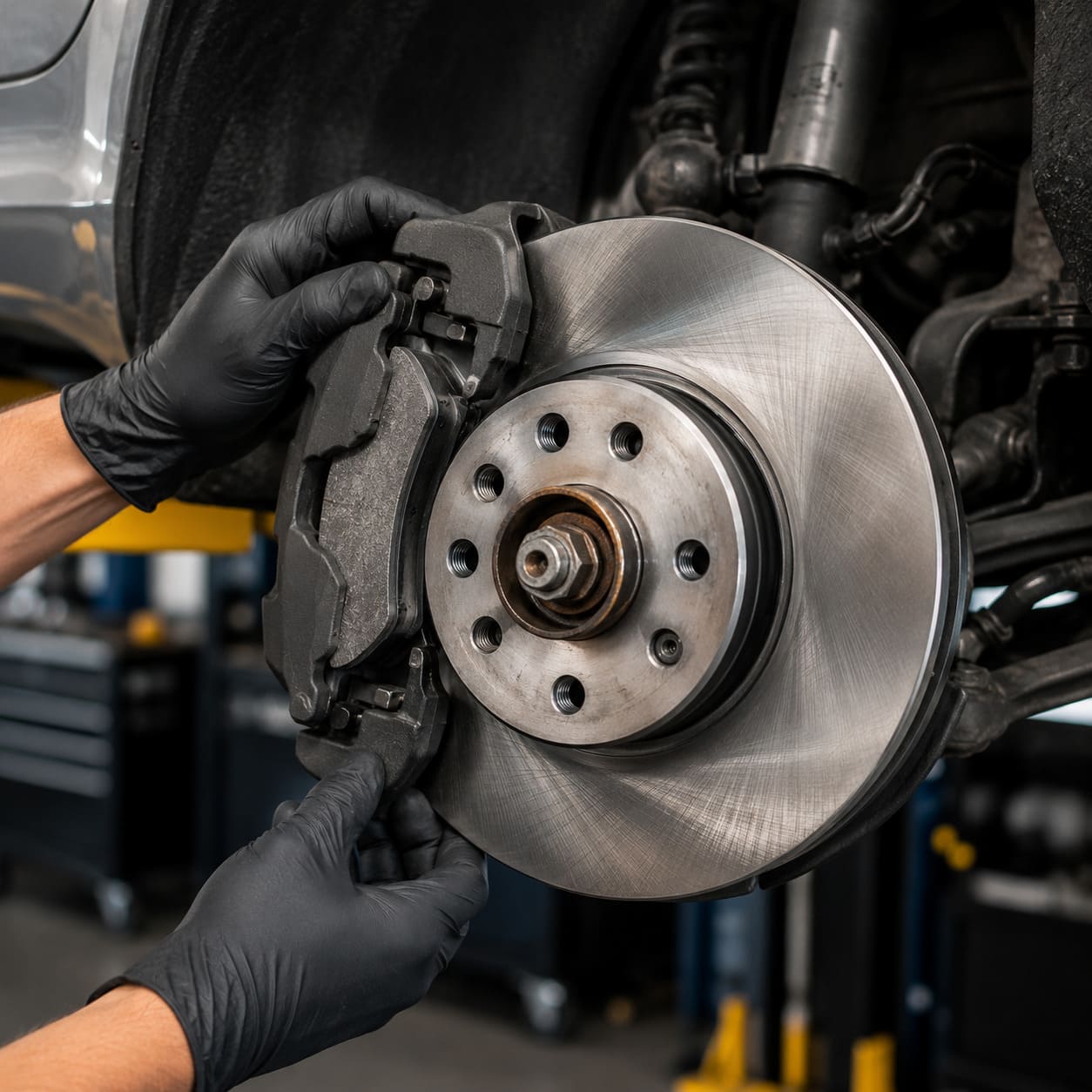
When a car drives straight but tugs left or right as soon as you brake, one front brake is gripping harder than the other. The usual culprits are a caliper or slide pin that is sticking, a brake hose that has collapsed inside, or a pad soaked with fluid or grease. Have it inspected this week, because uneven braking gets worse in a hard stop, exactly when you need the car to go straight.
Under braking, each front wheel tries to slow the car with roughly equal force. If the left brake grips harder than the right, the left side slows faster and the car rotates toward it. The direction of the pull tells you something: a car usually pulls toward the side that is braking harder, or away from the side that is braking weakly.
Separating a brake pull from a general pull is the first job. If the car drifts the same way when you are just driving, the cause is more likely alignment, tire pressure or a tire defect, which our guide on a car pulling to one side covers. If the car only misbehaves when you press the pedal, the brakes or the parts that hold them in place are the suspects.
The checks below help you describe the symptom precisely, which saves diagnosis time and keeps a shop from guessing.
Symptoms
- Car goes straight while cruising but veers to one side as soon as you press the brake
- Pull is strongest at the start of a stop, then fades as you keep pressure on
- One wheel is much dirtier with brake dust than the opposite side
- Hot or burning smell from one wheel after driving
- Steering wheel jerks to one side in a hard stop
Likely causes and what they cost
1. Sticking caliper slide pins
$100-$200 to service one axle; $250-$450 with new padsMost calipers float on two greased pins. When a pin corrodes or its grease dries out, the caliper cannot center itself, so one side applies unevenly or drags. A dragging brake can pull the car even when you are barely touching the pedal.
The fix: Remove the caliper, clean and lubricate the pins with high-temperature brake grease, replace torn boots, and usually replace the pads, which will have worn unevenly.
2. Seized caliper piston
$300-$650 per caliper installed; $550-$1,000 per axle with pads and rotorsIf the piston in one caliper corrodes and moves slowly, that wheel applies late and releases late. The car may pull away from it at first, then toward it as it drags afterward. A heat-damaged or torn piston boot often lets moisture in to start the corrosion.
The fix: Replace the caliper, usually as a pair on the same axle for balance, then bleed the brakes.
3. Internally collapsed brake hose
$150-$300 per axleThe rubber hose to each front caliper can deteriorate from the inside, forming a flap that acts like a one-way valve. Fluid gets to that caliper slowly and drains back slowly. Trade sources describe the giveaway: the car pulls hard at the start of a stop and evens out after a second or two.
The fix: Replace the brake hoses on that axle and bleed the system. Hoses are inexpensive compared with calipers, so they should be checked before a caliper is condemned.
4. Contaminated pad on one side
$200-$350 for pads plus the cost of fixing the leak, often $150-$500Brake fluid from a leaking caliper, grease from a split axle boot, or gear oil from a leaking seal can soak into a pad. A contaminated pad grips much less, so the car pulls toward the opposite, clean side.
The fix: Fix the leak, replace the pads on both sides of the axle, and clean or replace the rotors.
5. Mismatched pads or rotors side to side
$350-$650 per axle with rotorsReplacing pads on one wheel only, mixing pad brands, or pairing a new rotor with a worn one on the other side changes friction from left to right. The difference shows up as a pull.
The fix: Replace pads and rotors as an axle set using the same parts on both sides.
6. Worn suspension bushings or uneven tires
free for pressure; $300-$800 per side for control arms plus $100-$180 alignmentBraking shifts weight forward and loads the control arms. Worn bushings let one wheel change angle under load, which steers the car. Uneven tire pressure or two very different tires across an axle can also cause a braking pull.
The fix: Set tire pressures, swap front tires side to side to test, and replace worn control arm bushings followed by an alignment.
Costs are typical South Florida ranges for parts and labor, for budgeting only.
What you can check yourself
- 1Set tire pressures first
Check all four tires cold, before driving, against the sticker in the driver's door jamb. A front tire 6-8 psi low on one side can mimic a brake pull. This takes five minutes with a gauge.
- 2Describe the pull precisely
In an empty lot, brake moderately from 25 mph with a light grip on the wheel. Note which way it pulls, whether it happens at the start of the stop or throughout, and whether it gets worse when you press harder.
- 3Compare wheel heat after a drive
After 15 minutes of normal driving, park and hold your palm a few inches from each front wheel's center, without touching. One side noticeably hotter than the other points to a dragging brake on that side. Rotors and calipers can burn skin, so keep your hand off metal.
- 4Look at brake dust and the inner tire sidewall
Heavier dust on one wheel suggests a dragging pad. A wet, oily streak on the inside of a tire or on the caliper suggests fluid or grease contamination on that side.
- 5Check for recent work
If the pull started after pads were replaced on one side, or after a tire was replaced on only one side, that is likely the cause. Mention it to the shop.
When to take it to a shop
- The car pulls under braking for more than a day or two
- One wheel is clearly hotter than the other, or smells hot
- You see fluid on a caliper or the inside of a tire
- The pull is strong enough that you have to correct the steering in a normal stop
- The pull comes with grinding, a soft pedal or a brake warning light
The Florida factor
Caliper slide pins are the part that suffers most from coastal living. Salt air along A1A and the Intracoastal, combined with constant humidity, corrodes pins and the bracket bores they slide in. Many braking pulls on cars from Highland Beach, Lighthouse Point or east Boca are simply seized pins. Ask for them to be cleaned and greased at every pad change, not only when they fail.
Rubber brake hoses age with heat as well as mileage. A car that spends its days parked on hot asphalt in a Mizner Park or Town Center lot, with under-car temperatures well above the air temperature, is likely to see hoses crack or soften internally sooner. Hoses older than about 8-10 years are worth a look even if they seem fine outside.
After a heavy afternoon storm, one side of the car can be noticeably wetter than the other if you drove through a curbside puddle on Federal Highway. A brief pull right after that is the wet brake drying off. If it is gone after a few stops, nothing is wrong. If it persists into the next day, it is mechanical.
Brake Repair shops near Boca Raton
- Tire Kingdom23193 Sandalfoot Plaza Drive, Boca Raton, FL, 33428
Frequently asked questions
Is it a brake problem or an alignment problem?
If the car pulls only when you brake, start with brakes. If it pulls all the time, start with tires and alignment. Some cars have both, so a pull that changes when you brake points to both.
Which side is the bad brake on?
Usually the car pulls toward the side that is gripping harder, which can be a dragging brake on that side. It can also pull away from a side that is gripping weakly, such as a contaminated pad. Wheel temperature and dust help tell which.
Do I need to replace calipers in pairs?
Not always, but many shops recommend it on the same axle so the two sides apply evenly. At minimum, pads should always be replaced as an axle set.
Can a brake pull be dangerous?
Yes. In an emergency stop, a pull can turn the car into another lane. It is one of the brake problems that should not be left for months.
Related guides
More on this job: Brake Repair in Boca Raton, costs and how to choose a shop
- RepairPal: Brake caliper replacement cost
- Tire Review: Solving brake pulsation complaints before they happen (caliper slides and hardware)
- Mazda USA: Why are my brakes squeaking? (calipers that do not release, hardware)
General information, not a diagnosis. A car problem can have causes a guide cannot see, so have anything safety-related inspected in person. Read our editorial policy.