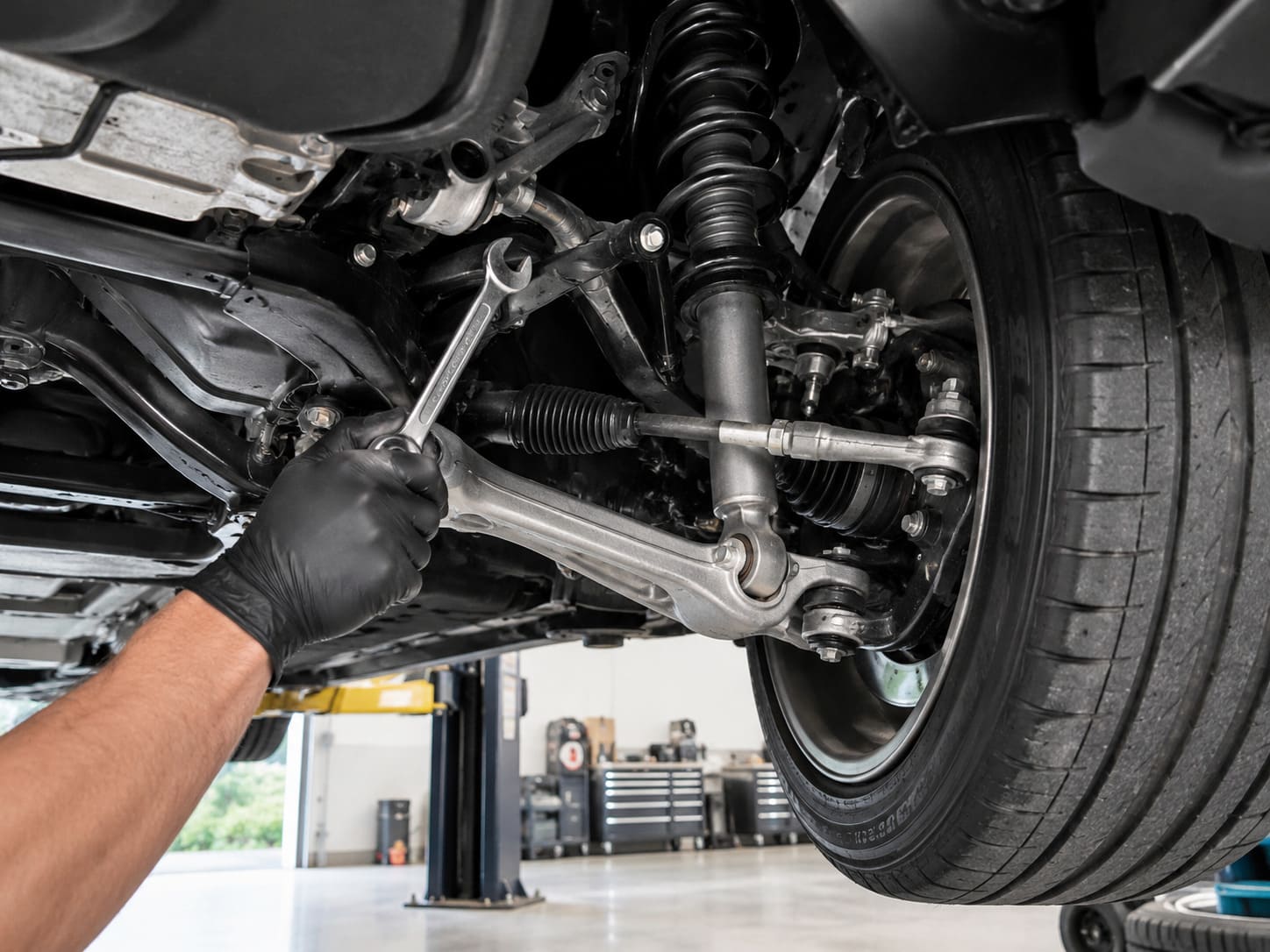
A clunk or knock over bumps usually comes from worn sway bar end links, a tired strut mount, or worn control arm bushings, all of which let metal parts tap together. Before you book anything, empty the trunk and check that the spare and jack are tied down, because loose cargo makes the same sound. A clunk paired with loose or wandering steering can be a ball joint and needs prompt attention.
Suspension parts are held together by rubber bushings and greased ball-and-socket joints. When new, they flex without letting metal touch metal. As the rubber cracks and the sockets wear, small gaps open up and every bump lets a part travel through that gap and hit its stop. The noise you hear is that impact.
Sound travels well through a car body, so a clunk that seems to come from the driver's footwell might really be the right front sway bar link. Narrow it down with timing: noise only over sharp bumps at low speed points to links and mounts; noise when turning in place points to strut mounts or the steering; noise when accelerating or braking points to control arm bushings or engine mounts.
Shops also see plenty of clunks that turn out to be a jack rolling in its tray, a loose spare tire, a golf bag or a heat shield on the exhaust. Ruling those out costs nothing.
Symptoms
- A hollow knock from one corner over speed bumps, potholes or driveway lips
- A clunk when turning the steering wheel at parking-lot speeds
- Rattle over rough pavement that stops on smooth roads
- A thud from the rear when braking hard or pulling away
- Clunking along with vague steering or the car wandering in its lane
- Noise gets worse when the car is loaded with passengers or luggage
Likely causes and what they cost
1. Worn sway bar end links
$150-$230 per pair installed at an independent shopEnd links connect the anti-roll bar to the struts or control arms with a small ball joint at each end. Those joints wear loose and knock over uneven bumps, particularly when one wheel hits a bump the other does not. It is the single most common suspension clunk on modern cars.
The fix: Replace the links, usually as a pair. No alignment is needed for links alone.
2. Worn strut mount or strut bearing
$250-$500 per side for a mount alone; $500-$1,100 per front pair for complete strut assemblies with alignmentThe top of a front strut bolts to the body through a rubber mount with a bearing that lets the strut rotate when you steer. A collapsed mount knocks over bumps, and a dry bearing pops or clunks when you turn the wheel slowly in a parking lot.
The fix: The strut is removed and the mount replaced. Many shops recommend a complete strut assembly with a new mount, spring seat and damper, especially past 80,000 miles, followed by an alignment.
3. Cracked control arm bushings
$350-$800 per arm installed with alignment, more on European cars with multiple arms per cornerControl arms locate each wheel through large rubber bushings. Once the rubber tears, the arm shifts fore and aft under braking and acceleration, giving a thunk when you stop or pull away and often a slight pull or uneven tire wear.
The fix: Either the bushings are pressed out and replaced, or the complete arm is replaced with new bushings already fitted. The car is aligned afterward.
4. Worn ball joint
$300-$650 per sideBall joints are the pivots the steering knuckle turns on. A worn joint clunks over bumps and when steering, and in severe cases lets the wheel tilt. This is a safety part: a separated ball joint can drop the control arm and lock up the corner of the car.
The fix: Replace the ball joint, or the control arm if the joint is integrated into it, then align.
5. Worn shocks or struts
$250-$550 for a pair of rear shocks; $500-$1,100 for a pair of front strutsA blown damper lets the suspension hit its bump stops on sharp bumps, causing a heavy thud, and you may see oil dripping down the body of the shock. The car also floats or bounces after dips.
The fix: Replace in axle pairs. Front struts usually get an alignment afterward.
6. Loose cargo, spare or exhaust heat shield
free to $60The spare tire, the jack in its foam tray, items in the trunk well and thin exhaust heat shields all rattle or clunk over bumps. A shield usually makes a tinny buzz rather than a deep knock.
The fix: Secure the cargo and tighten the spare hold-down. A loose heat shield can be refastened with a stainless clamp.
Costs are typical South Florida ranges for parts and labor, for budgeting only.
What you can check yourself
- 1Empty the car and secure the spare
Remove loose items from the trunk, cabin and door pockets. Lift the trunk floor and confirm the spare and jack are clamped tight. Drive the same bumpy route again.
- 2Do a bounce test on each corner
With the car parked, push down hard on one corner of the body and let go. It should rise and settle in about one motion. Two or more bounces, or a clunk as you push, points to a worn damper or mount on that corner.
- 3Turn the wheel in place and listen
With the engine running and the car stopped, have a helper stand outside near the front wheels while you turn the steering lock to lock slowly. A pop or creak from the top of a strut tower suggests a strut mount.
- 4Look at rubber boots and shocks
With a flashlight, look behind each front wheel for torn rubber boots on ball joints and tie rod ends, grease flung around the area, and oily residue on the shock bodies. Look only; do not crawl under a car supported by a jack.
- 5Note when and where it happens
Record whether the noise is over sharp bumps or rolling dips, when turning, braking or accelerating, and which side it seems to come from. That narrows a shop's test drive and inspection.
When to take it to a shop
- The clunk continues after the car is emptied and the spare is secured
- You notice loose steering, wandering, a pull or uneven tire wear along with the noise
- A rubber boot is torn and grease is visible around a joint
- A shock or strut is wet with oil
- The noise started after a pothole or curb strike
- You hear a clunk from the rear when braking on a vehicle with an open suspension recall
The Florida factor
Boca's gated communities and HOA streets are lined with speed humps and speed tables, and residents may cross dozens of them a day. That repetition is exactly what wears out end links and strut mounts, so a car that never leaves western Boca can need links far sooner than its mileage suggests. Taking humps at an angle so one wheel hits at a time makes the noise obvious if a link is worn, but crossing them straight and slowly reduces wear.
The FEC railroad crossings beside Dixie Highway, on east-west roads such as Palmetto Park Road, Camino Real and Yamato, are raised and rough, and they load every suspension joint at once. Add the lip of steep condo garage ramps along A1A and many cars take more hard hits than in a typical suburb.
Heat and ozone age rubber. Bushings and boots on cars parked outdoors in full sun crack earlier, and salt air near the Intracoastal corrodes ball joint studs and sway bar link threads, which can make a simple link job slower when the nuts are seized.
Notes for specific makes
- Ford: Ford has recalled rear toe links on 2013-2017 Explorers and, in 2026, certain 2017-2019 Explorers, because the links can fracture. A clunk from the rear, especially when braking, is a reason to run your VIN through the NHTSA recall lookup before paying for a repair.
- Audi: Many Audi A4, A5 and A6 models use multiple upper and lower front control arms per side, and their bushings and ball joints commonly wear by 60,000 to 90,000 miles. Clunking over bumps plus a vague steering feel is typical, and replacing arms in sets is common.
- Volkswagen: Volkswagen models sharing Audi-style front suspensions, such as the Passat and some Jetta and Golf generations, also commonly need front control arm bushings and sway bar links in the 60,000 to 100,000 mile range.
- Ram: Heavy front ends on Ram 1500 pickups wear out front sway bar end links regularly, and the resulting knock over driveway lips is one of the most common complaints. Links are inexpensive and quick to replace.
Steering & Suspension shops near Boca Raton
We are still adding shops for this service. Browse the directory or use the quote form.
See all shops for this serviceFrequently asked questions
Is it safe to drive with a clunking noise?
A worn sway bar link is a nuisance, not a hazard. A worn ball joint or tie rod end is a hazard. Since you cannot tell them apart by sound alone, have it inspected soon, and treat any steering looseness as urgent.
Do I need an alignment after suspension work?
After struts, control arms, tie rods or ball joints, yes, because those parts set wheel angles. After sway bar links alone, usually not.
Why does it only clunk on one side?
Links, mounts and bushings wear independently, and the side that hits more potholes or curbs usually goes first. Many shops still replace links and struts in pairs so both sides behave the same.
Could the clunk be my brakes?
A single clunk when you first brake after reversing is often brake pads shifting in their brackets, which is normal on some cars. A clunk every time you brake can be a loose caliper or worn control arm bushing and should be checked.
Related guides
More on this job: Steering & Suspension in Boca Raton, costs and how to choose a shop
- RepairPal: Stabilizer Bar Link Kit Replacement Cost Estimate
- Motor1: Ford Recalls 412,000 Explorers for Rear Toe Link Fracture
- RepairPal: Wheel Alignment Cost Estimate
General information, not a diagnosis. A car problem can have causes a guide cannot see, so have anything safety-related inspected in person. Read our editorial policy.