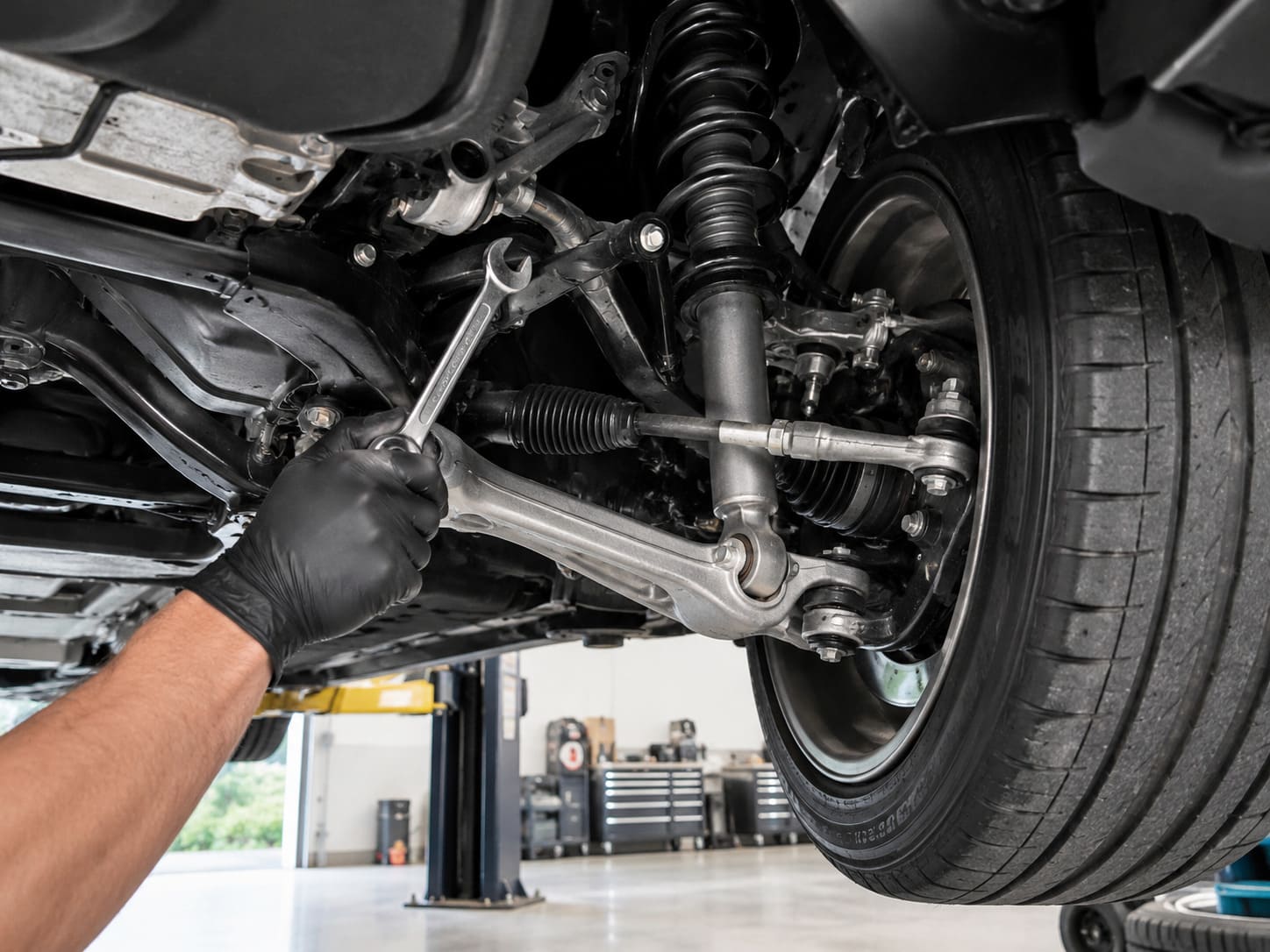
The most common reasons a car pulls to one side are uneven tire pressure, an alignment knocked out by a pothole or curb, and a tire with an internal defect that steers the car. Check the pressures first because it is free, then have the alignment measured. A pull that gets stronger when you brake is a brake problem, not an alignment problem.
A car that pulls is being steered by something other than you. The source is almost always at the corners: a tire that is softer than its partner, wheels that are no longer pointed in the same direction, a tire built with a slight cone shape, or a brake that will not let go. Each has its own pattern, and a few minutes of observation can save you paying for the wrong repair.
Start by separating pull from drift. Every public road is built with a crown, higher in the middle so rain runs off, and that slope gently pushes cars toward the curb. In the US that means a light drift to the right is normal on most two-lane roads. The test is whether the car still pulls in an empty, flat parking lot or in the left lane of a road that slopes the other way.
If the car only pulls while braking, read our guide on that symptom instead; the causes there are calipers, brake hoses and pads. This page is about a pull you feel while cruising.
Symptoms
- You have to hold the steering wheel slightly turned to go straight
- Letting go of the wheel on a flat road, the car drifts into the next lane within a few seconds
- The steering wheel logo sits off-center when the car is going straight
- The pull started right after hitting a pothole, curb or parking stop
- One front tire is wearing faster on its inside or outside edge
- The pull changes direction after the tires are rotated
Likely causes and what they cost
1. Unequal tire pressure side to side
free to $2A tire with less air has a larger, flatter contact patch and more rolling resistance, so it drags its side of the car back. A difference of 5 psi between the two front tires is enough to feel at highway speed.
The fix: Set all four tires to the door-jamb placard pressure when cold, then drive the same road again.
2. Wheel alignment out of spec
$120-$250 at an independent shop; $180-$320 at a dealerAlignment is the set of angles, called camber, caster and toe, that point each wheel. A hard curb strike or pothole can shift them, and worn bushings let them creep over time. When caster or camber differs side to side, the car leans toward the side with less caster or more positive camber.
The fix: A four-wheel alignment on a computerized rack measures every angle and adjusts it back to the factory range. A good shop gives you a printout with before and after numbers.
3. Tire pull from conicity or a shifted belt
$30-$60 to diagnose with a swap; $120-$300 for a replacement tire if not under warrantyA tire with a manufacturing variation or an internal belt that moved after an impact can roll slightly like a cone, steering the car even when the alignment is perfect. The giveaway is a pull that changes or moves when tires are swapped between sides.
The fix: A shop swaps the two front tires left to right to confirm. A defective tire is replaced, often under the tire maker's warranty if it is new.
4. Sticking brake caliper
$80-$150 to service the slides; $300-$650 per side to replace the caliper with padsA caliper piston or slide pin that corrodes can keep a pad lightly pressed on the rotor. That wheel acts like it has a slight brake on all the time, pulling the car toward it, burning fuel and overheating the rotor.
The fix: The slide pins are cleaned and lubricated, or the caliper is replaced along with pads and sometimes the rotor if it overheated.
5. Worn or bent steering and suspension parts
$350-$800 per control arm installed with alignment; $200-$400 for a tie rod end with alignmentA torn control arm bushing, a loose ball joint or a bent tie rod lets one wheel change its angle under load. The pull may come and go with bumps or with acceleration, and alignment will not hold until the worn part is replaced.
The fix: The worn part is replaced and the car is aligned afterward. Control arms are often sold with new bushings and ball joints already pressed in.
6. Mismatched tires on the same axle
$0 for a rotation if you have a matching pair; $240-$600 for a pair of new tiresTwo tires of different brands, tread patterns or wear levels on the front axle roll at slightly different diameters and grip differently. It shows up most after a single tire was replaced following a flat.
The fix: Put the matching pair on the front, or replace tires in axle pairs going forward.
Costs are typical South Florida ranges for parts and labor, for budgeting only.
What you can check yourself
- 1Gauge both front tires cold
Compare the two front readings to each other and to the door-jamb sticker. Correct them and retest before anything else. This solves a surprising share of pulls.
- 2Do the flat-lot test
Find an empty, level parking lot early on a weekend. Drive straight at 10 to 15 mph and relax your grip without letting go. If the car holds a line there but pulls on the street, the road crown is most of what you feel.
- 3Feel for a hot wheel, carefully
After a 15 minute drive with light braking, hold the back of your hand near, not on, the center of each front wheel. One wheel radiating noticeably more heat than the other suggests a dragging brake. Do not touch the rotor or caliper; they can exceed 300 degrees.
- 4Read the tire edges
With the steering turned fully to one side, run your palm across the front tread. Wear concentrated on one edge, or a feathered sawtooth feel, means the alignment has been off for a while.
- 5Look at the steering wheel on a straight road
If the wheel is crooked but the car tracks straight, the toe was set with the wheel off-center. That is an alignment correction, not a sign of a damaged part.
When to take it to a shop
- The pull continues with all tires at the correct pressure on a flat surface
- The pull began after a curb strike, pothole or minor collision
- You hear a clunk, feel looseness in the steering, or see a wheel sitting at a visibly odd angle
- One wheel is hotter than the other or you smell a hot brake smell after driving
- The car was just aligned and still pulls, which points to a tire or worn part
The Florida factor
Palm Beach County roads are built to shed heavy afternoon rain quickly, and many multi-lane roads such as Glades, Yamato and Military Trail have a pronounced slope toward the outside lanes. A car that drifts right in the curb lane and goes nearly straight in the left lane is mostly feeling the road, not a fault. Test on flat ground before paying for an alignment.
Summer storms are also when the real alignment damage happens. Water standing on side streets hides potholes and broken edges, and a wheel dropping into one at 35 mph can bend a tie rod or shift a control arm. Shopping plazas along Federal Highway and Palmetto Park Road are full of concrete wheel stops and tall curbs that catch front tires during tight parking. If a pull appears the same week as a hard hit like that, mention the impact to the shop so they inspect parts before aligning.
Lane-shift zones and grooved pavement during I-95 construction can make a car feel like it is wandering. If the sensation stops once you are back on smooth asphalt, the car is probably fine.
Notes for specific makes
- Ford: Ford has issued several recalls for rear toe links on Explorers, including 2013-2017 models in 2021 and certain 2017-2019 models in 2026, because the links can fracture. A rear end that feels loose or steers the car is worth a recall check by VIN before any alignment.
- Jeep: Wranglers and Gladiators with solid front axles can drift or wander when the track bar bushings or mounting bolts wear. A standard alignment will not fix it until the track bar is tightened or replaced.
- Tesla: Heavy battery packs and large wheels make Model 3 and Model Y alignment sensitive to curb hits. Many owners report inside-edge wear and a slight pull after impacts, so ask for a printout showing rear camber and toe after any alignment.
Steering & Suspension shops near Boca Raton
We are still adding shops for this service. Browse the directory or use the quote form.
See all shops for this serviceFrequently asked questions
How much does an alignment cost in Boca Raton?
Plan on roughly $120 to $250 for a four-wheel alignment at an independent shop and $180 to $320 at a dealer. Trucks, luxury cars and vehicles that need driver-assist cameras recalibrated afterward sit at the high end.
Can new tires make my car pull?
Yes. A new tire with a conicity defect can steer the car on its own. If the pull started with new tires, ask the installer to swap the fronts side to side. If the pull moves or changes, the tire is the cause and should be replaced under warranty.
Do I need an alignment after new tires?
It is not required, but it is good insurance. A bad alignment can wear a new set unevenly in a few thousand miles, and the alignment costs less than one tire.
Why does my car pull right but only slightly?
On most US roads that is the crown, the deliberate slope that drains rainwater. If the drift disappears on a flat lot or in a left lane that slopes the other way, the car is normal.
Related guides
More on this job: Steering & Suspension in Boca Raton, costs and how to choose a shop
- RepairPal: Wheel Alignment Cost Estimate
- Michelin: When to Replace Tires, Wear, Age and Safety Signs
- Motor1: Ford Recalls 412,000 Explorers for Rear Toe Link Fracture
General information, not a diagnosis. A car problem can have causes a guide cannot see, so have anything safety-related inspected in person. Read our editorial policy.