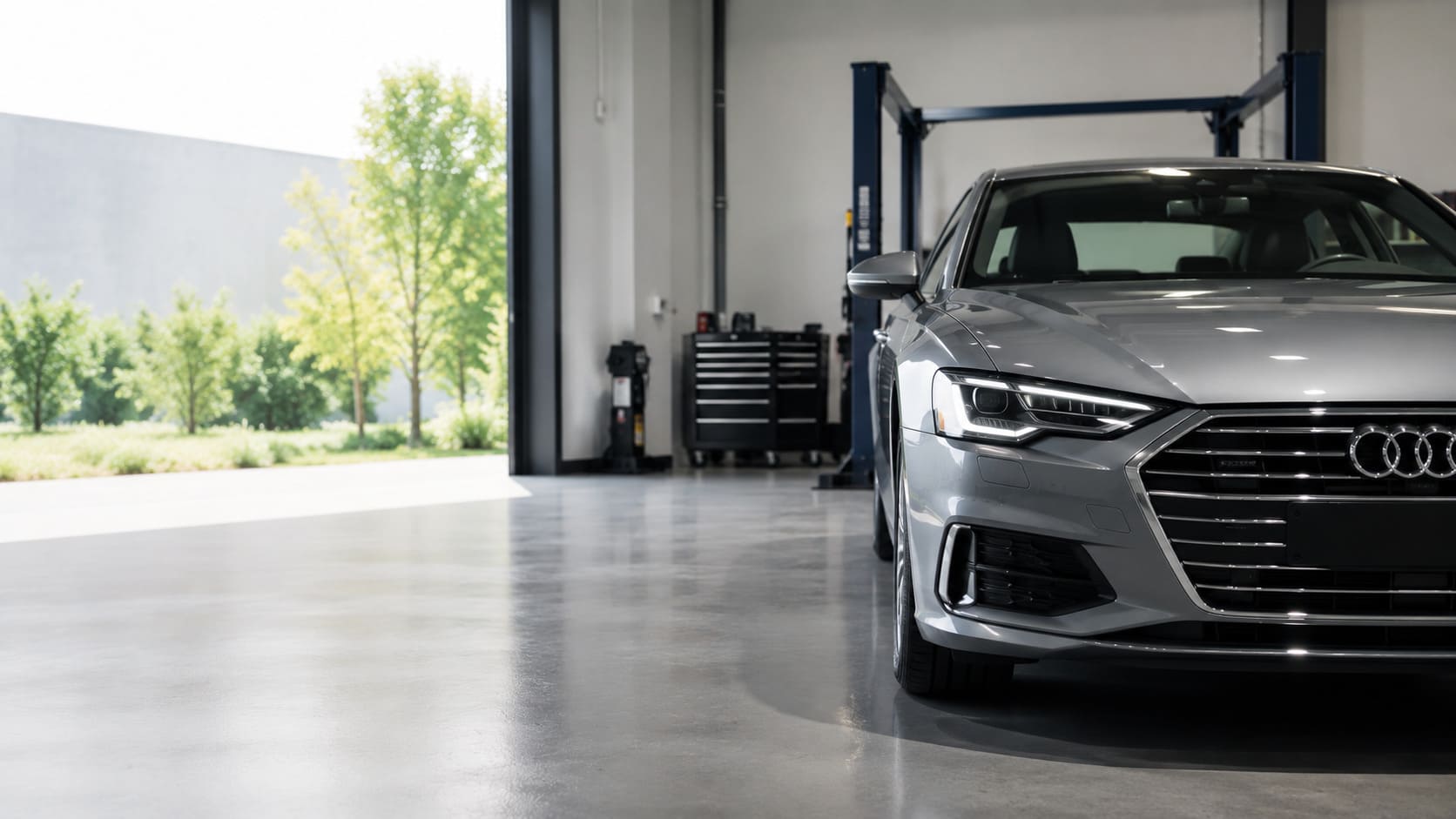
The Audi problems that cost South Florida owners the most are oil burning on early 2.0T engines, leaking thermostat and water pump housings on the supercharged 3.0T, carbon buildup on direct-injection engines, and water getting where it should not through clogged drains or failed seals. Most are predictable by engine and year, so check those first and run your VIN for recalls, especially on 2018-2022 Q5s and any e-tron.
Audi shares engines and platforms with Volkswagen, but it pairs them with quattro all-wheel drive, more electronics and tighter packaging. That last part is why an Audi repair that sounds simple, like a thermostat, can take five hours: the part sits deep under the intake manifold or behind the supercharger.
RepairPal puts Audi at 3.0 out of 5, 28th of 32 brands, with average annual repair and maintenance spending around $987. A newer Audi on a lease is usually trouble-free; costs climb after the 4-year or 50,000-mile warranty ends, which is right when many local Audis change hands.
The brand runs on a simple schedule, an oil service every 10,000 miles or 12 months, with larger inspections layered in. The repairs that surprise owners are almost never on that schedule, so a little knowledge of your specific engine goes a long way.
Popular Audi models in South Florida
- Q5 (2018-2024 second generation, plus the 2025 redesign): The most common Audi in the area. 2018-2022 models were recalled because liquid can get into the gateway control module and cut engine power. Uses the 2.0T EA888 four, generally strong in this generation.
- A4 and S4 (B9, 2017-2024 in the US): Popular as a used commuter. The S4 switched from the supercharged 3.0T to a turbocharged 3.0 V6 for 2018, which has a different list of issues.
- Q7 (2017 and newer): Three-row SUV with lots of glass and a large sunroof. Many 2017-2019 models use the supercharged 3.0T V6, so ask about thermostat and water pump history. Keep sunroof drains clear.
- A3 and S3 (2015 and newer): Entry Audi with a transverse 2.0T and a dual-clutch S tronic gearbox. Fluid service on the gearbox matters more than owners expect.
- Q3 (2019 and newer): Compact SUV common with first-time Audi buyers. Several recalls overlap with Volkswagen Tiguan parts, so run the VIN.
- e-tron and Q8 e-tron (2019-2024): Audi's first big electric SUV is now common on the used market. It has had high-voltage battery and brake pedal recalls; confirm each one is closed before buying.
Known Audi problems to watch for
Oil consumption on early 2.0T engines
Piston rings with too little drain-back clogged with carbon, letting oil slip into the combustion chamber. Owners saw a low oil warning between changes or added a quart every 600 to 1,000 miles. Dealers ran an oil consumption test and, on qualifying cars, replaced pistons and connecting rods; late-2012 engines got revised parts. Out of warranty, that repair costs $3,500-$5,500, so check the oil level every other fill-up on any older 2.0T.
Guide: Blue smoke from the exhaust: is my car burning oil?Thermostat housing and water pump leaks on the supercharged 3.0T
The plastic thermostat housing and the water pump sit in the valley under the supercharger, and both crack or seep with heat cycling. A pink crust on the engine, coolant smell after parking or a slowly dropping reservoir are the clues. Because the supercharger must come off, the job runs $1,400-$2,400 at an independent. Doing pump and thermostat together saves paying that labor twice.
Guide: Sweet smell from my car, like maple syrup: is it a coolant leak?Gateway module water intrusion and sudden power loss
Under NHTSA recall 21V947, liquid can reach the gateway control module, which can shut down and cause a sudden drop in engine power. That is a real hazard merging onto I-95. The dealer inspects, seals and replaces the module as needed for free. Any Q5 from these years with dash warnings after a rainstorm deserves a VIN check right away.
Clogged sunroof and plenum drains
Each sunroof corner has a small drain tube, and the cowl below the windshield has drains of its own. Leaves, pollen and sand block them, water overflows into the headliner or footwell, and wet carpet can short connectors or modules mounted under the floor. Clearing drains costs $100-$250. Drying the cabin and replacing a water-damaged module can cost $800 to several thousand.
Guide: Water leaking inside the car on the passenger floor when the A/C is onCarbon buildup on intake valves
With fuel sprayed straight into the cylinder, nothing washes oil vapor off the back of the intake valves, and carbon builds up. Expect a rough cold idle, misfires and a slow loss of power, often after 60,000 miles. The fix is walnut-shell blasting with the intake removed, about $600-$1,000. Later EA888 engines added port injection that greatly reduces the problem.
Guide: Why does my engine idle rough or shake at a stop?e-tron high-voltage battery and brake pedal recalls
Audi's 2019 recall 19V434 addressed moisture entering the battery through a faulty charging socket seal, a fire risk. Recall 23V867 covered battery modules that could overheat, and 24V621 an incorrectly assembled fastener that could let the brake pedal detach from the booster. All are free at a dealer. Ask a seller for proof that each one is closed, since battery work can take weeks to schedule.
Maintenance schedule highlights
| Every 10,000 miles or 12 months | Synthetic oil and filter meeting VW 502 00, 504 00 or 508 00 depending on engine, plus an inspection. Audi alternates minor and standard maintenance, and the larger visits add filters and fluids. |
| Every 20,000 miles | Cabin dust and pollen filter. Replace it more often if the car parks under trees or near a construction site; a clogged filter strains the blower and the A/C. |
| Every 2 years | Brake fluid replacement on a time basis, regardless of mileage. |
| About every 40,000 miles | Dual-clutch S tronic gearbox fluid and filter on many models, spark plugs on most turbo engines, and engine air filter. Some newer gearboxes have different intervals; your maintenance booklet is the final word. |
| Around 60,000-80,000 miles | Serpentine belt inspection, coolant system pressure test, and an intake valve carbon check on older direct-injection engines. |
Always confirm against your owner's manual or maintenance minder for your exact model and year.
Typical Audi repair costs
| Job | Typical cost | Notes |
|---|---|---|
| 10,000-mile oil service | $150-$260 | Independent; dealer service usually $200-$350. |
| 40,000-mile service with S tronic fluid | $700-$1,200 | Dealer pricing can reach $1,500. |
| Front brake pads and rotors | $550-$950 | Includes wear sensor. Dealer $850-$1,400. |
| 3.0T thermostat and water pump | $1,400-$2,400 | Supercharger removal is most of the labor. |
| 2.0T water pump and thermostat housing | $800-$1,300 | Independent price on EA888 engines. |
| Intake valve carbon cleaning | $600-$1,000 | Walnut blasting with new intake gaskets. |
| Ignition coils and spark plugs, four-cylinder | $350-$600 | A single failed coil is $90-$180 installed. |
| Sunroof drain cleaning | $100-$250 | Water damage repairs cost far more. |
| Diagnostic scan with ODIS or VCDS | $130-$220 | Usually credited toward the repair. |
Typical South Florida ranges for parts and labor, for budgeting only. Your quote depends on the vehicle and the shop.
Dealer or independent shop?
An Audi dealer is the right call while the car is under its 4-year or 50,000-mile warranty, for recall work like the Q5 gateway or e-tron battery campaigns, and for high-voltage repairs on electric Audis. Dealers also have the online access needed for some module coding and component protection when a used control unit is installed.
Out of warranty, a VW and Audi specialist with ODIS or professional VCDS software does the same work for less. Expect independent labor rates of about $130-$185 an hour in Palm Beach County against $195-$260 at dealers, and parts from the same suppliers Audi uses, such as Mahle, Bosch, Pierburg and INA.
Specialists earn their keep on the classic Audi jobs, such as 3.0T cooling, carbon cleaning and 2.0T oil consumption diagnosis, because they do them every week and quote the job accurately before starting.
Owning a Audi in South Florida
Afternoon thunderstorms are the Audi owner's real enemy here. A sunroof drain packed with oak pollen or a cowl drain full of seagrape leaves can overflow in one twenty-minute downpour, and several Audis mount control modules low in the cabin where water collects. Once or twice a year, pour a cup of water into each sunroof corner gutter and watch for it to exit behind the front wheels.
The 3.0T's buried thermostat and water pump endure some of the hottest operating conditions of any Audi part, and a Boca summer adds to it. Coolant that drops between top-ups is not normal. Topping off without finding the leak only delays a bigger bill, and running low in Spanish River Boulevard traffic can warp heads.
Many Audis sold here wear dark paint and black interiors that bake in open lots. Use a windshield shade: dashboard displays, the MMI screen and the electronics behind them last longer when the cabin stays under 140 degrees.
Repair shops near Boca Raton
- Boca Auto Fix4301 Oak Circle, Boca Raton, FL, 33431
- Element, Pickup trucks and trailer repair3120D Northwest 16th Terrace, Pompano Beach, FL, 33064
- Europen Auto Service CentreParkland, FL
- Ferrari of Boca Raton6403 W Rogers Cir, Boca Raton, FL, 33487
- FirestonePompano Beach, FL
- Firestone1259 North Federal Highway, Boca Raton, FL, 33432
Audi FAQ
How much oil is too much for an Audi to burn?
On older 2.0T engines, the dealer test treated roughly one liter per 1,000 km, about a quart every 600 miles, as a qualifying problem. A healthy modern engine uses far less. If you are adding a quart between changes on an older 2.0T, ask for a documented oil consumption test.
Does my Audi need premium fuel?
Most turbocharged and supercharged Audis call for 91 octane or higher. Lower octane makes the engine pull timing, cutting power and fuel economy, and over time it can contribute to carbon buildup.
Is S tronic fluid service really necessary?
Yes, where the booklet calls for it. The dual-clutch gearbox's fluid cools the clutches and lubricates the mechatronic unit, and a skipped service is a common factor in expensive gearbox repairs.
My Q5 lost power and showed warnings after it rained. What should I do?
If it is a 2018-2022 Q5 or SQ5, check the VIN for recall 21V947 immediately. Liquid can get into the gateway module and reduce engine power. The fix is free at a dealer.
Can an independent shop handle quattro all-wheel drive?
Yes. Rear differential and transfer case fluid service, axle work and wheel alignment are routine for an Audi specialist. Make sure all four tires match in size and wear, since mismatched tires strain the drivetrain.
Guides for Audi owners
Audi services
Open recalls are repaired free at any franchised Audi dealer. Check your VIN at nhtsa.gov/recalls or see recent recalls.
- NHTSA recall 21V947: Audi Q5 gateway module liquid intrusion
- NHTSA recall 19V434: Audi e-tron charging socket seal and battery moisture
- RepairPal: Audi reliability rating and annual repair cost
- Wikipedia: Volkswagen EA888 engine, known problems
General information, not a diagnosis. A car problem can have causes a guide cannot see, so have anything safety-related inspected in person. Read our editorial policy.