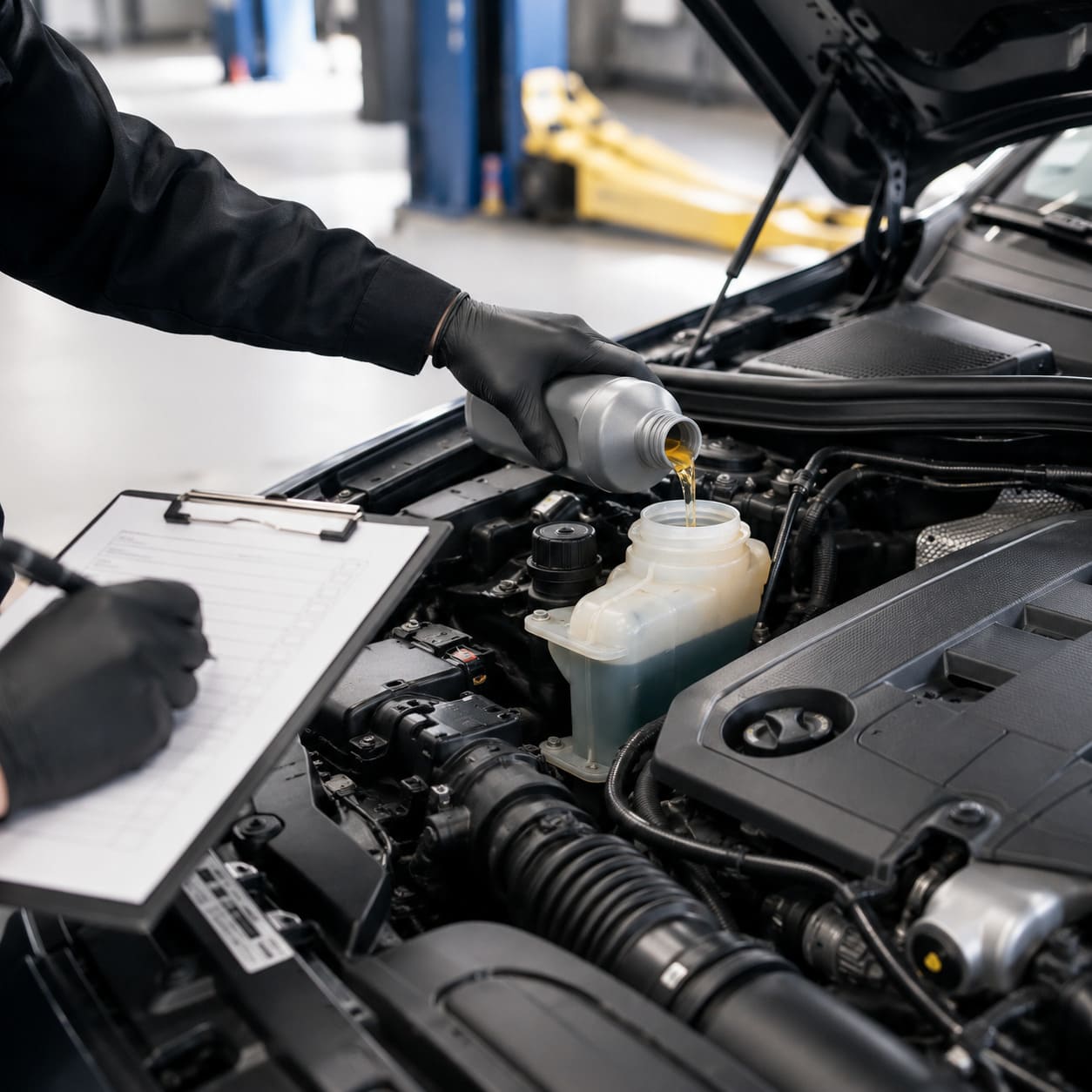
Most cars need $400-$1,000 a year in scheduled maintenance, with bigger visits around 30,000, 60,000 and 100,000 miles that can reach $500-$1,500. Follow the owner's manual rather than a shop's menu, use the severe-service column if you mostly drive short trips in Florida heat, and know that federal law lets you use any shop without voiding your factory warranty as long as you keep records.
Routine maintenance is the work the carmaker schedules to keep the car from breaking: oil and filters, tire rotations, brake fluid, coolant, transmission fluid on many models, spark plugs, belts, and a lot of inspections. The schedule lives in the owner's manual or the maker's app, and it usually has two columns: normal and severe. Severe usually means short trips, stop-and-go traffic, extreme heat, dusty roads or towing, which describes a lot of driving in South Florida.
Shops often sell maintenance as numbered packages, like a '60K service.' Dealers tend to bundle more into those packages than the maker requires. Independent shops tend to be cheaper per hour. Neither is automatically right, which is why it pays to compare the package to the manual line by line.
Labor rates set much of the price. In Palm Beach County, independent shops commonly charge roughly $120-$170 an hour and dealers $170-$250 or more, with European brands at the high end. Most shops bill from a labor guide, so a job rated at 1.5 hours costs 1.5 times the rate, regardless of how long it actually takes.
What the job includes
- Oil and filter change with the oil type and grade your manual specifies, and a reset of the oil-life monitor.
- Tire rotation, pressure set to the door-jamb spec, and a tread depth reading for each tire.
- Engine air filter and cabin air filter inspection, replaced when dirty or due.
- Brake inspection with pad thickness and rotor condition written down, and a brake fluid moisture test.
- Fluid checks: coolant, transmission, power steering where present, washer fluid, and leaks under the car.
- A battery and charging-system test, and a look at belts, hoses, wipers, lights and suspension joints.
- A written list that separates what is due now, what can wait, and what is just a suggestion.
What routine maintenance costs in Boca Raton
| Job | Typical cost | Notes |
|---|---|---|
| Synthetic oil and filter change | $70-$130 | European cars that need more oil or special specs run $120-$200. |
| Tire rotation | $25-$50 | Often free with tire purchase or an oil change package. |
| Engine air filter, installed | $40-$90 | Usually a five-minute job you can do yourself. |
| Cabin air filter, installed | $40-$100 | Also easy DIY on most cars. |
| Brake fluid exchange | $100-$180 | Typically every 2-3 years regardless of mileage. |
| Coolant exchange | $120-$250 | Long-life coolants often go 5 years or 100,000 miles first. |
| Transmission fluid service | $150-$400 | CVTs and some European transmissions cost more. |
| Spark plugs, 4-cylinder | $150-$350 | V6 engines with rear plugs under the intake can run $300-$700. |
| 30,000-mile dealer service package | $300-$700 | Compare each line to the manual before approving. |
| 60,000-mile dealer service package | $500-$1,200 | Often includes items an independent shop prices separately for less. |
Typical South Florida ranges for parts and labor, for budgeting only. Your quote depends on the vehicle and the shop.
Routine Maintenance shops near Boca Raton
- Boca Auto Fix4301 Oak Circle, Boca Raton, FL, 33431
- Element, Pickup trucks and trailer repair3120D Northwest 16th Terrace, Pompano Beach, FL, 33064
- Europen Auto Service CentreParkland, FL
- Ferrari of Boca Raton6403 W Rogers Cir, Boca Raton, FL, 33487
- FirestonePompano Beach, FL
- FirestoneDelray Beach, FL
- Firestone1259 North Federal Highway, Boca Raton, FL, 33432
- Florida Prime GlassBoca Raton, FL
- Foreign & Corvette Repair World2108 Mears Pkwy, Coconut Creek, FL, 33063
- Jiffy LubeDelray Beach, FL
- Meineke23193 Sandalfoot Plaza Drive, Parkland, FL, 33428
- MidasParkland, FL
How to choose a shop
- Look for ASE certification. The ASE blue seal on a shop means a large share of its techs are certified; individual techs list certifications such as A1 through A8 for engine, brakes, electrical and more. Master technicians have passed the full set.
- For cars still under factory warranty, an independent shop is fine. The FTC is clear that you do not have to use the dealer for routine maintenance to keep your warranty, and a manufacturer must show that a part or service actually caused a problem before denying a claim. Keep every receipt with date, mileage and parts used.
- Ask what oil and parts they use. A good shop names the oil spec your engine needs (for example, a carmaker approval number on many European engines) and uses filters of OEM quality. Vague answers on spec are a reason to go elsewhere.
- Ask how they report findings. The best shops send photos or a digital inspection with measurements, so you can see the 3 millimeter brake pads or the leaking hose yourself. That is the strongest protection against upselling.
- Use your Florida rights. Under the Motor Vehicle Repair Act, a registered shop must give you a written estimate before doing work over $150 unless you waive it, cannot charge more than the allowed margin over that estimate without asking, and must provide an itemized invoice that notes any used or rebuilt parts.
Red flags and upsells to question
- Engine, fuel injector or throttle body 'flush' services that are not in the maker's schedule, especially at every oil change.
- A transmission flush on a car whose maker calls for a simple drain and fill, or on a high-mileage car with fluid that was never changed.
- Nitrogen in the tires sold as a required service.
- An air filter shown to you dirty that is not the one from your car. Ask to see it come out.
- A 3,000-mile oil change sticker on a car whose oil-life monitor or manual says 7,500 or 10,000.
- 'Your brakes are dangerous' with no pad measurement written on the inspection sheet.
- A package that includes every inspection on the list as a separate charge.
The Florida factor
Most drivers around Boca Raton fit the severe-service definition without realizing it. Short trips to Publix and school pickup lines, idling with the A/C on, and crawling along Glades Road or Military Trail at rush hour mean engine hours pile up faster than miles. If your car has an oil-life monitor, trust it; if it uses a fixed schedule, the severe column is the honest one here.
Heat kills batteries and wipers more than cold does. A car battery often lasts three to five years here, compared with longer up north, and wiper rubber hardens in the sun within a year. Have the battery load-tested every service after year three, and replace wipers before the June storm pattern starts.
Snowbird cars have their own maintenance rhythm. A car that sits from April to November still needs oil changed on time, because oil ages in the crankcase even without miles, and brake fluid keeps absorbing moisture in the humid air. Before storage, fill the tank, inflate tires to spec, and connect a battery maintainer; on return, check tires, battery, brakes and the A/C before the first long drive. Before hurricane season, a quick check of tires, battery, wipers and a full tank covers most of what an evacuation needs.
Frequently asked questions
Is the dealer's maintenance schedule the same as the manufacturer's?
Not always. Dealer menus often add services or shorten intervals. The schedule in your owner's manual or the maker's website is the one that matters for warranty and reliability.
How much should I budget each year for maintenance?
For a typical car, $400-$1,000 a year averages out the small visits and the bigger interval services. Luxury and European cars often run higher, while newer EVs usually run lower.
Do I have to keep receipts?
Yes. If you ever file a warranty claim for an engine or transmission problem, the maker can ask for proof of maintenance. A folder of receipts or a shop's digital history also helps resale value.
Can I do some maintenance myself?
Many owners change air filters, cabin filters and wipers themselves in minutes. Keep the receipt for parts and note the date and mileage. Oil changes are DIY-friendly on some cars, but dispose of used oil at a parts store or county collection site.
What should I do if a shop recommends a lot of work at once?
Ask them to sort it into safety items now, items due soon, and optional items. Get a written estimate, then compare it with your manual and, for bigger jobs, a second shop's quote.
Guides related to routine maintenance
- FTC: Auto warranties and service contracts
- Florida Statutes 559.905: Written repair estimate required
- Florida Statutes 559.909: Charges over the estimate and inspection of parts
- FDACS: Motor vehicle repair shop registration
General information, not a diagnosis. A car problem can have causes a guide cannot see, so have anything safety-related inspected in person. Read our editorial policy.