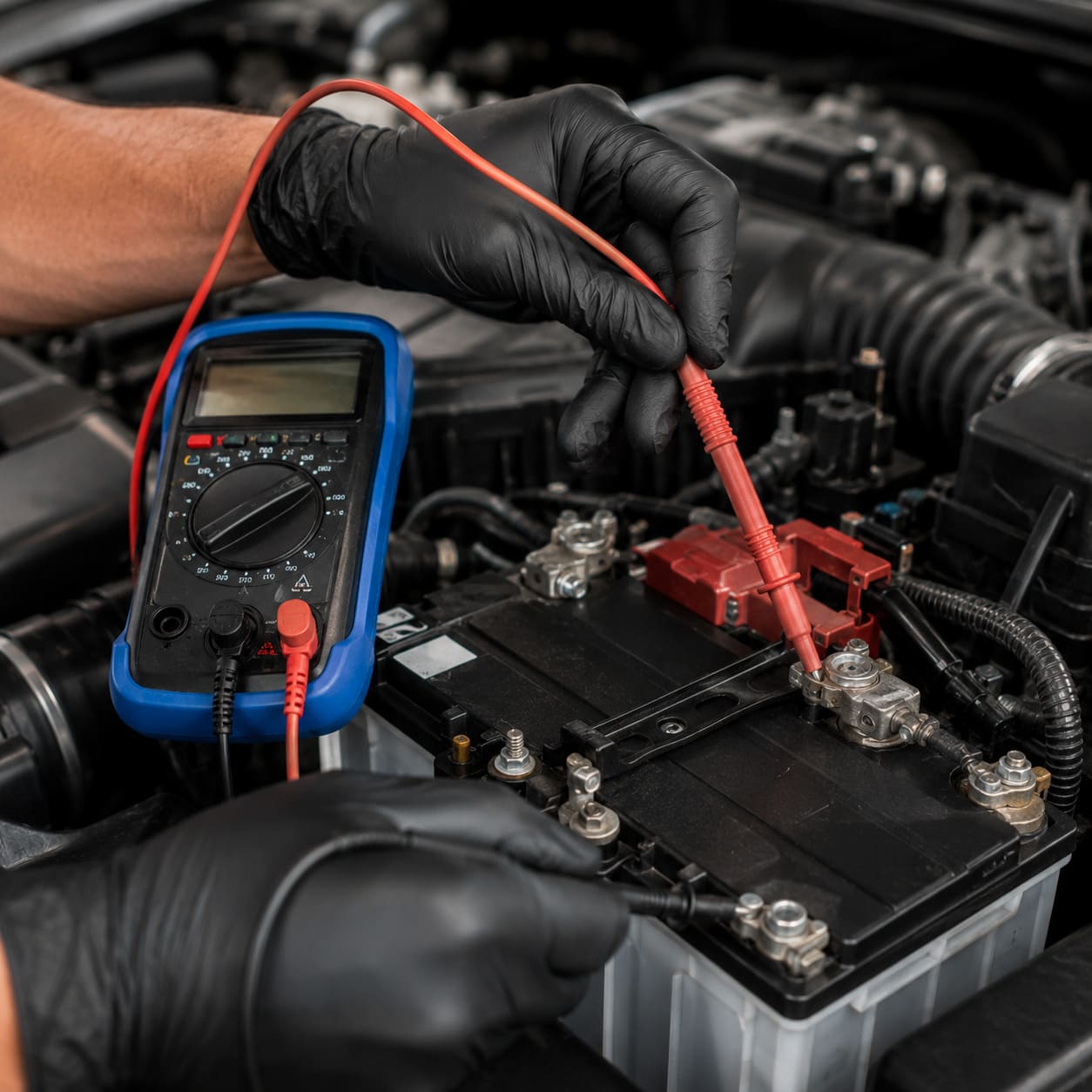
A replacement battery installed in the Boca Raton area usually costs $180 to $350 for a standard flooded battery and $250 to $450 for an AGM battery, with registration or coding adding to that on many newer cars. Alternators typically run $500 to $1,100 and starters $450 to $900 installed. Insist on a battery and charging-system test before buying any of them, because a bad cable or a parasitic drain can mimic every one.
Electrical problems are where parts get replaced on guesswork most often. A no-start can be a dead battery, a failing starter, a loose ground strap, a corroded terminal or a module that never goes to sleep and drains the battery overnight. Each has a different fix and a very different price, and a 10-minute test with a proper battery and charging analyzer separates most of them.
Batteries are the most common electrical purchase by far. Many newer cars, especially those with automatic engine stop-start, use AGM (absorbed glass mat) or EFB batteries that cost more and must be matched to the original type. Many European and some Asian and domestic models also need the new battery registered to the car's computer, so the charging system knows it has a fresh battery. Skipping that step can shorten the new battery's life.
Deeper electrical faults, such as power windows that quit, lights that flicker, or a battery that dies after sitting two days, are diagnostic work billed by the hour. Expect to pay for an hour or two of testing before anyone can quote the repair honestly.
What the job includes
- A conductance or load test of the battery, with the printed or emailed result showing state of health and state of charge.
- A charging-system test: alternator output at idle and under load, typically about 13.5 to 14.7 volts on most cars.
- A starter draw and voltage drop test across the main cables and ground straps.
- Cleaning and tightening battery terminals and checking cables for corrosion under the insulation.
- Installing the battery with the correct group size, terminal layout and hold-down, and registering or coding it on cars that need it.
- A parasitic draw test if the battery goes dead while parked, measuring current after the car's modules go to sleep.
- Taking back your old battery for recycling, with the state battery fee and any core charge shown on the invoice.
What battery & electrical costs in Boca Raton
| Job | Typical cost | Notes |
|---|---|---|
| Battery and charging-system test | free-$60 | Many parts stores and shops test free. |
| Standard flooded battery, installed | $180-$350 | Most older cars without stop-start. |
| AGM battery, installed | $250-$450 | Required on most cars with engine stop-start. |
| Battery registration or coding | $40-$150 | Needed on many European models and some others. |
| Alternator replacement, most cars | $500-$1,100 | Remanufactured units are common. Front-wheel-drive V6 models often cost more in labor. |
| Starter replacement, most cars | $450-$900 | Some V6 and V8 engines bury the starter under the intake. |
| Parasitic drain diagnosis | $150-$400 | Billed as diagnostic time. The fix is separate. |
| Electrical diagnosis, per hour | $130-$200 | For window, lighting, wiring and module faults. |
Typical South Florida ranges for parts and labor, for budgeting only. Your quote depends on the vehicle and the shop.
Battery & Electrical shops near Boca Raton
We are still adding shops for this service. Browse the directory or use the quote form.
See all shops for this serviceHow to choose a shop
- Ask whether the technician holds ASE A6 (Electrical and Electronic Systems) certification. For a car with complex networks, such as many German makes, a shop with factory-level scan software for your brand will find module and coding faults faster.
- Ask the shop to give you the test results, not just the conclusion. A battery report showing low state of health, or an alternator reading of 12.4 volts with the engine running, is a solid reason to replace it. 'It's probably the alternator' is not.
- Check the battery date and warranty. Most batteries carry a sticker or stamp showing the month and year they were shipped. Free-replacement periods of two to three years are common, followed by a prorated period on some brands. Ask how the warranty is honored if you move or travel.
- Remember the Florida estimate rule when a no-start turns into an open-ended diagnosis. Anything over $150 should be in writing first, including the diagnostic charge, and the shop needs your OK before going more than $10 or 10 percent past it, with a $50 maximum.
Red flags and upsells to question
- A new battery sold without a test, or a test with no printed result.
- An alternator replaced when the battery was simply discharged after the lights were left on. Charge and retest first.
- Both a battery and an alternator recommended together without separate test numbers for each.
- An AGM car fitted with a cheaper flooded battery to lower the price. It may fail early and can upset the stop-start system.
- A recurring dead battery 'fixed' by selling another battery, with no parasitic draw test.
- Terminal corrosion ignored. Corroded clamps can cause no-starts on a perfectly good battery.
The Florida factor
Heat, not cold, is what wears out batteries, and under-hood temperatures in a Boca Raton parking lot in August are extreme. High temperatures speed up the chemical reactions and water loss inside the battery, so a battery that would last five or six years up north often lasts about three in South Florida. If yours is over three years old, have it tested before summer, not after it strands you at a store on Glades Road.
Seasonal residents leave cars parked for months, and modern cars draw a small current even when off. Over a long summer that drain flattens most batteries, and a fully discharged lead-acid battery left that way loses capacity permanently. A quality battery maintainer, or disconnecting the negative terminal if the car allows it, saves a replacement. Some cars need radio codes or window resets after reconnection, so check your manual.
Florida law adds a $1.50 fee to every new or remanufactured lead-acid battery sold, which funds safe recycling. It should appear on the invoice. Salt air near the coast also corrodes battery terminals and ground straps faster, so a yearly terminal cleaning is cheap insurance.
Frequently asked questions
How long do car batteries last in Florida?
Often three to four years, sometimes less. Heat is harder on batteries than cold, and short trips that never fully recharge the battery also shorten its life.
Can I replace my own battery?
On many older cars, yes, with gloves and eye protection, removing the negative cable first and reconnecting it last. On cars that need battery registration or have the battery under a seat or in the trunk, a shop may be easier.
What is a parasitic drain?
A circuit that keeps drawing power after the car is off, such as a stuck relay, a glovebox light, an aftermarket accessory or a module that will not sleep. It drains the battery over a day or two.
Is it the battery or the alternator?
If the car starts with a jump and then dies again soon after, suspect the alternator. If it starts fine with a jump and keeps running, but will not start the next morning, suspect the battery or a drain. A test confirms either one.
Why does my new battery need to be registered?
Some cars adjust charging voltage based on battery age. Registration tells the car a new battery is installed, so it charges it correctly and does not overcharge it.
Guides related to battery & electrical
- RepairPal: Battery replacement cost
- RepairPal: Alternator replacement cost
- RepairPal: Starter replacement cost
- Car Care Council: Summer heat takes a toll on your car's battery
- Florida Statutes 403.7185: Lead-acid battery fees
General information, not a diagnosis. A car problem can have causes a guide cannot see, so have anything safety-related inspected in person. Read our editorial policy.