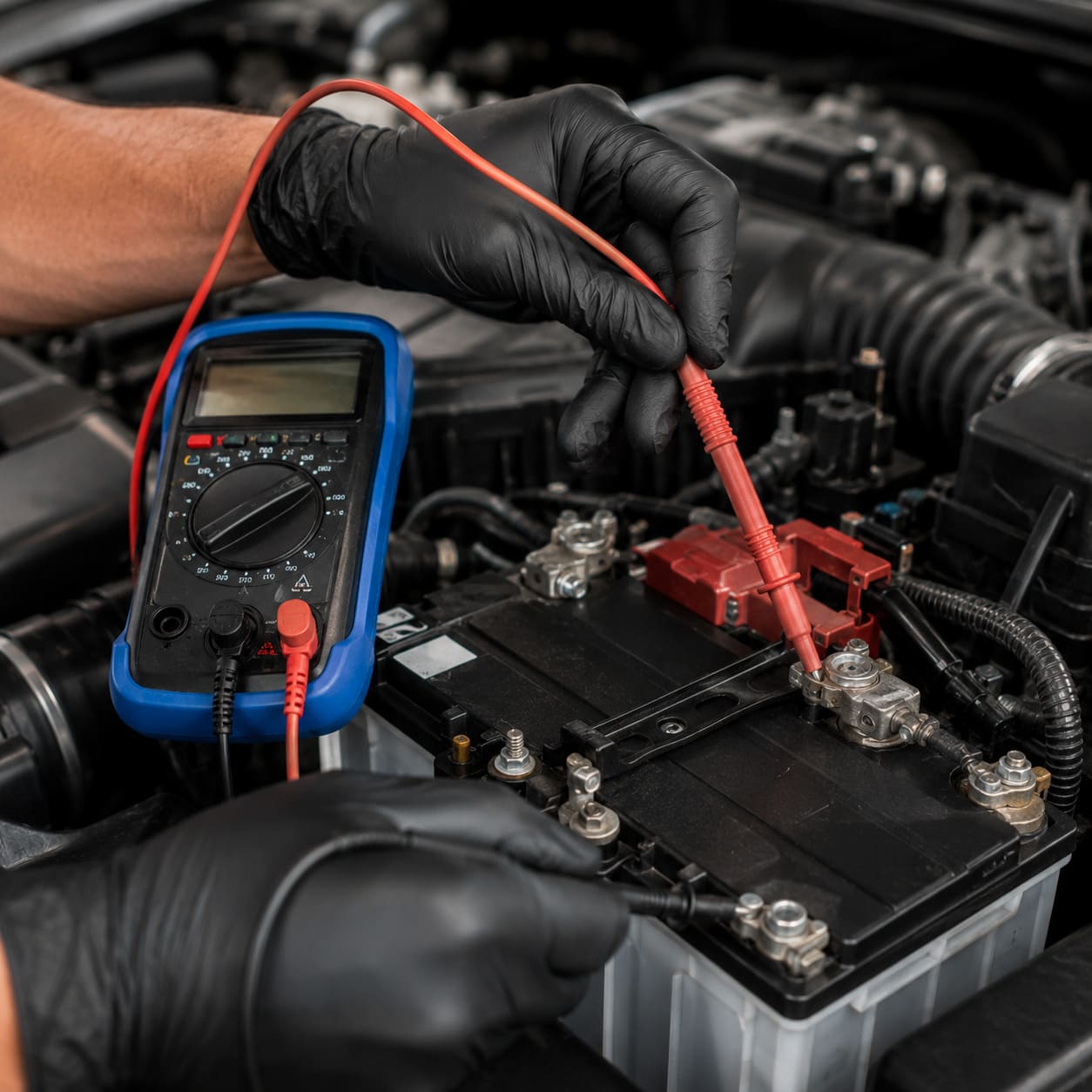
The clearest signs of a failing alternator are a battery or charging light while driving, lights that dim at idle and brighten when you rev, and a battery that keeps going flat even when it tests good. A meter on the battery with the engine running should read roughly 13.5 to 14.7 volts. Much lower, or above about 15, means the charging system needs attention.
The alternator is a belt-driven generator that runs every electrical system once the engine is on and recharges the battery after each start. Inside it, a spinning rotor creates alternating current, a set of diodes converts it to direct current, and a regulator holds the voltage steady. Any of those can fail, and so can the bearings the rotor spins on.
Failure is usually gradual. A worn alternator might keep up at highway speed but fall behind at idle with the A/C fan, headlights and wipers all on, which is why many of the early signs show up in traffic. When the output finally drops too far, the car draws the battery down while you drive, and modern engines with electronic throttle and fuel pumps stall when voltage collapses. RepairPal lists typical replacement at roughly $809 to $1,088 nationally, and the job varies a lot by how buried the alternator is.
Symptoms
- Red battery or charge warning light while the engine is running
- Headlights and dash dim at a stoplight, then brighten as you accelerate
- Power windows, wipers or the blower move slower than normal
- A whining or growling noise from the front of the engine that rises with rpm
- Smell of hot wiring or burning rubber
- Battery dies repeatedly even though it was replaced or tested good
- Engine stalls while driving, with multiple warning lights flashing on
Likely causes and what they cost
1. Worn alternator internals
$550-$1,100 for most cars; $900-$1,600 on some luxury and V6 models where access is hardBrushes wear down, diodes fail and the voltage regulator ages, especially with years of heat cycling. Output drops or becomes unsteady. A failed diode also creates electrical noise that can upset computers and the radio.
The fix: Replace with a new or quality remanufactured alternator. Most independent shops in Palm Beach County offer both, with remanufactured units saving $100-$300.
2. Slipping or worn serpentine belt
$100-$200 for a belt; $200-$400 with a tensionerIf the belt is glazed, cracked or loose, it slips on the alternator pulley and the alternator cannot spin fast enough. The usual clue is a squeal on start-up or when the A/C clutch engages.
The fix: Replace the belt, and the tensioner if it no longer holds firm tension.
3. Failed alternator bearing or decoupler pulley
$150-$350 for a decoupler pulley; alternator cost if the bearing is internalA dry bearing growls and gets louder with rpm. Many newer cars use a one-way decoupler pulley on the alternator that can fail and cause rattling, belt chatter or reduced output.
The fix: Replace the pulley alone where it is serviceable, otherwise the whole alternator.
4. Bad connection at the alternator or battery
$100-$300A corroded output stud, loose ground strap or burned fusible link can make a good alternator look bad. The alternator makes power, but it never reaches the battery.
The fix: Voltage-drop test the charging circuit, clean or replace the cable, ground or fuse.
5. Weak battery overworking the alternator
$160-$400 for the batteryAn internally shorted battery can demand more charging current than the alternator was designed to deliver continuously, overheating it. Replacing the alternator without the battery can kill the new alternator too.
The fix: Load test the battery whenever the alternator is replaced, and replace both if the battery is weak.
Costs are typical South Florida ranges for parts and labor, for budgeting only.
What you can check yourself
- 1Read battery voltage with the engine off
A healthy, rested battery reads about 12.6 volts. If it is well below 12.4, charge it first, or the following test will be misleading.
- 2Read it again with the engine running
At idle you should see roughly 13.5 to 14.7 volts. Keep the meter leads, your hands and any loose clothing well away from the belt and fan.
- 3Load it up
Turn on headlights, A/C on max fan and the rear defroster. Voltage should stay above about 13 volts. If it sinks toward the 12s, the alternator is struggling.
- 4Look at the belt
With the engine off, look for cracks, shiny glazing or fraying. Press it midway on its longest run, it should feel firm, not floppy. Never check the belt with the engine running.
- 5Do not pull a battery cable to test
The old trick of disconnecting the battery with the engine running to see if it stalls can send a voltage spike through modern electronics. Use a meter or a free parts store charging test instead.
When to take it to a shop
- The battery or charging light comes on while driving
- Running voltage is under 13 volts or over 15 volts
- You hear growling from the alternator area or smell hot wiring
- The car stalled and restarted only after a jump
- A recall notice for the alternator applies to your VIN
The Florida factor
South Florida summers ask a lot of an alternator. Idling in traffic on Glades Road or Palmetto Park Road with the A/C on maximum, headlights on for an afternoon downpour and wipers running is close to a worst case: high electrical demand at low engine speed while the alternator itself is breathing 150-degree air from the radiator. A unit that is beginning to weaken often shows its first dimming lights in exactly that situation.
Heat also hardens rubber, so serpentine belts here crack and glaze sooner than mileage alone would suggest. Inspect the belt at every oil change after about four years. On engines where the alternator sits low, driving through deep standing water after a storm can soak it, and a few weeks later the bearings or diodes fail from corrosion.
Notes for specific makes
- Nissan: Nissan recalled 2003-2005 Murano SUVs (NHTSA campaign 05V-319) because a wire inside the alternator could break and stop the battery from charging. Dealers replaced it with a modified unit. Check any older Murano's VIN for completion.
- Jeep: FCA recalled certain 2014 Jeep Grand Cherokee, Dodge Durango, Charger, Challenger and Chrysler 300 models with the 3.6-liter V6 and 160-amp alternator (NHTSA 17V-741) because the alternator could fail suddenly and stall the engine.
- Dodge: The same 2014 alternator recall covers some 3.6-liter Durango, Charger and Challenger models. Run the VIN through NHTSA's recall lookup before paying for an alternator out of pocket.
- Honda: On some Honda models, such as the CR-V, the alternator is tucked low and behind other components, which is why RepairPal's estimate for the CR-V runs higher than for a Civic or Accord.
Battery & Electrical shops near Boca Raton
We are still adding shops for this service. Browse the directory or use the quote form.
See all shops for this serviceFrequently asked questions
How long can I drive with a bad alternator?
Only as long as the battery lasts, often 20 minutes to an hour with minimal electrical load, much less with A/C and headlights on. Do not plan a highway trip on it.
Can a jump start fix a bad alternator?
No. A jump gets the engine running, but if the alternator is not charging, the battery will run down again. If the car dies again soon after a jump, suspect the alternator.
New or remanufactured alternator?
A quality remanufactured unit with a solid warranty is a reasonable choice for most daily drivers. Cheap rebuilt units with short warranties are where most repeat failures come from.
How long does an alternator last?
Many last 100,000 to 150,000 miles, but heat, water exposure and heavy electrical loads shorten that. There is no set replacement interval; replace it when it tests weak.
Should I replace the battery at the same time?
Only if it tests weak. A battery that has been run completely flat several times by a failing alternator often has lost capacity, so test it before deciding.
Related guides
More on this job: Battery & Electrical in Boca Raton, costs and how to choose a shop
- RepairPal: alternator replacement cost estimate
- AAA Club Alliance: warning signs of a bad alternator
- NAPA Know How: car won't start, alternator or battery?
- CarComplaints: 2014 FCA alternator recall 17V741000
- Justia: 2003 Nissan Murano alternator recall 05V319000
General information, not a diagnosis. A car problem can have causes a guide cannot see, so have anything safety-related inspected in person. Read our editorial policy.