Rapid clicking almost always means the battery cannot deliver enough current, usually from low charge or a loose, corroded terminal. A single loud click with bright dash lights points more toward the starter motor, its solenoid, or the cable feeding it. A jump start is the fastest way to tell the two apart.
The click you hear is a relay or the starter solenoid trying to close. The solenoid is an electromagnet that pushes the starter gear into the flywheel and connects the heavy battery cable to the starter motor. When it closes, the starter needs well over 100 amps for a second or two. If the battery or the cable cannot supply that, voltage collapses, the solenoid drops out, voltage recovers, and it tries again. That loop is the rapid clicking.
The rhythm matters. Many clicks per second means the electrical supply is the weak link. One heavy clunk with no crank means the solenoid engaged but the motor did not spin, which shifts suspicion to the starter itself, a worn starter contact, or a high-resistance connection right at the starter. Paying attention to which one you hear can save a misdiagnosis and a part you did not need.
Symptoms
- Fast, machine-gun clicking from under the hood or dash when you turn the key or press start
- One solid click, then nothing, while the dash and headlights stay bright
- Dash lights flicker or dim each time the clicking happens
- The engine turns over once or twice very slowly, then the clicking takes over
- The car starts fine after a jump, then clicks again the next morning
- Clicking that comes and goes, sometimes fixed by wiggling the battery cable
Likely causes and what they cost
1. Low or failing 12-volt battery
$160-$280 installed for a standard battery; $230-$400 for AGMA battery that has lost capacity can still light the dash, which fools people, but it cannot hold voltage under the starter's load. A reading of 12.4 volts or less at rest means it is partly discharged; under 12.0 it is close to flat. Age, short trips and heat all wear down capacity.
The fix: Recharge and load test. If it fails the load test, replace it with one of the correct group size and cold-cranking rating.
2. Loose or corroded battery terminals
under $20 DIY; $30-$75 at a shop; $80-$200 if a clamp or cable end must be replacedWhite, blue or green crust on the posts adds resistance exactly where the starter needs the least. A clamp you can twist by hand produces the same result. The battery may be fully charged and still click.
The fix: Disconnect negative first, clean posts and clamps with a terminal brush and baking soda solution, reconnect positive first and tighten until the clamp cannot rotate.
3. Failing starter motor or solenoid
$450-$900 at an independent shop; $700-$1,200 at a dealerInside the solenoid, copper contacts burn and pit over thousands of starts until they stop passing current. The motor brushes also wear. The classic sign is one firm click, bright lights, and no crank, sometimes cured temporarily by a light tap on the starter body.
The fix: Replace the starter, usually as a complete unit with the solenoid attached. Labor depends heavily on access; some V6 engines bury it under the intake.
4. Bad ground strap or main cable
$120-$350 depending on cable length and routingThe engine-to-body ground strap and the main positive cable carry starter current. Corrosion can creep inside the insulation where you cannot see it, so the cable looks fine but behaves like a thin wire. A cable that feels warm after a start attempt is a strong clue.
The fix: Voltage-drop test the cables, then replace the failing strap or cable.
5. Weak alternator leaving the battery undercharged
$550-$1,100 depending on the vehicleIf the charging system is not putting enough back, the battery slowly runs down and the car starts clicking every few days. The battery gets blamed and replaced, then the problem returns. Running voltage under about 13.2 volts with the engine at idle suggests the alternator is not keeping up.
The fix: Test charging output and replace the alternator if it fails, along with the belt if it is worn.
6. Seized engine or hydrolocked cylinder
$200-$500 to diagnose and clear water if caught early; thousands if internal parts bentIf the engine cannot physically rotate, the starter clicks and stalls. This can follow driving through deep water, which matters in a flood-prone area, or a catastrophic internal failure.
The fix: Stop cranking immediately. A shop will try to turn the engine by hand and inspect for water in the cylinders.
Costs are typical South Florida ranges for parts and labor, for budgeting only.
What you can check yourself
- 1Count the clicks
Have someone turn the key while you stand outside with the hood open. Rapid clicking points to supply, one clunk points to the starter. Keep hands and loose clothing away from belts and the fan, which can start without warning.
- 2Turn on the headlights and try again
If the headlights go nearly dark when you try to start, the battery or its connections cannot hold voltage. If they stay bright and you hear only one click, the battery is probably strong enough and the starter circuit is the suspect.
- 3Inspect and wiggle the terminals
With the car off, look for crust on the posts and try to twist each clamp by hand. Wear gloves and eye protection, since battery deposits are acidic. Do not lay a metal tool across both posts.
- 4Read the battery voltage
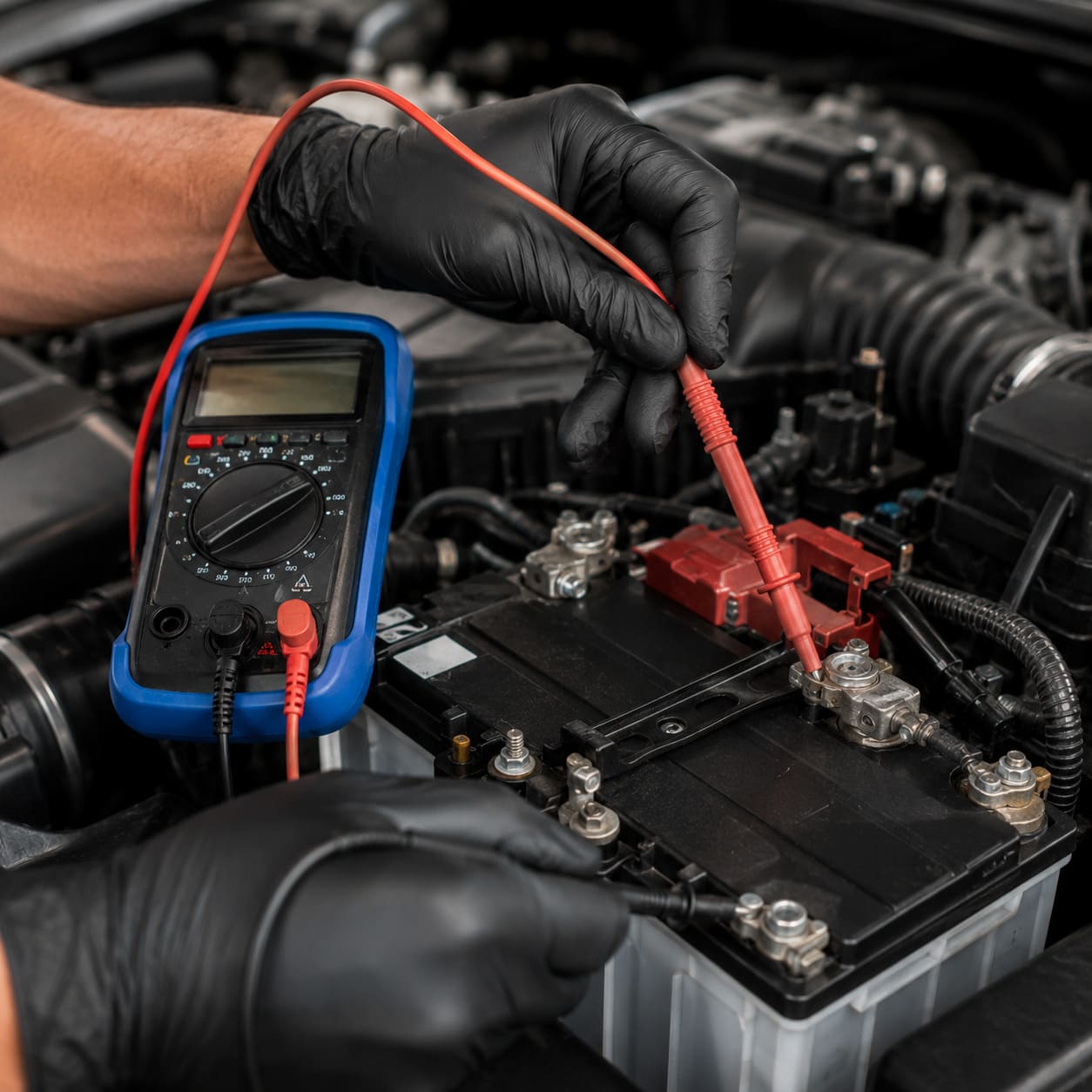
An inexpensive multimeter across the posts should read 12.6 volts or a little higher on a healthy, rested battery. Around 12.2 is roughly half charged. Under 12.0 means the battery is essentially flat and needs a charge before it can be tested properly.
- 5Try a careful jump start
Connect positive to positive, then the donor negative to bare metal on your engine, away from the battery. If the car fires right up, the battery side is the likely problem. If it still gives one click with a good jump, the starter is the likely problem.
- 6Check the shifter and try neutral
On automatics, move the lever firmly into Park, or try starting in Neutral with your foot on the brake. A worn range switch can cause odd behavior, though it more often gives silence than clicking.
When to take it to a shop
- A good jump start still produces only a single click
- The battery is new or tests fine, yet the clicking keeps returning
- You smell burning, see smoke, or a cable feels hot after a start attempt
- The car recently drove through standing water and now clicks without cranking
- The battery is swollen, cracked, leaking or smells like rotten eggs
The Florida factor
Clicking no-starts in Boca Raton cluster in two seasons. The first is late summer, when months of 90-degree days and engine bays that bake in open parking lots on Glades Road have quietly corroded the battery's internal grids. The second is when seasonal residents return in November to cars that sat since spring with only the alarm and clock drawing current. Either way the battery is often the root cause, but the click is the first time anyone notices.
Humidity and salt air near A1A and the Intracoastal speed up terminal corrosion, so a car garaged in Highland Beach or Lighthouse Point may need its clamps cleaned more often than one kept inland in Parkland. After a summer storm, if the car clicks and you parked in standing water, do not keep cranking. Water in the intake can bend a connecting rod, turning a cheap problem into an engine replacement.
Notes for specific makes
- BMW: Most BMWs since the mid-2000s track battery health through a sensor on the negative terminal. A new battery should be registered with a BMW-capable scan tool, or the car may keep charging it as if it were the old, worn one.
- Toyota: Toyota hybrids use a small 12-volt auxiliary battery to boot the system. A weak one can cause clicking relays and a dead dash even though the large hybrid pack is fine. It is usually in the trunk or under a rear seat, with a jump terminal under the hood.
- Ford: Many newer Fords use a battery monitoring sensor and expect a battery management reset after replacement, which a shop does with a scan tool. Skipping it can leave start-stop and charging behaving oddly for weeks.
Battery & Electrical shops near Boca Raton
We are still adding shops for this service. Browse the directory or use the quote form.
See all shops for this serviceFrequently asked questions
Can a bad starter make a rapid clicking noise?
It can, but less often. Rapid clicking is far more typical of low voltage. A failing starter usually gives one click or a grinding whir without engaging the engine.
Why does my car click but the radio and lights work?
Lights and radio draw a few amps. The starter draws over a hundred. A battery can have enough left for one and not the other, and a corroded clamp can pass a small current while choking a large one.
Is it safe to keep trying to start it?
A few tries are fine. Endless cranking overheats the starter and wiring. If three or four attempts and a jump do not work, stop and get it tested.
Will a parts store test my battery for free?
Most chain parts stores in Palm Beach County will test the battery and the charging system at no charge, often in the parking lot. A shop diagnosis of a starter circuit typically runs $100-$180.
Does tapping the starter really work?
Sometimes. A light tap can shift worn solenoid contacts enough for one more start. It is a sign the starter is failing, not a fix, so plan on replacing it soon.
Related guides
More on this job: Battery & Electrical in Boca Raton, costs and how to choose a shop
- AAA: 14 reasons why your car won't start
- RepairPal: starter replacement cost estimate
- NAPA Know How: car won't start, alternator or battery?
- RepairPal: battery replacement cost estimate
General information, not a diagnosis. A car problem can have causes a guide cannot see, so have anything safety-related inspected in person. Read our editorial policy.