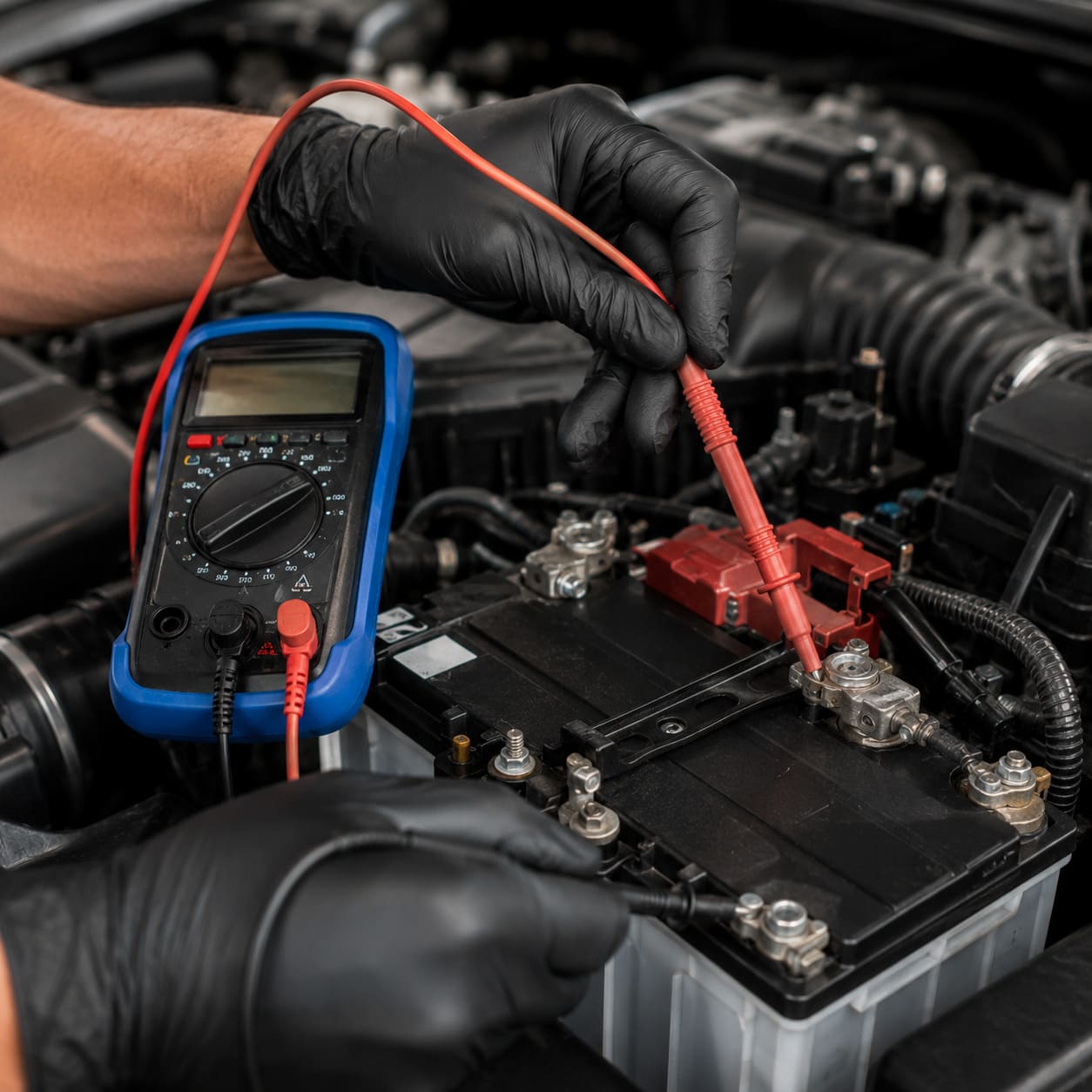
Total silence usually means the start request never reaches the starter. The most common reasons are a completely flat battery, the car not detecting your key, the shifter not reading Park, or a blown starter fuse or relay. Start by checking whether the dash lights come on, because that one observation splits the list in half.
A modern car has several gatekeepers between your finger and the starter motor. The battery must have enough voltage to wake the computers. The body or security module must recognize a valid key. The transmission range sensor must confirm Park or Neutral, and on a manual, the clutch switch must confirm the pedal is down. Only then does the computer energize the starter relay, which sends power to the solenoid. Silence means one of those gates stayed shut.
Unlike the rapid clicking of a weak battery, a silent failure gives you very little sound to work with. That is why the visual clues matter. Dark dash, dead remote and no dome light point to power. A bright dash with a key or security warning points to the immobilizer. A bright dash with no warning at all points toward the shifter switch, the relay, the fuse or the starter circuit itself.
Symptoms
- Nothing happens when you turn the key or press the start button, not even a click
- The dash stays completely dark, or lights up normally but the engine never turns
- A message such as key not detected, or a flashing key or security light
- Push-button start lights up the accessories but never cranks
- The shifter feels loose, or the car starts only after you jiggle it
- The remote does nothing at the doors and the interior light does not come on
Likely causes and what they cost
1. Completely discharged battery
free to recharge; $160-$400 if replacement is neededBelow roughly 10 to 11 volts, many cars cannot power the modules that authorize a start, so there is no click to hear. A dead remote and a dome light that will not come on are the giveaway. Lights left on, an aftermarket accessory, or weeks of sitting can drain a battery this far.
The fix: Jump or charge, then load test. A battery drained to zero is often permanently weakened and may need replacing.
2. Key not recognized by the immobilizer
$5-$10 for a fob battery; $200-$500 for a programmed replacement keyEvery car built in the last two decades checks a chip in the key or fob before allowing a start. A weak fob battery, a damaged key chip, or radio interference from a phone or charging pad can block that check. The car stays silent and usually shows a key or security symbol.
The fix: Replace the fob battery, try the spare, or use the backup method in the owner's manual. A failed transponder needs a new key programmed to the car.
3. Transmission range (neutral safety) switch
$150-$450 depending on accessThis switch tells the computer the car is in Park or Neutral. When its contacts wear or it slips out of adjustment, the car may think it is in gear and refuse to crank. Backup lights that do not work in reverse, or a start that works only in Neutral, are typical clues.
The fix: Adjust or replace the range switch on the transmission, or repair the shift linkage or cable bushing if the lever is not moving the switch fully.
4. Blown starter fuse or failed starter relay
under $20 for a fuse; $20-$80 for a relay; $100-$180 for a shop diagnosisThe starter relay is a small plug-in box that switches the starter solenoid. Relays wear out and fuses blow, often after a jump start done in the wrong order. Everything else in the car works normally.
The fix: Check the fuse and swap the relay with an identical one from a non-critical circuit, such as the horn, to test.
5. Ignition switch or start button fault
$40-$150 for a brake light switch; $200-$500 for an ignition switchWorn contacts in a keyed ignition switch can light the dash but never send the start signal. On push-button cars, the button or brake light switch can fail, and many cars will not start without seeing the brake pedal pressed.
The fix: Test the switch and brake switch signals, then replace the failed part.
6. Open circuit in the starter or its wiring
$100-$250 for a wiring repair; $450-$1,100 for a starterA starter can fail with a dead spot in the motor or a broken solenoid winding and make no sound. The small trigger wire to the solenoid can also corrode or break, especially on cars that have been through high water.
The fix: Check for voltage at the solenoid trigger terminal during a start attempt, then repair the wire or replace the starter.
Costs are typical South Florida ranges for parts and labor, for budgeting only.
What you can check yourself
- 1Look at the dash first
Turn the key to on, or press start without the brake. Dark dash and a dead remote mean a power problem. A bright dash narrows it to the key, shifter, fuse, relay or starter.
- 2Press the brake hard and shift through the gears
Push the brake firmly, move the lever to Neutral, and try. Then back to Park and try again. If it starts in Neutral only, the range switch or shift cable is the prime suspect.
- 3Try the spare key or the fob backup
Most push-button cars accept a fob held directly against the start button, or placed in a marked pocket in the console or cupholder. Your owner's manual shows the exact spot. Move phones and wireless chargers away while you try.
- 4Check the starter fuse and relay
The under-hood fuse box lid usually has a diagram. Pull the starter fuse and look for a broken strip. Swapping in an identical relay is a safe test. Turn the car off and keep your hands away from the battery posts while you work.
- 5Inspect the battery connections
A clamp that has slipped off a post can cut all power at once. Wear gloves and eye protection, and tighten negative last so a wrench touching metal cannot spark across the positive.
When to take it to a shop
- The battery is charged and the dash is bright, but the car still makes no sound after the checks above
- A key or security light keeps flashing with both of your keys
- The car starts only in Neutral, or you have to wiggle the shifter every time
- You smell hot plastic or find melted fuse box parts
- The car was in flood water deep enough to reach the floor
The Florida factor
Silent no-starts are the classic snowbird problem in Boca Raton and Delray Beach. A car parked from April to November with its alarm armed and its modules checking for the key can drain a healthy battery to nothing. Owners who leave for the summer should either have a trusted person run the car every couple of weeks or use a smart maintenance charger in a garage, not a cheap trickle charger that can overcharge in the heat.
Hurricane season adds a second risk. Fuse boxes, relays and starter connectors sit low in many engine bays, and brackish storm surge along the Intracoastal starts corroding copper within days. A car that was fine before a storm and is silent after one may have water in a connector or a fuse block, which is worth checking before you buy a new battery. If the water reached the seats, treat it as a flood car and do not attempt to start it until the electrical system has been inspected.
Notes for specific makes
- Toyota: On Toyota and Lexus smart-key models, a fob with a dead battery can still start the car if you touch the fob's logo side to the start button while pressing the brake. The car reads the fob's passive chip at very short range.
- Chevrolet: Older GM vehicles with the Passlock system can refuse to crank and flash a security light. Many can be relearned by leaving the key on for about 10 minutes until the light stops flashing, then switching off and starting, though the exact routine varies by model.
- Honda: Hondas show a flashing green key indicator when the immobilizer does not recognize the key. Try the spare. If both fail, the immobilizer unit or antenna ring around the ignition is a known suspect on older models.
- Tesla: A Tesla depends on its low-voltage battery to open doors and boot the screen. If it fails, the car can seem completely dead even with a charged main pack. Tesla publishes the jump and manual door release procedure in each owner's manual.
Battery & Electrical shops near Boca Raton
We are still adding shops for this service. Browse the directory or use the quote form.
See all shops for this serviceFrequently asked questions
What is the difference between no sound and clicking?
Clicking means the starter solenoid is getting a signal but not enough current. Silence usually means the signal is not reaching it at all, which points to the key, shifter, fuse, relay or a totally flat battery.
Can a dead key fob stop the car from starting?
Yes. If the car cannot read the key, the immobilizer blocks the start. Most fobs have a backup method that works even with a dead coin cell, described in the owner's manual.
Why does my car start in Neutral but not in Park?
That is the classic symptom of a worn or misadjusted transmission range switch. It is safe to start in Neutral as a short-term workaround with your foot on the brake, but get it repaired.
How much does it cost to diagnose a silent no-start?
A shop diagnosis of the starting circuit in Palm Beach County typically runs $100-$180. If the car will not start, add the cost of a tow, often $75-$150 within a short distance.
Related guides
More on this job: Battery & Electrical in Boca Raton, costs and how to choose a shop
- AAA: 14 reasons why your car won't start
- Kelley Blue Book: why won't my car start?
- Kelley Blue Book: key fob replacement
General information, not a diagnosis. A car problem can have causes a guide cannot see, so have anything safety-related inspected in person. Read our editorial policy.