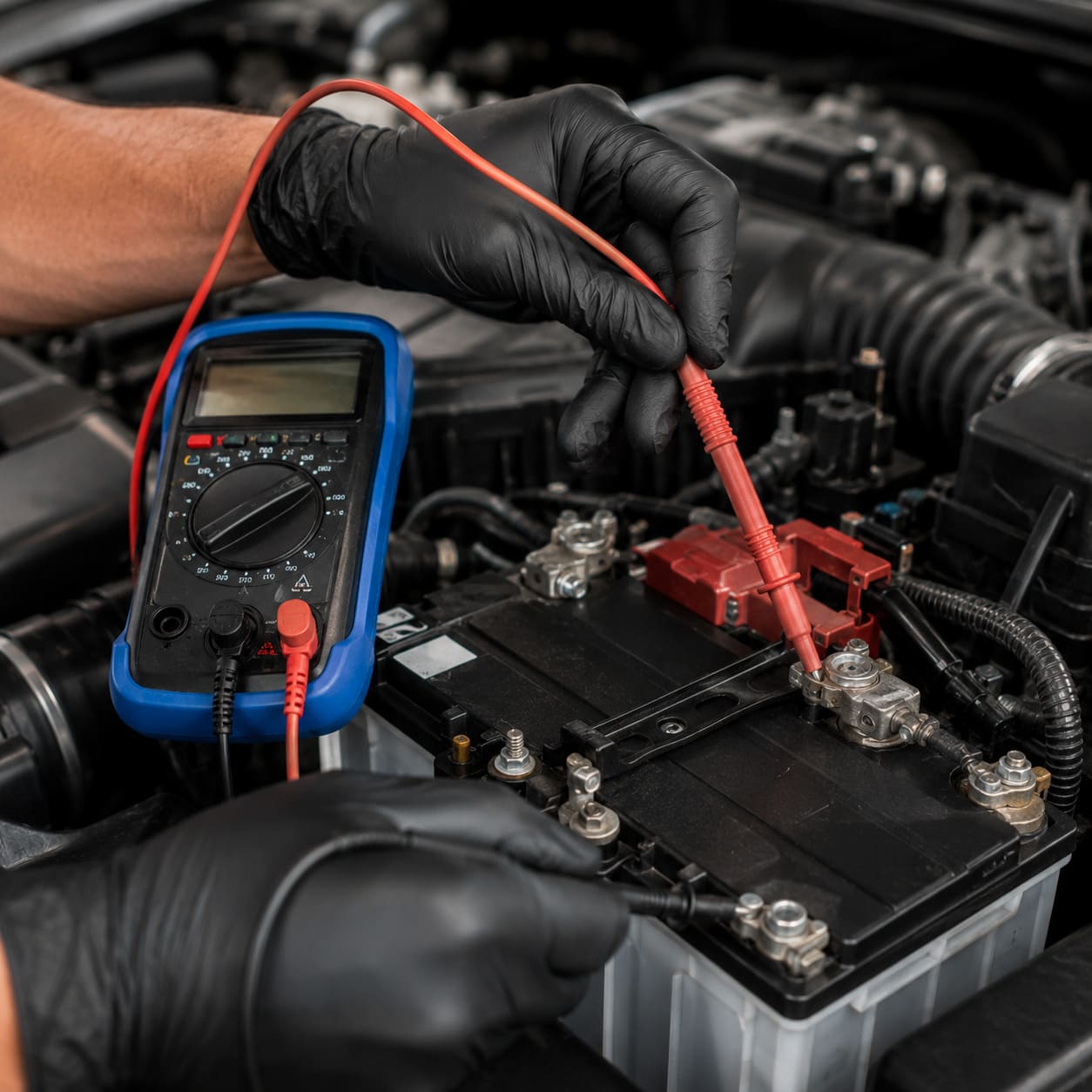
A battery that keeps going flat has one of three problems: it is worn out and cannot hold a charge, something is drawing power while the car is off, or the alternator is not refilling it while you drive. A free battery and charging test rules out the first and third, and a parasitic draw test with a meter finds the second.
Every car draws a small amount of current when it is off, to keep the clock, the alarm and the computers' memory alive. On most vehicles that resting load settles to roughly 20 to 50 milliamps once the modules go to sleep, which a healthy battery can support for weeks. When something stays awake, the draw can jump to several hundred milliamps or more, and a battery that should last a month is empty by morning.
The mistake most owners make is replacing the battery without asking why the old one died. If the cause was a drain or a weak alternator, the new battery fails the same way, and each deep discharge shortens its life. The order that works is: test the battery, test the charging system, and only then hunt for a drain.
Symptoms
- Car is dead after sitting overnight or over a weekend, then runs fine after a jump
- A battery replaced in the last year is already going flat
- Slow, labored cranking that gets worse the longer the car sits
- Battery or charging warning light while driving
- Clock, radio presets or seat memory reset on their own
- A faint hum, glow or warm module somewhere in the car after it is locked
Likely causes and what they cost
1. Battery that has lost its capacity
$160-$280 for flooded; $230-$400 for AGM; more on cars that need the battery registeredLead-acid batteries lose usable capacity every year, faster in heat. A four-year-old battery can show 12.6 volts and still have so little reserve that a normal overnight draw finishes it off. Only a load test or conductance test shows the real condition.
The fix: Replace with the correct group size and type. Cars that came with an AGM battery need an AGM replacement.
2. Parasitic drain from an accessory or module
$100-$250 to locate a drain; repair cost depends on the part foundAftermarket dash cams, remote starters, amplifiers and trackers wired to constant power are frequent offenders. Factory culprits include a glovebox or trunk light that never switches off, an infotainment or telematics unit that fails to sleep, or a sticking relay. A draw over about 50 milliamps after the sleep period deserves investigation.
The fix: Measure the draw, pull fuses one at a time to find the circuit, then repair or unplug the device on it.
3. Alternator not charging enough
$550-$1,100 depending on the vehicleWith the engine running, the system should hold roughly 13.5 to 14.7 volts. If the alternator delivers less, the battery goes into every start a little lower until it cannot crank. A failing internal diode can also let current leak back through the alternator when the car is off.
The fix: Test output under load and replace the alternator if it fails. A shop can also check for diode ripple.
4. Short trips and long idle periods
free; $40-$90 for a quality maintenance chargerStarting takes a burst of energy that a five-minute drive does not fully replace, especially with the A/C fan on high. A car used only for quick runs to Publix can slowly run down with nothing broken at all.
The fix: Take a 30-minute highway drive weekly, or connect a smart maintenance charger at home.
5. Corroded cables or a weak ground
under $20 to clean; $120-$350 to replace cablesResistance in the cables limits both how much current reaches the starter and how much charge gets back into the battery. The symptom looks like a battery that never quite fills up.
The fix: Clean and tighten the terminals, then voltage-drop test the main cables and ground strap and replace any that fail.
6. Battery not registered or system not reset
$50-$120 for the registration aloneMany European and newer domestic cars track battery age and adjust charging voltage to match. If a new battery is installed without telling the car, it may keep undercharging it as if it were old.
The fix: Register or reset the battery management system with a capable scan tool.
Costs are typical South Florida ranges for parts and labor, for budgeting only.
What you can check yourself
- 1Get the free tests done first
Most parts stores will test the battery, starting and charging system in the lot at no cost. Ask for the printout. It shows the battery's measured cranking amps against its rating and the alternator's output.
- 2Measure resting voltage the next morning
Fully charge or drive the car, then check the voltage at the posts after it sits 12 hours. A drop from about 12.7 to below 12.4 overnight suggests a meaningful drain or a battery that cannot hold charge.
- 3Look for lights that stay on
At night, check through the windows and gaps for a glow in the glovebox, trunk, vanity mirrors or under-hood lamp. Press the trunk or glovebox switch by hand to make sure it actually turns the bulb off.
- 4Unplug every add-on
Remove dash cams, phone chargers and anything plugged into a 12-volt outlet for a few nights. If the battery stops dying, plug them back in one at a time.
- 5Do a parasitic draw test if you have a meter
With the car locked and the meter in series on the negative cable, wait 30 to 45 minutes for modules to sleep before reading. Do not turn the ignition on with the meter connected, and wear eye protection near the battery.
When to take it to a shop
- The draw test shows more than about 50 to 85 milliamps after the sleep period and you cannot find the circuit
- The charging test fails or the battery light comes on while driving
- A second new battery has gone flat within months
- The battery case is swollen, hot or smells of sulfur
- The car has a European make that needs the battery registered after replacement
The Florida factor
Two Boca Raton habits work against a battery. One is the short, hot trip: the car sits in an outdoor lot at Town Center, the engine bay soaks to well over 140 degrees, and the drive home on Glades Road is too short and too stop-and-go to replace what the start and the A/C used. The other is the part-time car, kept at a condo for a season and parked the rest of the year with the alarm and keyless entry listening for a fob.
For the part-time car, a smart maintenance charger in a garage beats a cheap trickle charger, which can boil a battery in Florida heat. If the car lives outdoors, disconnecting the negative cable for long absences stops the drain but resets radio and window settings, and some cars need a relearn afterward. Ask whoever checks on the car to start it and drive it at least 20 minutes, not just idle it in the driveway.
Notes for specific makes
- Acura: Owners of several 2000s and 2010s Acura models have reported the HandsFreeLink Bluetooth unit failing to go to sleep and draining the battery, and the issue was the subject of litigation. A fuse-pull draw test that points to the HFL circuit is the telltale.
- Honda: Some Honda models share the HandsFreeLink module design with Acura, and similar drain reports exist. Unplugging the module confirms it, at the cost of losing hands-free calling until it is replaced.
- BMW: BMW's energy management relies on an intelligent battery sensor. After any battery replacement, the new one should be registered with a BMW-capable tool. Skipping it causes no warning light but can lead to chronic undercharging.
- Ford: Many Ford models with a battery monitoring sensor need a battery management reset after a new battery. Without it, the system can report the wrong charge state and shut off accessories early.
Battery & Electrical shops near Boca Raton
We are still adding shops for this service. Browse the directory or use the quote form.
See all shops for this serviceFrequently asked questions
How long should a car sit before the battery dies?
A healthy, fully charged battery with a normal draw should start the car after two to four weeks. If yours dies in a day or two, something is drawing far more than normal or the battery is worn out.
Can a bad alternator drain the battery with the car off?
Yes. A failed diode inside the alternator can let current flow backward. A shop can isolate it by disconnecting the alternator's output wire during a draw test.
Will driving the car charge a dead battery fully?
Not reliably. An alternator is designed to maintain a battery, not recover a deeply drained one. Use a proper charger, then test it.
Is a jump pack a good solution?
It is a good emergency tool to keep in the car. It is not a fix. Every deep discharge costs the battery some of its life, so find the cause.
What does a parasitic drain diagnosis cost?
Expect $100-$250 at an independent shop, usually billed as one to two hours of diagnostic time. Intermittent drains that only happen some nights can take longer.
Related guides
More on this job: Battery & Electrical in Boca Raton, costs and how to choose a shop
- Battery Tender: parasitic battery drain, how to find and fix it
- NAPA Know How: car won't start, alternator or battery?
- RepairPal: battery replacement cost estimate
- Car Care Council: summer heat takes a toll on your car's battery
General information, not a diagnosis. A car problem can have causes a guide cannot see, so have anything safety-related inspected in person. Read our editorial policy.