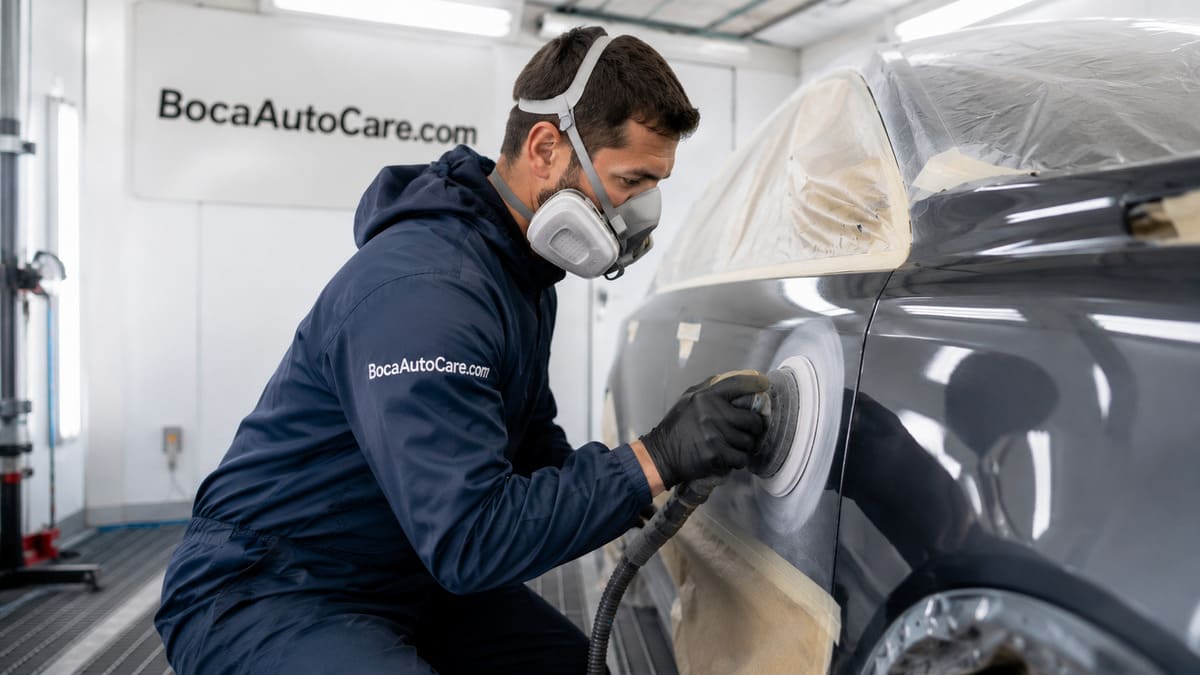
Small dents can cost $75-$250 with paintless repair, a bumper repair and refinish usually runs $400-$1,000, and a crash that touches sensors or structure easily passes $3,000. Look for a shop with I-CAR Gold Class or OEM certification for your make, get the parts plan and warranty in writing, and know that under Florida law an insurer that requires its own shop must return the car to pre-loss condition at no extra cost to you.
Body work covers everything from a shopping-cart ding to a car that needs its frame pulled back into spec. The price is set by three things: how many panels are damaged, whether the damage reaches structure or safety sensors, and how much paint has to be blended into neighboring panels so the color matches.
Modern cars complicate the old rules. High-strength steel and aluminum panels often cannot be heated or straightened the way older steel could, and carmakers publish repair procedures that say what can be repaired, what must be replaced, and where welds and rivets go. Radar sensors sit behind bumper covers and grille emblems, and a refinish that is too thick over a sensor can blind it.
Whether you pay yourself or go through insurance, the estimate is a negotiation document. The first one is rarely the final one, because hidden damage shows up once the bumper comes off. That is normal. What matters is that each change is written down and approved by you.
What the job includes
- A teardown or blueprint inspection to find hidden damage before the final estimate, not after the car is half painted.
- Repair or replacement of panels following the carmaker's published repair procedures, including any one-time-use bolts or sectioning rules.
- Measuring the structure with an electronic or mechanical measuring system when the hit was hard enough to move mounting points.
- Corrosion protection, seam sealer and cavity wax restored on repaired or replaced metal.
- Color matching by paint code and spray-out cards, with blending into adjacent panels when needed, and a clear coat finish.
- Pre-repair and post-repair diagnostic scans, plus ADAS calibration for radar, cameras and parking sensors that were disturbed.
- A final inspection for gaps, paint texture, lights, and road test, along with a written workmanship warranty.
What auto body & collision costs in Boca Raton
| Job | Typical cost | Notes |
|---|---|---|
| Paintless dent repair, one small dent | $75-$250 | Works when the paint is not cracked. Hail damage is priced per panel. |
| Scratch repair and refinish, one panel | $300-$800 | Includes blending. Pearl and tri-coat colors cost more. |
| Bumper cover repair and refinish | $400-$1,000 | Plastic repair is often cheaper than a new cover. |
| Bumper cover replacement and paint | $800-$2,200 | Parking sensors, radar brackets and grilles add up fast. |
| Fender replacement and paint | $800-$2,000 | Aluminum fenders on some trucks and luxury cars cost more. |
| Door shell replacement or major door repair | $1,000-$2,800 | Transfer of glass, trim and electronics is labor heavy. |
| Frame or unibody straightening | $800-$4,000 | Depends on bench time and parts. Severe cases can total the car. |
| Post-repair ADAS calibration | $150-$600 | AAA found minor front-end crashes averaged about $1,540 in ADAS parts and calibration on 2023 models. |
| Rust repair, rocker panel or wheel arch | $500-$2,000 | Cutting out rot and welding in new metal, then refinishing. |
| Full repaint, quality job | $3,500-$10,000 | Budget repaints exist but skip prep and rarely last in Florida sun. |
Typical South Florida ranges for parts and labor, for budgeting only. Your quote depends on the vehicle and the shop.
Auto Body & Collision shops near Boca Raton
- Total Care Collision140 Northwest 14th Street, Pompano Beach, FL, 33060-5485
How to choose a shop
- Ask about training. I-CAR Gold Class means the shop's technicians keep current, role-specific training in collision repair, renewed every year. Many carmakers also run certified collision programs, and on aluminum-intensive or high-end vehicles a factory-certified shop has the tools and access to procedures that others may not.
- Ask what parts the estimate assumes: new OEM, aftermarket (non-original), or recycled (used OEM). Each has a place. Florida Statutes 626.9743 says an insurer may not require replacement parts that are not at least equal to the originals in kind, quality, fit, appearance and performance, so a poorly fitting aftermarket part is something you can push back on.
- Understand your choice of shop. Florida does not have a broad anti-steering law, and your own policy's wording controls on a first-party claim. If your insurer specifically requires its shop, the same statute makes the insurer responsible for restoring the car to pre-loss condition at no added cost beyond the policy. On a claim against the other driver's insurer, you are not bound by their direct-repair network, so you can pick the shop and let the shop deal with the adjuster.
- Get the warranty in writing. Lifetime workmanship and paint warranties for as long as you own the car are common at established collision shops. Ask what voids it and whether it transfers if the shop is part of a network.
- Check the shop's FDACS registration. Body and paint shops fall under the Florida Motor Vehicle Repair Act, so you are owed a written estimate on work over $150, a call before the bill goes over it by more than the allowed margin, and an invoice that identifies used or rebuilt parts.
Red flags and upsells to question
- An offer to 'eat your deductible' by inflating the claim. It is insurance fraud, and the shop that does it will cut corners on your car to make the math work.
- Pressure to sign a direction-to-pay or authorization the day you walk in, before you have an estimate or have talked to your insurer.
- No pre-repair or post-repair scan on a car built in the last ten years.
- A cash price far below other estimates with no explanation of what is being skipped, usually blending, corrosion protection or calibration.
- An estimate that lists aftermarket or used parts without saying so clearly. Substituting used or rebuilt parts without telling you is unlawful under Florida Statutes 559.920.
- A refusal to show you the old parts or the damage behind the bumper.
- A shop that tells you a repaired car does not need an alignment or a calibration after a wheel or bumper hit.
The Florida factor
South Florida sun is the real test of a paint job. UV breaks down clear coat on horizontal panels first, so a cheap refinish that looks perfect at pickup can turn chalky on the hood and roof in two summers. Ask what clear coat system the shop uses and whether the warranty covers fading and peeling. Let fresh paint cure for 30-90 days before waxing or a ceramic coating, and avoid parking under oak or ficus trees where sap and bird droppings sit on it.
Salt air matters for collision work near the coast. Bare metal exposed by a crash or a repair starts to rust fast east of US-1, so seam sealer, primer and cavity wax are not optional extras here. Cars kept in Highland Beach or along the Intracoastal deserve a close look at repaired seams a year after the job.
Hurricane season adds its own work. Storm debris, fallen branches and hail drive a wave of claims each fall, and flood cars from places like the low streets east of Federal Highway show up later at auctions with fresh paint over corroded wiring. Body shops get booked out after a storm; photograph damage right away, file the claim, and get on a shop's list early, even if repair waits a few weeks.
Frequently asked questions
Should I get more than one estimate?
Usually yes for paying out of pocket, since prices vary widely. For an insurance claim, the insurer writes its own estimate and the shop submits supplements as hidden damage appears. In that case, the shop's quality and warranty matter more than the first number.
What is a supplement?
An additional estimate filed after the car is taken apart and more damage is found. It is normal on most collision jobs. A good shop shows you photos of the newly found damage and gets approval before doing the work.
Can I keep the insurance check and not fix the car?
If you own the car outright, often yes for physical damage claims, but the next claim on the same panels will be reduced or denied. If you have a loan or lease, the lienholder is usually on the check and expects the repair.
Will a repaired car lose value?
Often, especially after structural damage that shows on a vehicle history report. This loss is called diminished value. In Florida, you may be able to claim it from the at-fault driver's insurer, so ask an attorney or public adjuster if the car is new or valuable.
How long does collision repair take?
Small bumper and dent jobs take one to three days. Moderate hits with parts on order often take one to three weeks. Structural damage or parts on backorder can stretch past a month, and rental coverage limits matter here.
Guides related to auto body & collision
- Florida Statutes 626.9743: Motor vehicle claim settlement practices
- Florida Statutes 559.920: Unlawful acts by repair shops
- Florida Statutes 559.903: Definitions, including body and paint shops
- AAA: ADAS repairs make up over a third of crash repair costs
General information, not a diagnosis. A car problem can have causes a guide cannot see, so have anything safety-related inspected in person. Read our editorial policy.