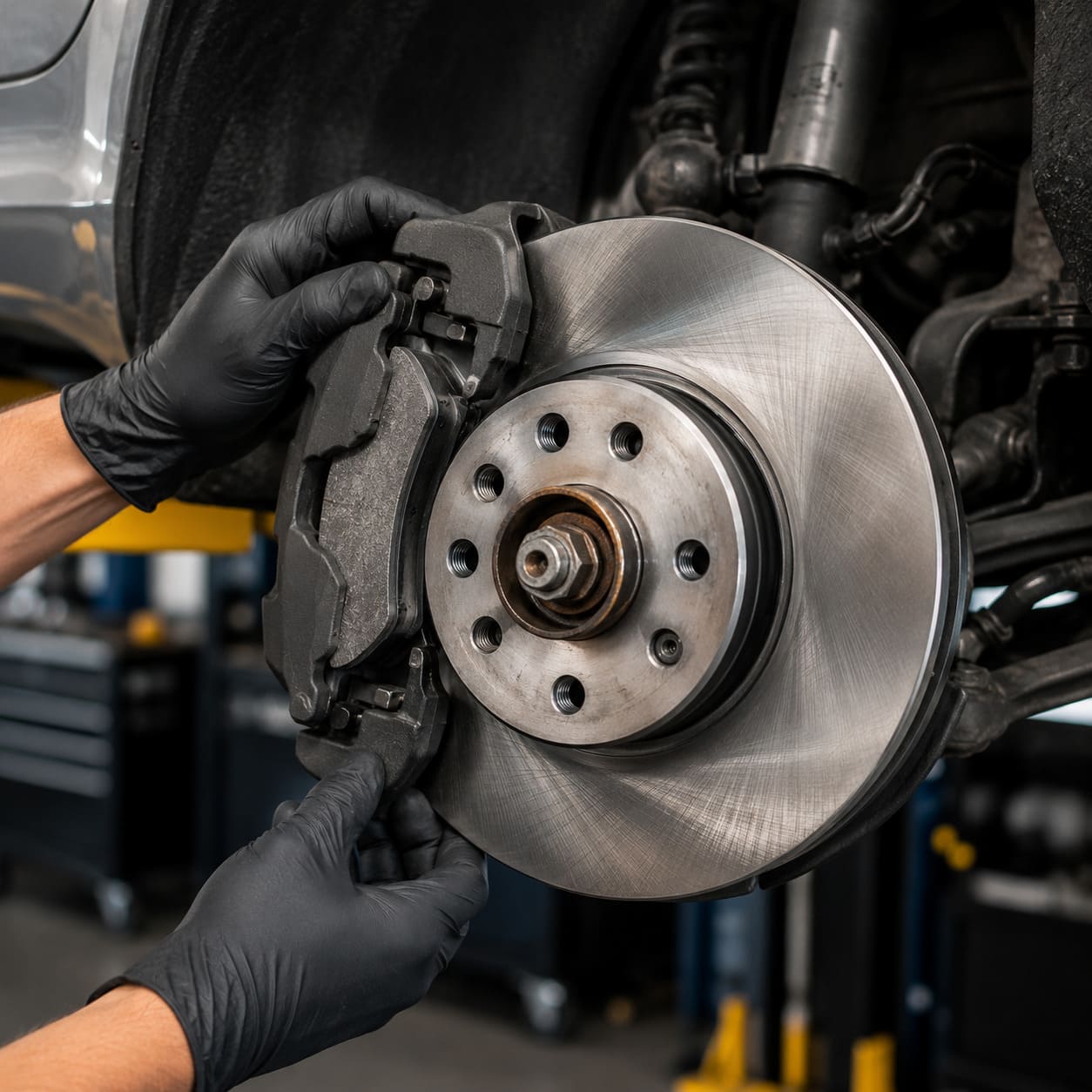
Front pads and rotors on a typical sedan cost about $350 to $650 per axle in the Boca Raton area, and pads alone run roughly $180 to $350. A fair quote lists pad and rotor measurements, the parts brand and grade, and labor per axle as separate lines. If you hear grinding or the pedal sinks toward the floor, stop driving and have the car towed or inspected right away.
Brakes are where the most money is made and lost on unnecessary work, because few drivers can judge for themselves whether rotors are really worn out. The fix is simple: ask for numbers. Pad thickness is measured in millimeters, and rotors have a minimum thickness stamped on the hat or edge. A shop that writes down 'front pads 3 mm, rotors 26.1 mm, minimum 26.0' is giving you the information you need to decide.
Most cars wear front brakes two to three times faster than rears, because weight shifts forward when you stop. Pads typically last 30,000 to 60,000 miles depending on driving, and rotors often last through one or two pad changes on vehicles where they can be resurfaced. Many newer cars use thin rotors that are cheaper to replace than to machine, so 'replace rotors' is not automatically an upsell.
Hybrids and electric cars can go much longer between pad changes because regenerative braking does most of the stopping. The catch is that their calipers and slide pins see little use and can seize from corrosion, which is a real concern in a humid coastal climate.
What the job includes
- A road test and visual inspection of all four corners, including pad thickness, rotor condition and any fluid leaks at the calipers and lines.
- Removing the old pads, cleaning and lubricating the caliper slide pins and pad contact points, and installing new hardware clips where supplied.
- Measuring rotors against their minimum thickness and either resurfacing or replacing them.
- Checking brake fluid level and, on request, testing its moisture content or boiling point.
- Bedding in the new pads with a series of controlled stops, so they transfer an even layer onto the rotors.
- Resetting the electronic parking brake service mode on cars that need a scan tool to retract the rear pistons.
- Writing pad and rotor measurements on the invoice, front and rear, so you know how much life is left.
What brake repair costs in Boca Raton
| Job | Typical cost | Notes |
|---|---|---|
| Front pads only, most sedans and small SUVs | $180-$350 | Per axle. Ceramic pads cost more than semi-metallic but dust less. |
| Front pads and rotors, most sedans | $350-$650 | Per axle. The most common brake job in the area. |
| Front pads and rotors, full-size truck or large SUV | $450-$850 | Larger, heavier rotors and pads. |
| Pads and rotors, German luxury car | $600-$1,100 | Per axle. Includes a wear sensor, which most of these cars need replaced with pads. |
| Rear pads with electronic parking brake | $250-$500 | Needs a scan tool to retract the pistons safely. |
| Brake caliper replacement, one side | $300-$900 | Remanufactured calipers are common and fine. The fluid must be bled afterward. |
| Brake fluid exchange | $100-$180 | Typical interval is every 2 to 3 years. Check your manual. |
| Brake inspection only | $0-$90 | Often free if you approve the repair at the same shop. |
Typical South Florida ranges for parts and labor, for budgeting only. Your quote depends on the vehicle and the shop.
Brake Repair shops near Boca Raton
- Tire Kingdom23193 Sandalfoot Plaza Drive, Boca Raton, FL, 33428
How to choose a shop
- Look for a technician with ASE A5 (Brakes) certification. The test covers hydraulics, ABS and electronic stability systems, which matter more every year. ASE certifications expire after five years, so check that the certificate on the wall is current.
- Ask what pads they plan to install and whether they are OE-equivalent. The cheapest economy pads often squeal, dust heavily and wear quickly. A good shop will offer two grades and explain the difference without pressure.
- Get the warranty in writing. Typical independent-shop warranties on brake work are 12 months or 12,000 miles on labor, with pads sometimes carrying a longer parts warranty. A 'lifetime pad' warranty usually covers the pads only, not the rotors or labor to replace them.
- Under Florida's Motor Vehicle Repair Act, for any job over $150 the shop has to offer a written estimate before starting, and it cannot exceed that estimate by more than $10 or 10 percent, capped at $50, without your approval. Leave a phone number where you can actually be reached.
Red flags and upsells to question
- A recommendation for new rotors with no measurement given. Ask for the actual thickness and the minimum spec.
- A 'brake special' price that turns into a much bigger bill once the wheels are off, without a call to you first. That is exactly what Florida's estimate rules prohibit.
- Calipers recommended on all four wheels at once when only one is sticking or leaking. Calipers are normally replaced in pairs per axle at most.
- A brake fluid flush sold on every visit. Ask for a moisture or boiling-point test result before you pay for it.
- Being told the ABS module has failed based only on a warning light, with no wheel-speed sensor or wiring test done first.
- No mention of the rear brakes. If the shop only looked at the fronts, you do not know the condition of half your braking system.
The Florida factor
Brake fluid absorbs water over time, and South Florida air sits at high humidity much of the year. Wet fluid has a lower boiling point, which shows up as a long or soft pedal after repeated hard stops on I-95 or coming down a parking garage ramp. The 2-to-3-year fluid interval in most manuals is not a suggestion here, and a simple test strip or electronic tester will show whether yours is due.
Salt air near A1A, the Intracoastal and the beach towns of Highland Beach and Deerfield Beach speeds up rust on rotor surfaces and caliper hardware. A car that sits for a week often makes a grinding noise for the first few stops while surface rust wipes off, which is normal. A car that sits for months, like many seasonal residents' cars, can develop rust pitting deep enough to cause vibration and seized slide pins.
Stop-and-go traffic on Glades Road, Yamato Road and Federal Highway is hard on pads and rotors, and so is summer heat soak. Pads chosen for daily highway commuting in a cooler state can glaze in this pattern of short hot stops, so tell the shop how you actually drive.
Frequently asked questions
Do I need to replace rotors every time I replace pads?
No. If the rotors are above minimum thickness, smooth and true, they can be reused or resurfaced. Many modern rotors are thin enough that replacing them costs about the same as machining, which is why shops often recommend it.
How long should a brake job take?
A single axle of pads and rotors usually takes one to two hours of shop time. Calipers, a fluid exchange or an electronic parking brake add time.
Why do my new brakes squeak?
Common causes are low-grade pads, missing anti-squeal shims, or pads that were not bedded in. A short squeal in the morning from dew or surface rust is normal. A constant squeal under braking should be looked at under the warranty.
Can I drive with the brake warning light on?
If it is the red brake light and the parking brake is fully released, the fluid may be low or there could be a hydraulic fault. Check the fluid level and do not drive far until it is inspected.
Can I get my old brake parts back?
Yes. Florida law lets you ask, when you authorize the repair, to inspect or have returned the parts removed from your car, unless they go back to a supplier under a warranty or core exchange.
Guides related to brake repair
- RepairPal: Brake pad replacement cost
- RepairPal: Brake rotor replacement cost
- RepairPal: Brake caliper replacement cost
- Florida Statutes 559.909: Charges in excess of repair estimate
General information, not a diagnosis. A car problem can have causes a guide cannot see, so have anything safety-related inspected in person. Read our editorial policy.