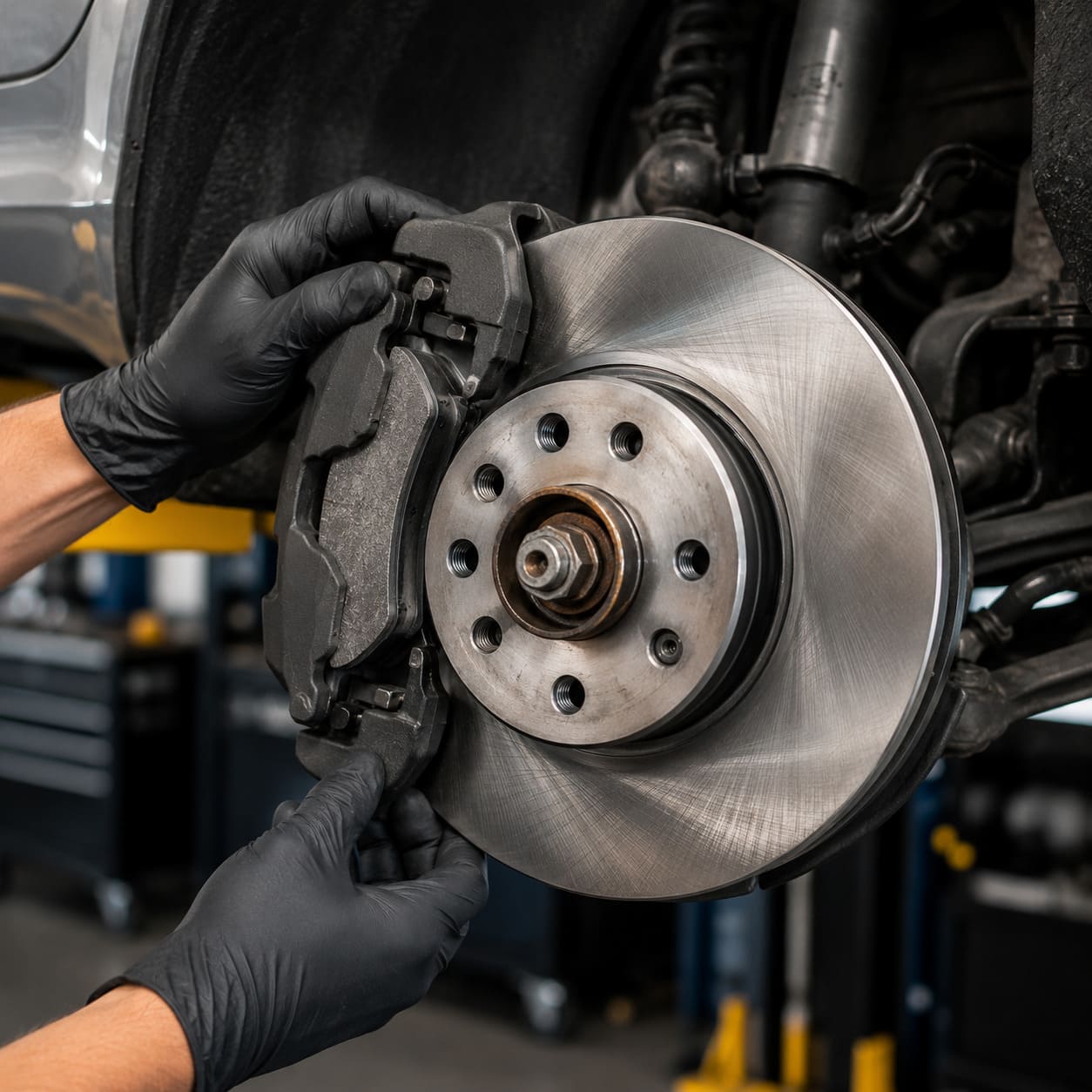
Most brake squeaks come from one of two things: a thin film of surface rust that wipes off after a few stops, or the small steel wear tab on a pad telling you the pads are close to done. If the squeak disappears within the first mile, it is usually moisture. If it happens on most stops, gets louder, or you hear it while rolling with your foot off the pedal, have the pads measured within the next few weeks.
Brake noise is a vibration problem. A pad pressed against a spinning rotor can resonate like a bow on a violin string, and anything that changes how the pad sits, its surface, or what is trapped between the parts can push it into that audible range. That is why the same car can be silent one day and squeal the next.
The good news is that the cause can usually be narrowed down by when the noise happens. Timing matters more than volume: morning-only, every-stop, light-pedal-only and constant squeals each point somewhere different. The checks below take about ten minutes and need no tools beyond a flashlight.
If what you hear is a deep growl or metal scraping rather than a squeal, read the grinding guide instead. That is a different and more urgent problem.
Symptoms
- High-pitched squeal on the first few stops of the morning that fades once the brakes warm up
- A chirp or squeal that repeats once per wheel turn, even with your foot off the brake
- Squeal that only shows up under light pedal pressure and goes quiet when you press harder
- Squeaking that started right after new pads were installed
- Squeal from one corner only, often with more brake dust on that wheel
Likely causes and what they cost
1. Pad wear indicator touching the rotor
$180-$320 per axle for pads at an independent shop; $300-$480 at a dealerMany pads carry a small spring-steel tab set to touch the rotor when roughly 2-3 mm of friction material is left. It makes a sharp, steady squeal that often continues when you are not braking and may quiet down when you press the pedal. It is a deliberate warning, not a defect.
The fix: Replace the pads on that axle. A good job also cleans and lubricates the caliper slide pins, replaces the abutment clips, and measures the rotors to decide whether they can be reused.
2. Overnight surface rust or moisture
free; $150-$300 per axle if rotors need resurfacingBare cast-iron rotors grow a light orange film within hours in humid air. The first few pad contacts scrape it off and squeal while doing it. Once the rotor face is shiny again, the noise stops.
The fix: Nothing, if the noise fades within a mile or two. Parking in a garage reduces it. If the rust has had weeks to build up, a shop may need to resurface or replace the rotors.
3. Missing, worn or dry shims and hardware
$90-$180 per axle as a separate service; often included in a pad jobThin shims on the back of the pads and clips in the caliper bracket damp vibration. When they rust, get left out during a cheap pad swap, or lose their lubricant, the pad can buzz against the bracket and squeal.
The fix: Pull the pads, clean the bracket, install new clips and shims, and apply brake-specific lubricant only to the contact points (never to the friction face).
4. Glazed pads or rotors
$300-$550 per axle with rotors on most mainstream carsRepeated hard stops or riding the brakes can overheat the pad surface until it hardens into a smooth, shiny layer. A glazed pad grips less and tends to squeal, especially at low speed.
The fix: Replace the pads and resurface or replace the rotors, then bed the new pads in with a series of moderate stops.
5. Hard pad compound or wrong pad for the car
$180-$350 per axleSemi-metallic and some performance pads are naturally noisier than ceramic pads. Bargain pads may also lack the chamfers and slots the factory part has, which are there partly to suppress noise.
The fix: Swap to a quality ceramic pad or an OE-equivalent pad specified for the car, with new hardware.
6. Sticking caliper slide pin
$100-$200 to service pins; $300-$650 per side if a caliper is neededIf a slide pin seizes, the caliper cannot center itself and one pad drags lightly on the rotor all the time. That can squeal on its own and wears the inner and outer pads at different rates.
The fix: Remove, clean and re-grease the pins and replace the boots, or replace the caliper bracket or caliper if a pin is corroded in place.
Costs are typical South Florida ranges for parts and labor, for budgeting only.
What you can check yourself
- 1Note exactly when it squeals
For two days, pay attention. First stops only, every stop, only light braking, or while rolling with no brake? Write it down. A shop can diagnose faster with this than with a vague 'it makes a noise'.
- 2Look at the pads through the wheel
With the car parked, the engine off and the wheels turned, shine a flashlight through the wheel spokes at the caliper. The outer pad's friction material should be thicker than about 4 mm, roughly the thickness of two stacked nickels. Close to the steel backing plate means replacement is due. Do not touch the rotor right after a drive, it can be hot enough to burn.
- 3Compare brake dust wheel to wheel
One wheel much dirtier than the others suggests a dragging pad or sticking slide pin on that corner, not a simple worn-pad squeal.
- 4Check for a dash message
Many European cars and some others have an electronic pad sensor. A brake pad warning on the dash plus a squeal makes the diagnosis almost certain.
- 5Try a gentle drying run
On an empty road, make five or six moderate stops from about 30 mph. If the squeal was moisture or light rust, it should fade. If it stays the same, it is mechanical.
When to take it to a shop
- The squeal happens on most stops for more than a week
- The noise is present with your foot off the pedal
- Pad material looks thinner than about 4 mm, or you cannot see it at all
- The squeal turns into grinding, scraping, or a pulsing pedal
- New pads were installed recently and they squeal on every stop; the shop that did the job should check its own work
The Florida factor
In Boca Raton the morning squeal is almost a fact of life. Overnight humidity often sits above 80 percent from May through October, and a car parked outside under a ficus or in an open lot will have an orange haze on its rotors by sunrise. That squeal on the way out of the driveway is usually harmless if it is gone by the time you reach Glades Road.
Beach trips add a second cause. Sand and fine shell grit from lots near Red Reef, Spanish River and Deerfield Beach Pier get kicked into the calipers and can lodge between pad and rotor, giving a scratchy squeal on every stop until it works its way out. A rinse of the wheels and wheel wells after a beach day helps, and it also washes off the salt that rusts the pad clips.
Afternoon storms can flood the brakes with water and grit in minutes. If the brakes squeal for the rest of the day after you drive through standing water on Federal Highway, give them a few firm, safe stops to dry and scrub the surfaces before you assume a part has failed.
Notes for specific makes
- BMW: BMW uses an electronic pad wear sensor on at least one front and one rear wheel. When it trips, a yellow brake symbol appears. The sensor is designed to be replaced with the pads, so budget roughly $25-$60 extra per axle for it and ask the shop to reset the service indicator.
- Mercedes-Benz: Mercedes factory pads are tuned for grip over quiet and produce a lot of dark dust. Many owners switch to low-dust ceramic pads, which are quieter, but stopping feel can change slightly. The pad wear sensor should be replaced along with the pads.
- Tesla: Regenerative braking does most of the slowing, so the pads and rotors on a Tesla see little use and rust more readily. A squeal or grinding from rarely used brakes is common. Tesla's manual suggests applying the brake pedal firmly from time to time to keep the surfaces clean.
- Honda: Many Hondas use a mechanical squealer tab on the inner pad, which you will not see through the wheel. If a Honda squeals and the outer pad looks fine, the inner pad may be the thin one.
Brake Repair shops near Boca Raton
- Tire Kingdom23193 Sandalfoot Plaza Drive, Boca Raton, FL, 33428
Frequently asked questions
Is it safe to drive with squeaky brakes?
Usually yes, for a short time. A squeal is a warning, not a failure. Get the pads measured within a few weeks. If the pedal feels soft, the car pulls, or the noise turns into grinding, stop driving it and have it inspected.
Why do my brand-new brakes squeak?
New pads often need 100-200 miles of normal driving to bed in. Persistent squeal after that usually means missing hardware, no lubricant on the contact points, a hard pad compound, or rotors that were reused without being resurfaced. Ask the installing shop to look at it.
Can I spray something on the brakes to stop the squeal?
Do not spray lubricant, WD-40 or anything oily near the pads or rotors. Contaminated pads lose grip and have to be replaced. Brake cleaner can remove dust, but it does not fix worn pads or missing shims.
Do I need new rotors when I replace squeaky pads?
Not always. If the rotors are above the minimum thickness stamped on them and are smooth, they can often be reused or resurfaced. Ask the shop to show you the measurement rather than just telling you they are bad.
Related guides
More on this job: Brake Repair in Boca Raton, costs and how to choose a shop
- Mazda USA: Why are my brakes squeaking?
- AAA Club Alliance: The most common reasons for squeaky brakes
- RepairPal: Brake pad replacement cost
General information, not a diagnosis. A car problem can have causes a guide cannot see, so have anything safety-related inspected in person. Read our editorial policy.