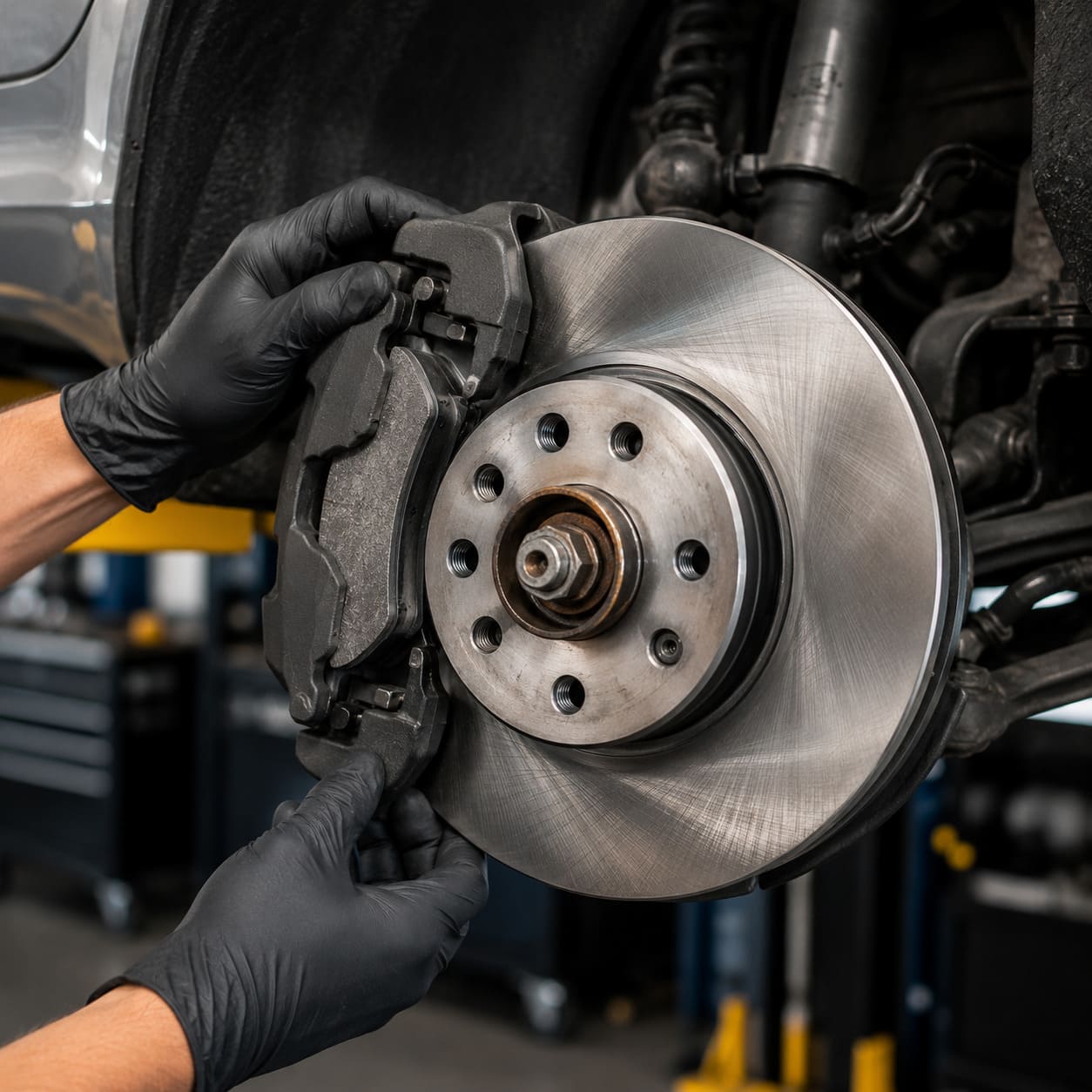
Grinding while braking most often means a pad has worn through its friction material and its steel backing plate is now cutting into the rotor. That is a safety problem and it gets more expensive with every mile, so book a brake inspection within a day or two and drive gently until then. Less often the cause is a small stone trapped behind the rotor shield, or heavy rust on a car that has been parked for weeks.
A squeal is a warning, grinding is usually the consequence of ignoring it. Brake pads are a layer of friction compound bonded or riveted to a steel plate. Once the compound is gone, steel rubs on cast iron. The rotor gets scored, the pad stops less effectively, and heat builds where it should not.
Grinding is not always worn pads, though. A pebble caught between the rotor and the thin metal dust shield behind it can make a terrible noise on a perfectly healthy brake. So can a thick crust of rust on a car that has sat. The difference matters, because one costs nothing and the other can cost several hundred dollars per axle.
The quickest way to tell is to listen to when it happens and to look at the rotor surface. The checks below cover both.
Symptoms
- A low, harsh grinding or growling every time you press the brake pedal
- A scraping metal sound that continues at low speed even without braking
- Fine grooves or a shiny ridge visible on the rotor face through the wheel
- Longer stopping distances or a pedal that needs more pressure than usual
- Grinding that appeared after the car sat unused for several weeks
Likely causes and what they cost
1. Pads worn down to the backing plate
$350-$650 per axle with rotors on mainstream cars; $600-$1,100 on many European modelsWith the friction material gone, the steel backing plate scrapes the rotor. The sound is a coarse, rhythmic grind on every stop, often from one axle, and it usually followed weeks of squealing. The rotor ends up with deep grooves or a raised lip.
The fix: New pads and new rotors on that axle in nearly every case, because a scored rotor is usually below its minimum thickness once it has been cut smooth again. Calipers are inspected for heat damage and a torn piston boot.
2. Stone or debris between rotor and dust shield
$50-$120 for inspection and removal; often free with a brake checkA small rock thrown up from gravel or construction debris can wedge between the rotor and the backing shield. It grinds or scrapes constantly, often changing pitch when you turn, and it may stop as suddenly as it started.
The fix: Remove the wheel and dislodge the debris, and bend the shield back if it was pushed into the rotor. The rotor face is checked for a scratch groove.
3. Heavy rust from a car that sat
free if it clears; $300-$550 per axle if rotors and pads are neededAfter weeks parked, rust forms a thick crust on the rotor, and the pad can bond to it. The first drives produce a coarse grind that may fade, or may leave a rough band where the pad was sitting. A rust lip builds up on the outer edge of the rotor.
The fix: If the grind fades after a few miles and the pedal feels normal, nothing more. If a rough, pitted band remains, resurface or replace the rotors and usually the pads.
4. Rust jacking on pad backing plates
$180-$350 per axle for pads and hardwareCorrosion can grow between the friction compound and the steel plate, pushing the compound off. A delaminated pad may still look thick from outside but grind or chatter because part of it has broken away.
The fix: Replace the pads, clean the caliper bracket, and use pads with a coated or galvanized backing plate.
5. Seized caliper keeping a pad clamped
$550-$1,000 per axle including caliper, pads and rotorsA stuck piston or slide pin can hold one pad against the rotor constantly. It wears that pad to metal much faster than the others, so you can have grinding on one wheel while the opposite side still has plenty of pad.
The fix: Replace or rebuild the caliper, plus pads and rotors on that axle, then bleed the brakes.
6. Worn wheel bearing or rear drum shoes
$300-$600 for a bearing; $250-$450 for rear shoes and drumsA failing wheel bearing makes a growl that increases with speed rather than with braking. On cars with rear drum brakes, shoes worn to the rivets grind from the rear only.
The fix: Replace the hub bearing, or the drum shoes and drums.
Costs are typical South Florida ranges for parts and labor, for budgeting only.
What you can check yourself
- 1Find out whether it grinds with the brake off
In an empty lot, roll at walking pace with the windows down and no pedal, then brake gently. Grinding only when braking points to pads or rust. Grinding all the time, changing with steering, points to debris or a bearing.
- 2Look at the rotor face
Engine off, parking brake on, wheels straight. With a flashlight, look at the visible part of the rotor. Deep circular grooves, a bright scored band, or blue heat marks suggest metal-on-metal contact. Let the brakes cool for at least 30 minutes after driving before going near them.
- 3Check outer pad thickness
Through the spokes, see whether you can make out a layer of friction material on the outer pad. If you see only the steel plate or less than 2 mm, the pad is finished.
- 4Feel for a rust lip
With the car cool, run a fingertip across the outer edge of the rotor. A tall ridge means the rotor has worn a lot, or rust has been building on a car that does not get driven much.
- 5Check the brake fluid level
Open the hood and look at the brake fluid reservoir. As pads wear, the level drops. A level well below MIN alongside grinding means very worn pads or a leak. Do not top up and keep driving; get it inspected. Brake fluid strips paint, so wipe spills right away.
When to take it to a shop
- Grinding on every stop, from any wheel
- Pedal that sinks further, feels spongy, or needs more force than usual
- Visible scoring or a pad you cannot see any friction material on
- Grinding from one wheel only, which suggests a caliper problem
- Any brake warning light on the dash along with the noise
The Florida factor
Seasonal residents see this one every November. A car parked for six months in a Boca or Highland Beach garage, or worse in an open carport, often grinds for the first several miles back. Usually the noise fades as the rust scrubs off, but a rotor that sat with a pad clamped to it can keep a rough band that pulses or grinds for good. If you leave for the summer, ask someone to drive the car 10-15 miles every few weeks, and expect a rotor check on return.
Salt air east of Federal Highway and along A1A speeds up the rust that delaminates pads from their backing plates. Cheaper pads with plain steel backs are the most prone. Paying a little more for coated backing plates and stainless clips makes sense if you live or park near the water.
Constant road and utility work on I-95, Glades Road and Military Trail throws gravel and shell rock into the road. A stone wedged behind the dust shield is a common and cheap cause of grinding here, so rule it out before you approve new rotors.
Notes for specific makes
- Volkswagen: Most recent VW models have an electronic parking brake on the rear calipers. Rear pads cannot be pushed back by hand; the shop needs a scan tool to put the brake in service mode. If you are doing it yourself and skip that step, you can damage the caliper motor.
- Audi: Audi uses electronic parking brakes and pad wear sensors, and rotors are generally replaced rather than resurfaced at pad time. A grinding Audi almost always needs pads, rotors and a sensor on that axle.
- Honda: Recent Accord, CR-V and Civic models with an electronic parking brake also need the rear calipers retracted with a scan tool or the car's maintenance mode. The rear pads on these cars sometimes wear faster than owners expect, so have all four corners checked when one grinds.
- Porsche: Porsche steel rotors are expensive and sensors are mandatory replacement items. Cars with the ceramic composite brake option, identifiable by yellow calipers on most models, should never be allowed to grind; replacement parts for those systems cost many thousands of dollars.
Brake Repair shops near Boca Raton
- Tire Kingdom23193 Sandalfoot Plaza Drive, Boca Raton, FL, 33428
Frequently asked questions
How long can I drive with grinding brakes?
As little as possible. Once metal touches metal, each stop scores the rotor further and braking power drops. Drive only to get it fixed, gently and at lower speeds, or have it towed if the pedal also feels wrong.
Can a shop just resurface my rotors?
Only if, after machining away the grooves, the rotor is still above the minimum thickness stamped on it. After true metal-on-metal grinding, that is often not the case. Ask for the measurement.
My brakes ground for a few stops after a rainy night, then stopped. Is that a problem?
Probably not. Wet rust and grit can grind briefly. If the noise is gone after a few stops and the pedal feels normal, it was the surface clearing itself.
Why does it grind only when I turn?
A stone behind the dust shield or a shield bent into the rotor will often change sound when the steering is turned. A wheel bearing can do it too. Either should be looked at, but both are usually less urgent than worn pads.
Related guides
More on this job: Brake Repair in Boca Raton, costs and how to choose a shop
- RepairPal: Brake pad replacement cost and related repairs
- Kelley Blue Book: Brake repair
- Mazda USA: Why are my brakes squeaking?
General information, not a diagnosis. A car problem can have causes a guide cannot see, so have anything safety-related inspected in person. Read our editorial policy.