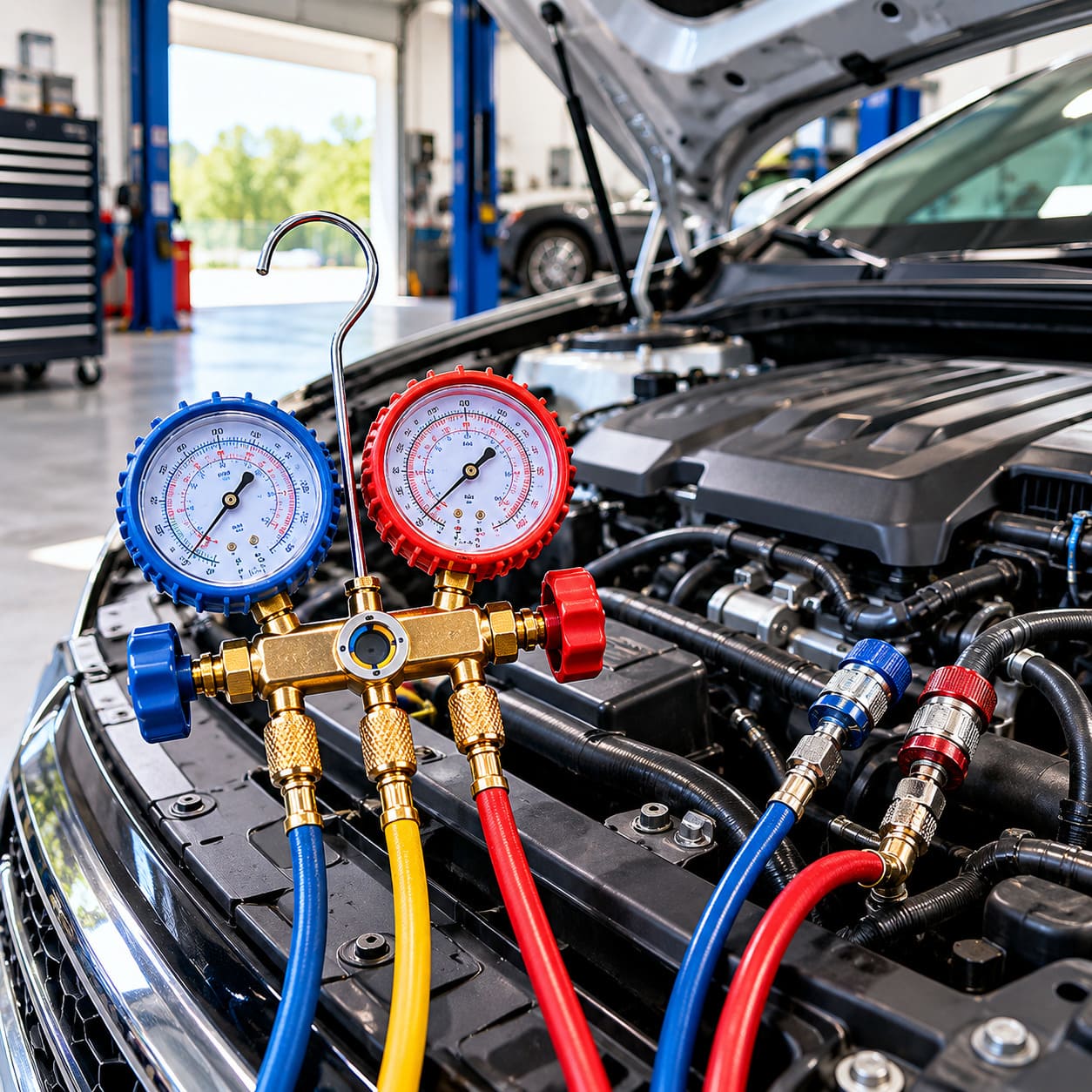
Most car A/C repairs in Boca Raton start with a leak test and pressure check that runs $90-$200, and the fix after that ranges from a $150 recharge to a $2,500 compressor job. Pay for a real diagnosis with a leak search before any recharge, and use a shop whose techs hold EPA Section 609 certification, which federal law requires for paid A/C work.
An automotive A/C system is a sealed loop. A compressor squeezes refrigerant, the condenser in front of the radiator sheds heat, an expansion valve or orifice tube drops the pressure, and the evaporator behind the dash gets cold. If the car is low on refrigerant, it leaked out somewhere. Refrigerant does not get used up like fuel.
That one fact drives most of the money on this page. A shop that only adds refrigerant is selling a few weeks or months of cold air. A shop that finds the leak, fixes it, then evacuates and recharges the system to the exact weight on the under-hood label is selling a repair.
The refrigerant your car uses matters too. Most cars built before about 2015 run on R-134a. Most newer cars use R-1234yf, which costs several times more per pound and needs its own service machine, so the same recharge can cost twice as much on a 2020 car as on a 2012 one.
What the job includes
- A performance test: vent temperature measured with a thermometer, high-side and low-side pressures read on gauges or a service machine, with the engine at idle and at about 1,500 rpm.
- A visual check of the compressor clutch, belt, condenser fins, cooling fans, hoses and fittings for oily residue, which marks a leak.
- A leak search with UV dye, an electronic sniffer, or a nitrogen pressure or vacuum-decay test. Dye needs a follow-up visit after you drive a few days.
- Refrigerant recovery, a vacuum pulled for at least 20-30 minutes to boil off moisture, then a recharge measured by weight to the factory spec, with the correct oil.
- An electrical check when the compressor will not engage: fuses, relay, pressure switch and clutch coil, before anyone condemns the compressor.
- A cabin air filter inspection, since a clogged filter can mimic weak A/C by choking airflow.
- A written estimate before work starts on anything over $150, as Florida law requires, plus the old parts back if you ask for them.
What a/c & heating costs in Boca Raton
| Job | Typical cost | Notes |
|---|---|---|
| A/C performance check and diagnosis | $90-$200 | Often credited toward the repair if you approve it at the same shop. |
| Evacuate and recharge, R-134a (older cars) | $150-$300 | Only worth it after the leak is fixed or confirmed to be very slow. |
| Evacuate and recharge, R-1234yf (most 2015 and newer) | $250-$600 | Refrigerant price drives the spread. Ask for the per-pound charge. |
| UV dye leak test | $100-$200 | May need a second short visit to read the dye. |
| O-ring, Schrader valve or service port seal | $150-$350 | Cheap parts, but includes the recharge afterward. |
| Condenser replacement | $550-$1,300 | Common after road debris or corrosion. Includes recharge. |
| Compressor replacement | $1,100-$2,800 | Should include a receiver-drier or accumulator and an orifice tube or expansion valve, plus a system flush. |
| Compressor clutch or clutch coil only | $350-$800 | Possible on some cars when the compressor itself is healthy. |
| Blend door actuator | $200-$650 | Cold on one side, warm on the other, or clicking behind the dash. |
| Evaporator replacement | $1,200-$3,000 | Mostly labor, since the dashboard usually comes out. |
Typical South Florida ranges for parts and labor, for budgeting only. Your quote depends on the vehicle and the shop.
A/C & Heating shops near Boca Raton
We are still adding shops for this service. Browse the directory or use the quote form.
See all shops for this serviceHow to choose a shop
- Ask whether the techs who will touch your car hold EPA Section 609 certification. Federal rules require it for anyone paid to service a vehicle A/C system, and a shop that does A/C every day will answer without hesitation. ASE A7 (Heating and Air Conditioning) certification is a good second sign of a tech who studies the system.
- Ask which refrigerant your car takes and whether the shop has a machine for it. R-1234yf needs dedicated equipment. A shop without one may try to talk you into a conversion or a top-off with the wrong gas, and either can cause trouble later.
- Ask how they find leaks. A good answer names a method: dye, an electronic detector, or a nitrogen pressure test. A vague answer like 'we'll top it off and see' means you are paying for a guess.
- Look for a written warranty that states its length and what it covers. Many independent shops give 12 months or 12,000 miles on parts and labor for A/C work, and some give longer on compressors. A warranty on the recharge alone, without a leak repair, is rarely offered and rarely worth much.
- Confirm the shop is registered with the Florida Department of Agriculture and Consumer Services. Under the Florida Motor Vehicle Repair Act (Florida Statutes Chapter 559, Part IX), it must give you a written estimate for work over $150, call you before going more than 10 percent or $10 over it (capped at $50), and let you inspect or keep the replaced parts.
Red flags and upsells to question
- A recharge sold as the fix with no leak test, especially if this is the second recharge in a year.
- 'Your compressor is shot' before anyone has checked the fuse, relay, pressure switch and clutch gap.
- A compressor replacement quote with no mention of the receiver-drier or accumulator, the expansion valve or orifice tube, and a flush. Skipping them can void the compressor warranty and kill the new one.
- A sealer or 'stop leak' injection added without your consent. Many shops refuse cars with sealer in them because it can clog their recovery machines and your system.
- A pitch to convert an R-1234yf car to R-134a to save money. It is not a legitimate repair and can affect warranty and resale.
- A cabin 'A/C deodorizer' or 'evaporator foam cleaning' bundled in before you mentioned any smell.
- Charges on the invoice that run past the estimate with no call to you first, which Florida law does not allow.
The Florida factor
In Boca Raton the A/C runs from January to December, so compressors and seals here wear on a calendar that would be generous anywhere else. A system that loses a little refrigerant each year can feel acceptable in February and fail outright in the first week of June, when the morning commute on Glades Road or I-95 means 20 minutes of idling in 92 degree air. That is why late spring is the busy season, and booking an A/C check in March or April usually gets you a quicker appointment and a calmer quote.
Humidity is the other half of the load. The evaporator pulls water out of the air all day, and the drain under it can clog with debris and mold, putting water on the passenger floor. Condensers behind the grille collect lovebugs in May and September and pick up corrosion from salt air east of Federal Highway, which is why condensers on cars garaged near the Intracoastal tend to fail sooner. A gentle hose rinse of the grille area every few weeks helps.
Snowbird cars that sit from April to November come back with dried-out seals, because refrigerant carries the oil that keeps those seals soft. Running the A/C for 10 minutes every couple of weeks, or asking whoever watches the car to do it, prevents a lot of slow leaks.
Frequently asked questions
Can I recharge my car A/C myself with a can from the parts store?
You can on many R-134a cars, and the cans are sold for that. The risk is overcharging, which raises pressures and can hurt the compressor, and ignoring the leak that caused the problem. Cans with sealer can make a later professional repair harder. On R-1234yf cars, DIY options are limited and expensive, so a shop recharge is usually the better value.
How long should an A/C repair take?
A diagnosis and recharge takes one to two hours. A condenser or compressor job is usually a half to full day. An evaporator can take one to two days because the dash comes apart. Parts for European cars may add a day or two if not in stock locally.
Why does my A/C work on the highway but not in traffic?
That pattern usually points to airflow across the condenser, often a weak or dead cooling fan, or a condenser blocked with bugs and debris. At highway speed, air is forced through it anyway. A shop can check fan operation quickly, and it is often a cheaper fix than a compressor.
Does insurance or my warranty cover A/C repair?
Collision or comprehensive insurance covers A/C damage only if it came from a covered event, like a condenser punctured in a crash. Normal wear is not covered. A factory or powertrain warranty may cover the compressor depending on the terms, so check before paying out of pocket on a newer car.
What should a fair A/C quote include?
The diagnosis fee, each part with its price, labor hours or a flat rate, the refrigerant type and amount, shop supplies, tax, and the warranty terms. For a compressor, the quote should also list the drier or accumulator, expansion valve or orifice tube, and flush.
Guides related to a/c & heating
- EPA: Motor vehicle air conditioning and Section 609 certification
- RepairPal: AC recharge cost estimate
- Florida Statutes 559.905: Written repair estimate required
- Florida Statutes 559.909: Charges over the estimate and inspection of parts
General information, not a diagnosis. A car problem can have causes a guide cannot see, so have anything safety-related inspected in person. Read our editorial policy.