In Palm Beach County, a professional A/C evacuate-and-recharge typically runs $150 to $300 on an older car that uses R-134a and $250 to $600 on a newer car that uses R-1234yf, because the newer refrigerant costs several times more per pound. Check the label under your hood to see which you have. If the system was low, budget for finding and fixing the leak too, or the recharge will not last.
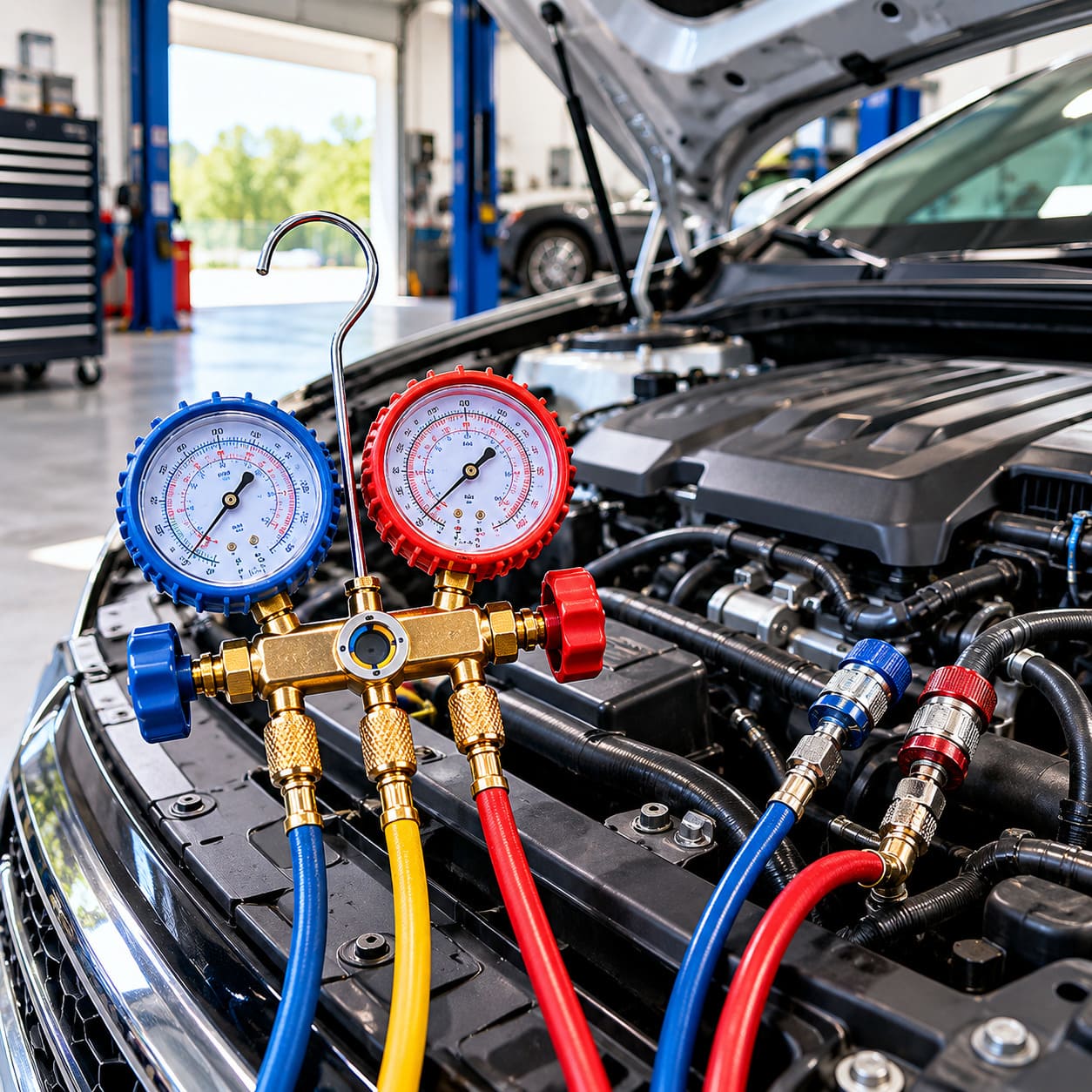
A recharge sounds like an oil top-off, but done properly it is a different process. A shop connects a recovery machine, pulls out whatever refrigerant is left and weighs it, holds the system under deep vacuum to boil off moisture and confirm it is not leaking badly, then refills it with the exact weight of refrigerant and oil printed on the label under your hood. That weight on most cars is only between one and two pounds, so being a few ounces off matters.
The two numbers that drive the price are the refrigerant your car uses and whether the shop includes a leak test. This guide breaks down both, so you can read a quote and tell whether it is fair.
Symptoms
- A/C has been getting gradually weaker over weeks or months
- Cooling is acceptable on the highway but poor in traffic
- Compressor clicks on and off every few seconds
- A shop told you the system is low on refrigerant
- You bought a used car and the A/C feels weak
Likely causes and what they cost
1. R-134a recharge, older vehicles
$150-$300Most cars and trucks built from the mid-1990s until roughly the late 2010s use R-134a. It is still widely available and relatively cheap per pound, so the bill is mostly labor and machine time. Many shops quote it as a flat A/C service.
The fix: Evacuate, vacuum test, recharge to spec, add UV dye on request, and check vent temperature.
2. R-1234yf recharge, newer vehicles
$250-$600, depending on system capacityCarmakers phased in R-1234yf through the late 2010s, and under EPA rules R-134a can no longer be used in new light-duty vehicles starting with the 2025 model year. R-1234yf has a far lower global warming impact, a GWP of 4 versus 1,430, but costs several times more per pound, and shops need separate, more expensive machines to handle it. Those costs show up on the invoice.
The fix: Same evacuate, vacuum and recharge process using an R-1234yf certified machine. Some shops also run a refrigerant identifier first to check for contamination.
3. Leak detection added to the recharge
$75-$200 on top of the rechargeIf the system was low, refrigerant escaped somewhere. A dye test means you drive for a few days and return so the technician can find the dye under UV light. An electronic sniffer or nitrogen pressure test can find leaks the same day.
The fix: UV dye added with the charge, or a standalone pressure and sniffer test.
4. Leak repair after the test
$100-$250 for seals and valves, $600-$2,000 for major componentsCommon leak points are O-rings at line fittings, Schrader service valves, the condenser and the compressor shaft seal. Fitting and valve leaks are cheap. Condensers, evaporators and compressors are not.
The fix: Replace the leaking seal or component, then evacuate and recharge again.
5. DIY recharge can from a parts store
$40-$80 for R-134a, considerably more for R-1234yf cansCans of R-134a with a gauge cost far less than a shop visit. They can restore cooling on a slightly low older system, but they add refrigerant without removing moisture or measuring how much is already in there, and the gauge reads only low-side pressure. Overfilling is common, and cans with sealer can clog parts and contaminate shop equipment.
The fix: Add refrigerant through the low-side port with the engine running and A/C on max, following the can's instructions.
Costs are typical South Florida ranges for parts and labor, for budgeting only.
What you can check yourself
- 1Find your refrigerant label
Open the hood and look on the underside of the hood, the radiator support or a strut tower for a sticker listing the refrigerant type, usually R-134a or HFO-1234yf, and the charge weight in kilograms or ounces. That label decides which price tier you are in.
- 2Look at the service port caps
On R-134a systems the caps often say L and H. R-1234yf systems use different-size quick-connect fittings, and refrigerant cans use a left-hand thread, so the two are not meant to be mixed. Do not open the ports unless you know what you are doing, the high side is under serious pressure.
- 3Check that the compressor runs
Idle the car in park with the A/C on max. If the compressor clutch never engages, the system may be nearly empty, or the problem may be electrical. A recharge will not fix a blown fuse or a dead clutch.
- 4Measure vent temperature
Stick a cheap kitchen thermometer in a center vent after five minutes on max with recirculate on. On a typical South Florida afternoon, a healthy system often reads in the 40s. Readings in the 60s or higher mean something is wrong, but not necessarily low charge.
- 5Ask what the quote includes
A fair quote states the refrigerant type, whether it is charged by weight, whether a vacuum hold or leak test is included, and whether dye is added. Ask to see the recovered amount. If they recovered close to the full charge, the system was not low.
When to take it to a shop
- Your car uses R-1234yf, which is mildly flammable and needs dedicated equipment
- You topped it off with a can and it went warm again within a few weeks
- The compressor does not engage at all
- The system has been opened for another repair, such as a radiator or condenser
- You want it done right the first time, since only a recovery machine can measure and charge by weight
The Florida factor
Pricing in South Florida runs above the national average for two reasons. Labor rates at Palm Beach County shops are higher than in much of the country, commonly well above $130 an hour at independents and more at dealers. And demand peaks from May through September, when shops along Federal Highway and Congress Avenue are booked with A/C work and less inclined to discount. If you can, get a weak A/C checked in March or April, when it is still tolerable and bays are open.
Because cars here run the A/C nearly every day of the year, a slow leak shows up as a performance problem quickly. A system that loses a few ounces a year might go unnoticed up north for a decade, but here it becomes uncomfortable within a summer or two. That makes the leak test more worthwhile in Florida than almost anywhere. Hurricane debris and flood water also damage condensers, so any A/C that dies right after a storm deserves a look at the front of the car before a recharge.
Notes for specific makes
- Tesla: Teslas use R-1234yf, and Model Y and newer Model 3 cars route it through a heat pump that also manages battery temperature, so A/C service is not a simple top-off. Expect it to be handled by Tesla service or a shop equipped for that system.
- Toyota: Toyota and Lexus hybrids use an electrically driven A/C compressor that needs a special non-conductive oil. Adding the wrong oil, which some DIY cans contain, can damage the compressor and its electrical insulation, so tell the shop it is a hybrid.
A/C & Heating shops near Boca Raton
We are still adding shops for this service. Browse the directory or use the quote form.
See all shops for this serviceFrequently asked questions
How do I know if my car takes R-134a or R-1234yf?
Check the A/C label under the hood. As a rough guide, most vehicles built before about 2015 use R-134a, many built from 2017 onward use R-1234yf, and the years in between depend on the model. Every new light-duty vehicle from model year 2025 must use a low-GWP refrigerant such as R-1234yf.
Can I put R-134a in a car designed for R-1234yf?
No. The fittings are different on purpose, the systems are engineered around each refrigerant's properties, and mixing them contaminates the system and shop equipment. Converting a yf car to 134a is not an approved practice.
How often does a car need an A/C recharge?
In theory, never. The system is sealed. If yours needs refrigerant every year or two, it has a leak, and fixing the leak is usually cheaper over time than paying for repeated recharges.
Does a shop need special certification to recharge A/C?
Yes. Under the Clean Air Act, anyone servicing vehicle A/C for pay must be certified through an EPA-approved Section 609 program and use approved recovery equipment. Venting refrigerant into the air is prohibited.
Why did my recharge quote double from last time?
If you moved to a newer car, it probably uses R-1234yf. Refrigerant prices have also risen as HFC production is phased down under federal rules, and that affects R-134a pricing as well.
Related guides
More on this job: A/C & Heating in Boca Raton, costs and how to choose a shop
- EPA: Acceptable refrigerants and their impacts for motor vehicle A/C
- EPA: Unique fittings and label colors for MVAC refrigerants
- EPA: Motor vehicle air conditioning, Section 609 certification
- RepairPal: AC recharge cost estimate
- AAA: Average mechanic labor rates by state
General information, not a diagnosis. A car problem can have causes a guide cannot see, so have anything safety-related inspected in person. Read our editorial policy.