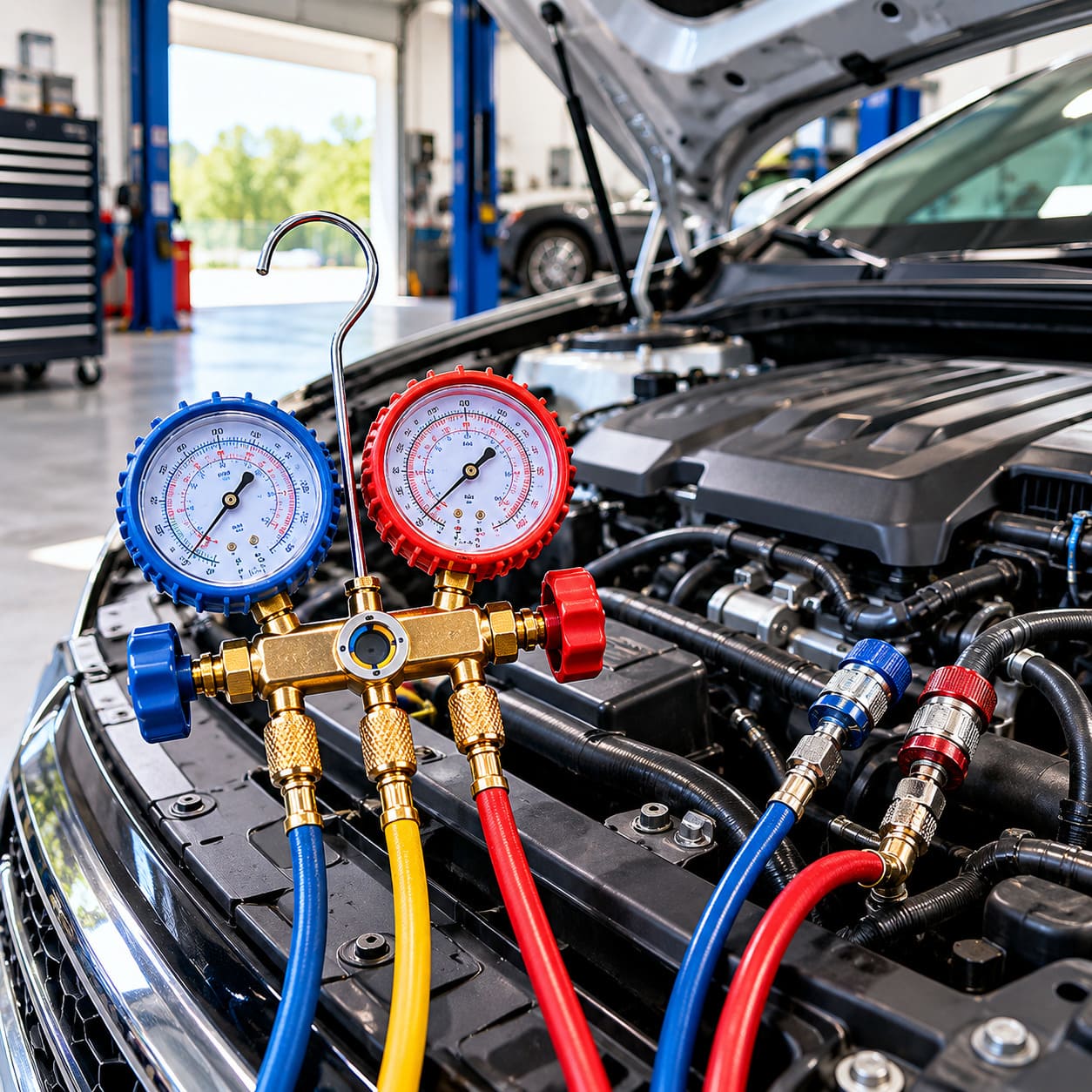
Most often the system is low on refrigerant because of a slow leak, and the compressor has stopped engaging. The next most likely causes are a failed compressor clutch, a dead condenser fan, or a stuck blend door. Check whether the compressor clutch spins and the fans run before paying for a recharge, because a recharge without a leak repair usually wears off within weeks.
Your car's A/C does not make cold air. It moves heat. The compressor squeezes refrigerant into a hot, high-pressure gas, the condenser in front of the radiator sheds that heat to the outside air, and the refrigerant then expands inside the evaporator under the dash, which gets cold and chills the air the blower pushes through it. Break any link in that loop and you get warm air.
The good news is that the failure usually announces itself in a way you can narrow down without tools. Whether the compressor clutch is turning, whether the electric fans come on, and whether the problem is the same on both sides of the cabin tells you which third of the system to look at. That matters because the repairs range from a $15 relay to a compressor job that can run past $1,500.
This guide is about A/C that has gone warm, either suddenly or over a few weeks. If yours starts cold and then fades during a drive, see our separate guide on A/C that turns warm after a while, because the causes are different.
Symptoms
- Air from the vents is the same temperature as the outside air, even on max
- The A/C was getting weaker over several weeks before it quit
- No click from the engine bay when you press the A/C button
- Cold on one side of the dash and warm on the other
- Cool on the highway but warm in traffic or at a light
- A squeal, rattle or grinding noise when the A/C is switched on
Likely causes and what they cost
1. Low refrigerant from a leak
$180-$350 for diagnosis and recharge, plus $150-$1,200 for the leaking partA sealed A/C system should not lose refrigerant, so a low charge means a leak somewhere: an O-ring at a fitting, a pinhole in the condenser, a worn compressor shaft seal or a corroded evaporator. Once pressure drops below a set point, a pressure switch stops the compressor from engaging to protect it, and the air goes warm. A slow leak gives you weeks of fading performance first.
The fix: Leak test with UV dye or an electronic sniffer, repair the leaking part, then evacuate and recharge to the exact factory weight on the under-hood label.
2. Compressor clutch, relay or fuse failure
Under $40 for a relay or fuse, $300-$700 for a clutch and coilMost compressors are driven by a belt through an electromagnetic clutch. If the clutch coil burns out, the air gap wears too wide, or the relay or fuse that powers it fails, the pulley freewheels and the compressor never pumps. The system can be fully charged and still blow warm.
The fix: Test for power at the clutch connector. Replace the relay or fuse if that is the fault, or re-shim or replace the clutch assembly.
3. Condenser fan not running
$20-$60 for a relay, $450-$1,000 for a fan assemblyThe condenser needs airflow to get rid of heat. At highway speed the wind does that job, but sitting still it depends entirely on the electric fan. With no fan, high-side pressure climbs until a safety switch shuts the compressor off, so the A/C goes warm at idle and recovers once you are moving.
The fix: Check the fan fuse and relay, then the fan motor and its control module.
4. Blend door actuator stuck on heat
$200-$650A small electric motor behind the dash moves a door that mixes air from the evaporator with air from the heater core. If it fails or strips its gears in the hot position, the A/C system can be working perfectly while the cabin gets heated air. Dual-zone cars often show this as one warm side.
The fix: Confirm with a scan tool or by listening for clicking behind the dash, then replace the actuator. Some are reachable under the dash in 20 minutes, others need dash disassembly.
5. Failed compressor
$1,100-$2,200, more on large SUVs and luxury modelsInternal wear, lost oil from a long-running leak, or debris can kill the compressor itself. It may lock up, squeal, or spin without building pressure. When a compressor fails internally it can spread metal through the system.
The fix: Replace the compressor, receiver-drier or accumulator, and expansion valve or orifice tube, and flush the lines. Skipping the flush is the most common reason a new compressor dies early.
6. Damaged or clogged condenser
$600-$1,100The condenser sits right behind the grille, where road debris, a minor front-end bump or years of salt air can puncture or corrode it. Bent or packed fins also block airflow and push pressures too high.
The fix: Replace the condenser and recharge. Clean packed fins gently with low-pressure water if they are only dirty.
Costs are typical South Florida ranges for parts and labor, for budgeting only.
What you can check yourself
- 1Watch the compressor clutch
With the engine idling in park and the A/C on max, look at the front of the compressor. The center plate of the pulley should be spinning with the belt. If only the outer pulley spins and the center stays still, the compressor is not engaging. Keep hands, hair and loose clothing well away from belts and fans.
- 2Check that the radiator fans run
On most cars the electric fans switch on within a minute or two of turning on the A/C. If they never spin while the A/C is on and the car is idling, the fan circuit is a strong suspect.
- 3Compare highway and idle
Note whether the air gets cold once you are moving at 40 mph or more. Cold at speed and warm at idle points toward airflow across the condenser, not refrigerant.
- 4Feel both sides and every vent
Set both zones to the coldest setting. If one side is cold and the other warm, or the face vents differ from the floor, a blend door is more likely than a refrigerant problem.
- 5Look at the fuse box
Find the A/C clutch fuse and relay using the diagram on the fuse box lid or the owner's manual. A blown fuse is visible. You can swap the A/C relay with an identical one, such as the horn relay, to test it.
- 6Inspect the condenser through the grille
With the engine off, use a flashlight to look for flattened fins, leaves, or oily patches. Oily dirt often marks a refrigerant leak, because the system oil escapes with the gas.
When to take it to a shop
- The compressor clutch does not engage and the fuse and relay are fine
- You hear grinding, knocking or a loud squeal when the A/C is on, which can mean the compressor is failing
- The engine temperature gauge climbs while the A/C is running
- You have already recharged it once this season and it went warm again
- Any work that opens the system, since refrigerant must be recovered with certified equipment by a technician certified under EPA Section 609
The Florida factor
South Florida runs the A/C eleven or twelve months a year, so systems here rack up compressor hours that a car in Ohio would take a decade to reach. Compressor shaft seals and O-rings dry out and leak sooner, and a weak system that would feel fine in March becomes unbearable by June, when a car parked in the sun at Town Center can reach cabin temperatures well above 130 degrees.
The condenser sitting behind the grille takes a beating from bugs, lovebug season in May and September, and the fine salt mist that drifts inland from A1A. Rinsing the grille area with a garden hose every few weeks helps. After a hurricane or a flooded street, check the condenser and fans first if the A/C stops working, because both sit low and in front where debris and water hit.
Notes for specific makes
- Honda: 2016 to 2018 Civics drew many owner complaints about A/C failures tied to condenser and compressor leaks. Honda extended coverage on some A/C components for certain vehicles, so ask a Honda dealer to run your VIN before paying out of pocket.
- Mercedes-Benz: Many Mercedes-Benz models use a variable-displacement compressor that is controlled electronically and has no traditional clutch, so the clutch check above will not tell you much. Newer models also use R-1234yf. A scan tool is needed to see whether the compressor is being commanded on.
A/C & Heating shops near Boca Raton
We are still adding shops for this service. Browse the directory or use the quote form.
See all shops for this serviceFrequently asked questions
Can I just recharge it with a can from the auto parts store?
You can on an older R-134a car, but it is a gamble. A can only adds refrigerant, it does not fix the leak, and overfilling is easy with a cheap gauge. Overcharged systems cool worse and strain the compressor. Cans with sealer can also clog shop recovery machines, and some shops charge extra or refuse to work on a system that has had sealer added.
How long does A/C refrigerant last?
In a healthy system, the life of the car. A/C is sealed, and refrigerant does not get used up. If you need a top-off every year, you have a leak worth finding.
Is it safe to drive with the A/C broken?
Usually yes, as long as the engine is not overheating and the compressor is not making grinding noises. If the compressor is seized, its pulley can shred the serpentine belt, which also drives the alternator and often the water pump. Turn the A/C off and get it checked if you hear grinding.
Why did my A/C quit right after a battery change?
On some cars the climate control module needs to relearn its door positions after power loss. Turn the car on, leave the climate control alone for a minute or two, and let the actuators cycle. A shop scan tool can force a recalibration if that does not work.
Related guides
More on this job: A/C & Heating in Boca Raton, costs and how to choose a shop
- RepairPal: AC compressor replacement cost
- RepairPal: AC condenser replacement cost
- EPA: Motor vehicle air conditioning (Section 609)
- MOTOR Magazine: Trouble Shooter, A/C clutch cycling
General information, not a diagnosis. A car problem can have causes a guide cannot see, so have anything safety-related inspected in person. Read our editorial policy.