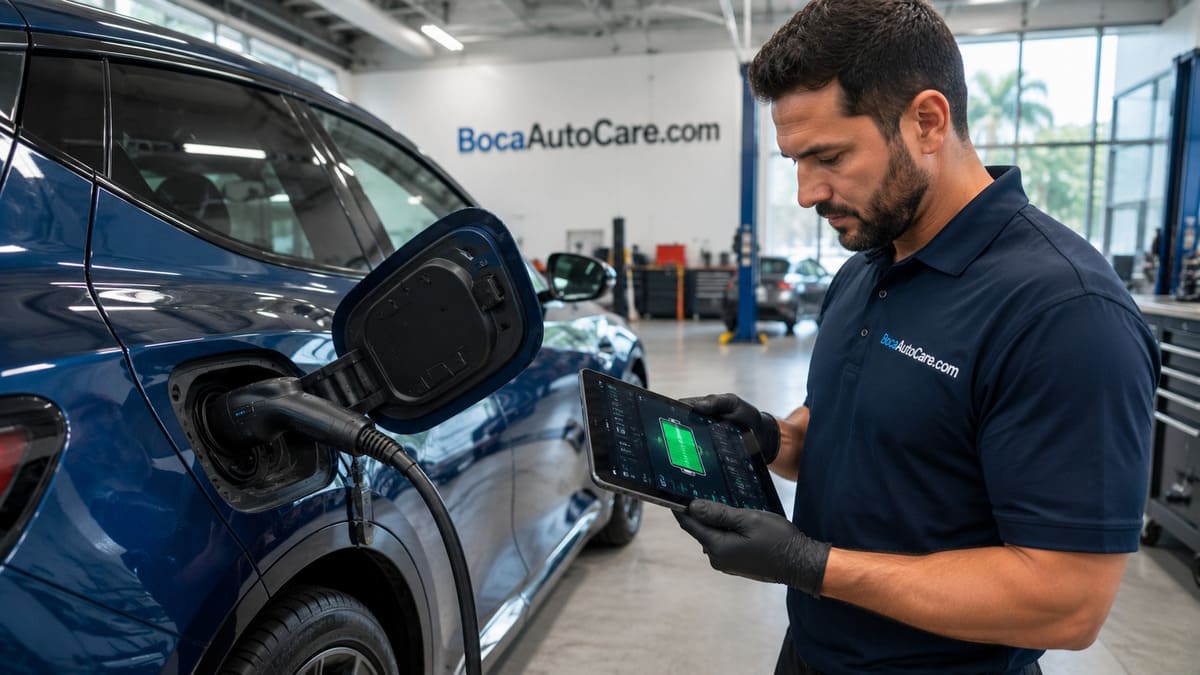
Routine EV service is mostly tires, cabin filters, brake fluid and battery coolant, and a typical year costs a few hundred dollars rather than the $600-$1,000 a gas car can need. The expensive item is the high-voltage battery, which most makers warranty for about 8 years or 100,000 miles, so check that coverage before paying for any battery work, and choose a shop with hybrid and EV high-voltage training such as ASE L3.
An electric car drops the oil changes, spark plugs, timing belts, exhaust and most of the transmission work. What remains is the chassis work every car needs, a few fluids, and the systems unique to EVs: the high-voltage battery and its cooling loop, the onboard charger, the drive motor and inverter, and a lot of software. Hybrids sit in between. They keep a gas engine with all its maintenance, add a smaller high-voltage battery, and use regenerative braking that makes pads last a long time.
High voltage changes who should work on the car. EV and hybrid systems typically run between about 400 and 1,000 volts, the orange cables carry it, and disconnecting a pack safely takes a procedure, insulated tools and training. A general shop can rotate tires and change a cabin filter on any EV; high-voltage diagnosis is a specialist job.
Dealers still handle much EV repair because of software access and warranty work, but independent EV and hybrid shops have grown, especially for out-of-warranty Toyota, Lexus, Honda and Ford hybrids and for older Tesla, Nissan Leaf and Chevrolet Bolt models.
What the job includes
- Tire rotation, pressure check and tread measurement at each visit. EVs are heavy and torquey, and many owners find tires wear faster than on a comparable gas car.
- Brake inspection, with attention to rust on rotors and stuck caliper slides, which happen because regenerative braking leaves the friction brakes barely used.
- Brake fluid test and replacement on the maker's schedule, usually every two to four years.
- Cabin air filter replacement, and on some EVs a desiccant bag or HEPA filter in the climate system.
- Inspection of the battery and power electronics coolant level, and replacement at the maker's interval, which varies widely by model.
- A 12-volt battery test. A weak 12-volt battery can keep an EV from powering on even with a full main pack.
- A battery health or state-of-health report from a scan tool, plus a check for software updates and open recalls.
- On hybrids, all the normal engine service, plus cleaning the hybrid battery cooling fan and intake filter where the car has one.
What ev & hybrid service costs in Boca Raton
| Job | Typical cost | Notes |
|---|---|---|
| Tire rotation and inspection | $25-$60 | Many tire shops include it free with purchase. |
| EV-rated tire, each, installed | $200-$450 | Load ratings and foam-lined quiet tires cost more. |
| Cabin air filter | $40-$120 | HEPA filters on some models run higher. |
| Brake fluid exchange | $100-$180 | Same job as on a gas car. |
| Battery coolant service | $150-$450 | Interval varies from 4 years to the life of the car, by make. |
| 12-volt auxiliary battery | $150-$400 | Lithium 12-volt units on some newer EVs cost more. |
| Battery health report | free-$150 | Worth getting before buying a used EV or hybrid. |
| Hybrid battery replacement, reconditioned | $1,500-$3,000 | Shorter warranty than new. Common for older Prius models. |
| Hybrid battery replacement, new | $2,500-$6,000 | Toyota and Lexus packs are at the lower end. |
| EV battery pack replacement, out of warranty | $6,000-$20,000+ | Module repair is sometimes possible for much less. |
Typical South Florida ranges for parts and labor, for budgeting only. Your quote depends on the vehicle and the shop.
EV & Hybrid Service shops near Boca Raton
- Tesla Delray BeachDelray Beach, FL
How to choose a shop
- Ask about high-voltage training. ASE offers the L3 Light Duty Hybrid/Electric Vehicle Specialist certification, and many makers train their dealer techs to their own levels. A shop doing battery or inverter work should have insulated gloves rated for the voltage, a lockout procedure, and a place to park a damaged EV away from the building.
- Check whether the job is under warranty before you pay. Many manufacturers cover the high-voltage battery for about 8 years or 100,000 miles, and some hybrid batteries carry 8 years or 100,000 miles or longer depending on make and model year. The coverage usually follows the car, so a used EV may still be covered. Your VIN and the maker's warranty booklet are the final word.
- Ask about software. Some repairs require the carmaker's tools to program a new module or calibrate a battery after work. Independent shops may subscribe to those tools; ask before the car is taken apart.
- Get a written estimate that separates diagnosis, parts and labor, as the Florida Motor Vehicle Repair Act requires for work over $150. For battery jobs, ask whether the replacement is new, remanufactured or used, and what warranty comes with it.
- Remember that you do not need a dealer for routine maintenance to keep your factory warranty, as long as the work follows the schedule and you keep records. Warranty repairs themselves still go to the dealer.
Red flags and upsells to question
- A quote for a full battery pack replacement without a state-of-health report or diagnostic codes to support it.
- Being sold an 'EV oil change' or engine-type services on a fully electric car.
- Pressure to replace brake pads that are still thick, when the real problem is rusted rotors or sticky calipers from light use.
- A shop that works on high-voltage parts but cannot describe how it de-energizes the system.
- Paying out of pocket for battery or drive unit work on a car still within its battery warranty.
- Battery 'reconditioning' services with no written warranty or capacity test results.
The Florida factor
Heat is the main enemy of lithium-ion batteries, and Boca Raton summers are long. A car that sits at 100 percent charge in a sun-baked lot at Mizner Park in August ages its pack faster than one kept at 50 to 80 percent in a garage. DOE estimates EV batteries last about 12 to 15 years in moderate climates and 8 to 12 in severe ones. Park in shade or a garage when you can, set the daily charge limit to 80 percent, and let the car's thermal system run while plugged in during heat waves.
Flooding is a specific danger here. Salt water from storm surge or king tides in low parts of the coastal neighborhoods can short a high-voltage battery, and a damaged EV can catch fire days or weeks later. If an EV or hybrid has been in salt water, do not charge it or park it in a garage or near the house; call your insurer and have it towed. When buying a used EV after a storm season, check for flood history.
Snowbird EVs left for the summer should be stored at about 50 percent charge, plugged in only if the maker recommends it, and checked every month or two for the 12-volt battery. Cars stored at a full charge in a hot garage for six months lose battery life they will not get back.
Frequently asked questions
Are EVs really cheaper to maintain?
Generally yes for routine maintenance, since there is no oil, spark plugs, timing belts or exhaust. Tires and insurance can cost more. Out-of-warranty battery or drive unit failures are expensive but uncommon in the first eight years.
How long do hybrid batteries last?
Many last 10 to 15 years or 150,000 miles and more, especially in Toyota and Lexus hybrids. Heat shortens life, so a clean cooling fan and intake matter in South Florida.
Can a regular mechanic work on my hybrid?
For engine, brake, tire and suspension work, a competent general shop can work on most hybrids. For the hybrid battery, inverter and electric motor, choose a shop with hybrid and EV training and the proper safety gear.
How do I check my EV battery's health?
Some cars show it in the menu, and many shops or dealers can pull a state-of-health report with a scan tool. Comparing your range on a full charge to the original rating is a rough check, but it is affected by temperature and driving.
Do brakes on an EV need any special care?
Pads last much longer, but rotors can rust and calipers can stick because the friction brakes see little use. Have them inspected and cleaned every year, and occasionally make a few firm stops to keep the rotors clean.
Guides related to ev & hybrid service
- U.S. DOE Alternative Fuels Data Center: Maintenance and safety of electric vehicles
- FuelEconomy.gov: Electric vehicle technology and battery life
- FTC: Auto warranties and service contracts
- Florida Statutes 559.905: Written repair estimate required
General information, not a diagnosis. A car problem can have causes a guide cannot see, so have anything safety-related inspected in person. Read our editorial policy.