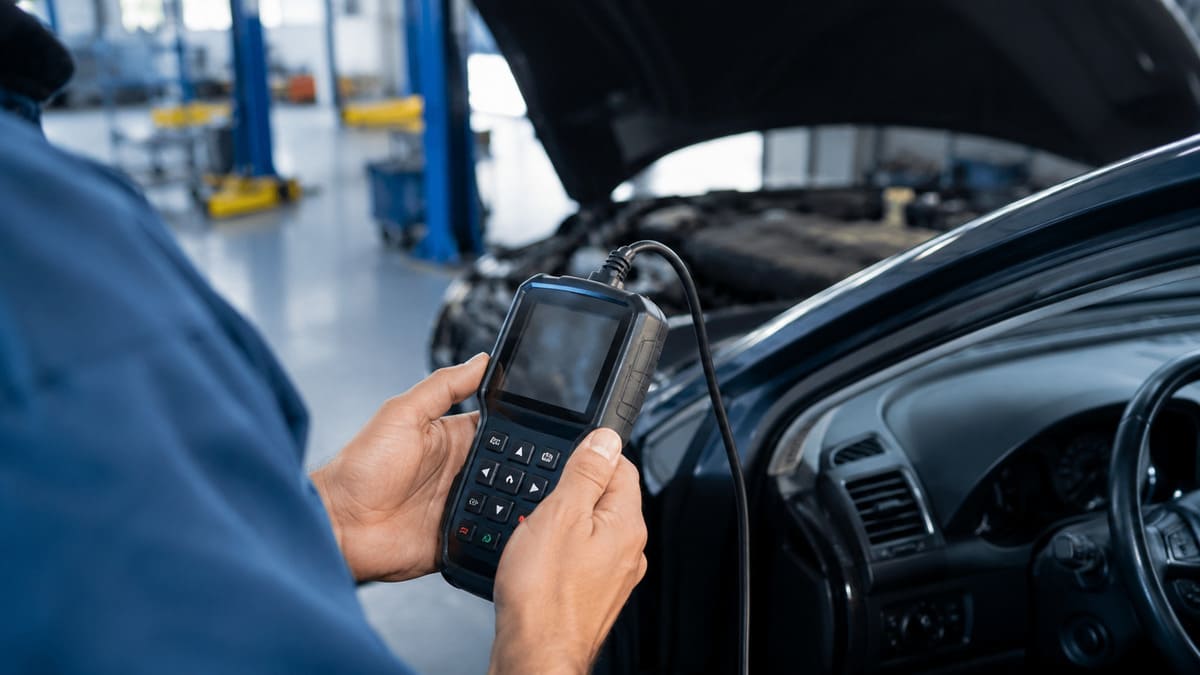
A proper pre-purchase inspection puts the car on a lift and checks the engine, transmission, brakes, tires, suspension, frame, A/C and electronics, plus a scan for stored and recently cleared trouble codes. Expect to pay about $100-$250 at an independent shop and more for European or exotic models, which is small next to the repair bills it can expose.
A pre-purchase inspection, or PPI, is a paid hour or two in a shop that has no stake in the sale. The goal is a written list of what is worn, what is leaking, what has been repaired, and what will need money in the next year, so you can walk away or negotiate with real numbers.
The FTC's Buyers Guide, the window sticker federal rules require on dealer used cars, itself tells buyers to get an independent inspection before buying. A dealer who refuses to let the car go to a shop of your choosing, or a private seller who will only meet in a parking lot at dusk, is telling you something about the car.
Use the owner checks below first. They cost nothing and can rule a car out before you pay anyone.
Symptoms
- You are about to buy a used car from a dealer or a private seller
- The seller says the car was 'just serviced' or 'never had a problem' but has no records
- The price is noticeably below similar cars in the area
- The car was registered in another state recently or came from an auction
- The vehicle history report is clean but the car smells musty or has new carpet
Likely causes and what they cost
1. Deferred maintenance and worn wear items
$300-$1,500 is a typical catch-up bill; timing belt alone $700-$1,500This is the most frequent finding on almost any used car. Thin brake pads, tires near the wear bars or past six years old, dirty fluids and an overdue timing belt are easy to miss on a test drive. They are not reasons to walk away, but they are real money.
The fix: Get the shop to price each item, then negotiate the total off the asking price or have the seller fix them before the sale.
2. Fluid leaks from the engine, transmission or power steering
Valve cover gasket $200-$600; rear main seal $800-$1,800Valve cover gaskets, oil pan gaskets and rear main seals seep with age, and a freshly pressure-washed engine bay can hide them for a test drive. On a lift, a technician can see wet spots and the trail they leave on the subframe.
The fix: Price the gasket or seal repair. Small seeps can be monitored; active drips need fixing.
3. Hidden accident repair
A PPI with a paint meter costs the same; buying a frame-damaged car can cost thousands in lost valueNot every collision ends up on a history report, especially if the owner paid cash. Mismatched paint, overspray on rubber trim, uneven panel gaps and fresh welds on the frame rails or the core support show it. Frame damage affects crash safety and resale value.
The fix: A paint thickness gauge and a look at the frame and airbag codes confirm it. Structural repair is usually a reason to pass.
4. Flood exposure
Title checks free to a few dollars; flood repairs often exceed the car's valueFlorida brands flooded titles under section 319.14 of the Florida Statutes, but a car flooded in another state, or never claimed through insurance, can still carry a clean title. Electrical faults from corrosion appear months later.
The fix: Look for silt under the seats and in seat-belt retractors, corrosion on seat bolts, and a waterline in the trunk. Run the VIN through Florida and national title databases.
5. Cleared trouble codes and unfinished readiness monitors
Included in most PPIs; a standalone scan $50-$150Disconnecting the battery or clearing codes with a scanner turns off a check engine light for a few days. The car's self-tests, called readiness monitors, then show as incomplete, which is a giveaway that codes were recently erased.
The fix: A full scan of every module, not just the engine computer, and a check of monitor status. Ask the seller directly why monitors are incomplete.
6. Transmission, turbo or hybrid battery trouble
Transmission $3,000-$7,000; hybrid battery $2,000-$4,500; turbo $1,500-$3,500These are the expensive failures. Slipping, harsh shifts, CVT shudder, blue smoke on startup or a hybrid battery with weak cells may only show up on a longer drive or with a scan tool that reads module data.
The fix: Ask for a road test of 15 minutes or more including highway speed, and a hybrid battery health readout where it applies.
Costs are typical South Florida ranges for parts and labor, for budgeting only.
What you can check yourself
- 1Match the VIN everywhere
Compare the VIN on the dash plate, the driver's door jamb sticker and the title or registration. Any mismatch ends the deal.
- 2Pull the Florida title record
For a Florida-titled car, FLHSMV's Motor Vehicle Information Check shows title brands such as salvage or flood. Also run a national NMVTIS report to catch brands from other states.
- 3Look up open recalls
Enter the VIN on the manufacturer's owner site or NHTSA's recall lookup. Recall repairs are free at a franchised dealer, and an open airbag recall is something to get done before you drive the car daily.
- 4Ask for a cold start
Ask the seller not to run the car before you arrive. Feel the hood. A cold engine that starts quickly, idles smoothly and has no blue or white smoke is a good sign. Stay clear of the fan and belts.
- 5Test the A/C with a thermometer
Run the A/C on max for five minutes and put a cheap probe thermometer in the center vent. Roughly 35-45 degrees Fahrenheit at the vent is healthy. Warm air means a likely repair from a few hundred to a couple of thousand dollars.
- 6Smell, then lift the trunk floor
A musty smell or heavy air freshener is a warning. Lift the trunk floor and look in the spare tire well for water, rust or dried mud.
- 7Read the tire date codes
The last four digits of the DOT code give the week and year. Four tires past six years old means budgeting $500-$1,000 for new ones.
When to take it to a shop
- Every time you are serious about a car, before you pay a deposit you cannot get back
- Any European, turbocharged, hybrid or high-mileage car, where repair costs swing widely
- A car with a rebuilt, salvage or out-of-state title
- A dealer car sold 'as is' with no warranty box checked on the Buyers Guide
- A private sale where the seller cannot show maintenance records
The Florida factor
Florida has no general cooling-off period for car purchases, and the state's lemon law covers new vehicles rather than older used cars, so a used car bought as is is generally yours once you sign. That makes the inspection the main protection you have. Private sales carry no Buyers Guide at all, and many Palm Beach County dealer cars are marked As Is - No Dealer Warranty.
After big storms anywhere in the Southeast, flood cars wash into the South Florida market through auctions, sometimes with titles from states that brand differently. The months after a hurricane season are when a careful flood check matters most. Look closely at carpet padding, seat rails and the connectors under the dash, not just the carpet surface.
Snowbird cars are a local specialty. A ten-year-old car with 40,000 miles from a seasonal owner can be a find, but long sitting dries out seals, flat-spots tires and kills batteries. Ask how the car was stored, and have the inspector look for dry-rot cracking in the tire sidewalls and leaks from rarely used seals.
Notes for specific makes
- BMW: Ask the inspector to look for oil leaks at the valve cover, oil filter housing and oil pan gaskets, which are common on many BMW engines, and for coolant system wear. A shop with BMW-capable software can read stored faults that a generic scanner misses.
- Nissan: Many Nissans use CVT automatics. Ask for a drive that includes gentle acceleration from a stop and highway merging, and for a check of CVT fluid condition and any stored transmission codes.
- Toyota: On Prius and other Toyota hybrids, ask for a hybrid battery health check that reads individual block voltages. A healthy-looking hybrid with a tired pack can need a battery within months.
- Jeep: Check the Wrangler or Grand Cherokee for prior off-road use: scraped skid plates, bent tie rods and lift-kit modifications. Also look at the front suspension for death wobble fixes such as aftermarket track bars or steering stabilizers.
Diagnostics shops near Boca Raton
- Ferrari of Boca Raton6403 W Rogers Cir, Boca Raton, FL, 33487
- Tire Kingdom23193 Sandalfoot Plaza Drive, Boca Raton, FL, 33428
Frequently asked questions
Who pays for the inspection?
The buyer, almost always. Some sellers will refund it if the car passes and you buy, but do not count on that.
Can a dealer refuse to let me take the car to my own mechanic?
They can refuse, since it is their car. Many reputable dealers allow it, or let a mobile inspector come to the lot. A refusal is a good reason to keep shopping.
Is a dealer's 150-point inspection the same thing?
No. It is done by the party selling the car. It may be thorough, but you want someone with no interest in the sale looking at it.
Is a clean history report enough?
No. Reports only show what was reported to insurers, DMVs and participating shops. Cash-paid accident repairs and flood damage outside an insurance claim do not appear.
How long does a PPI take?
Usually 60-90 minutes on a lift, plus a road test. Book it ahead, since many shops schedule inspections for the morning.
Related guides
More on this job: Diagnostics in Boca Raton, costs and how to choose a shop
- FTC: Dealer's Guide to the Used Car Rule (Buyers Guide requirements)
- FLHSMV: consumer advisory on flooded vehicles and title brands
- National Motor Vehicle Title Information System (NMVTIS)
General information, not a diagnosis. A car problem can have causes a guide cannot see, so have anything safety-related inspected in person. Read our editorial policy.