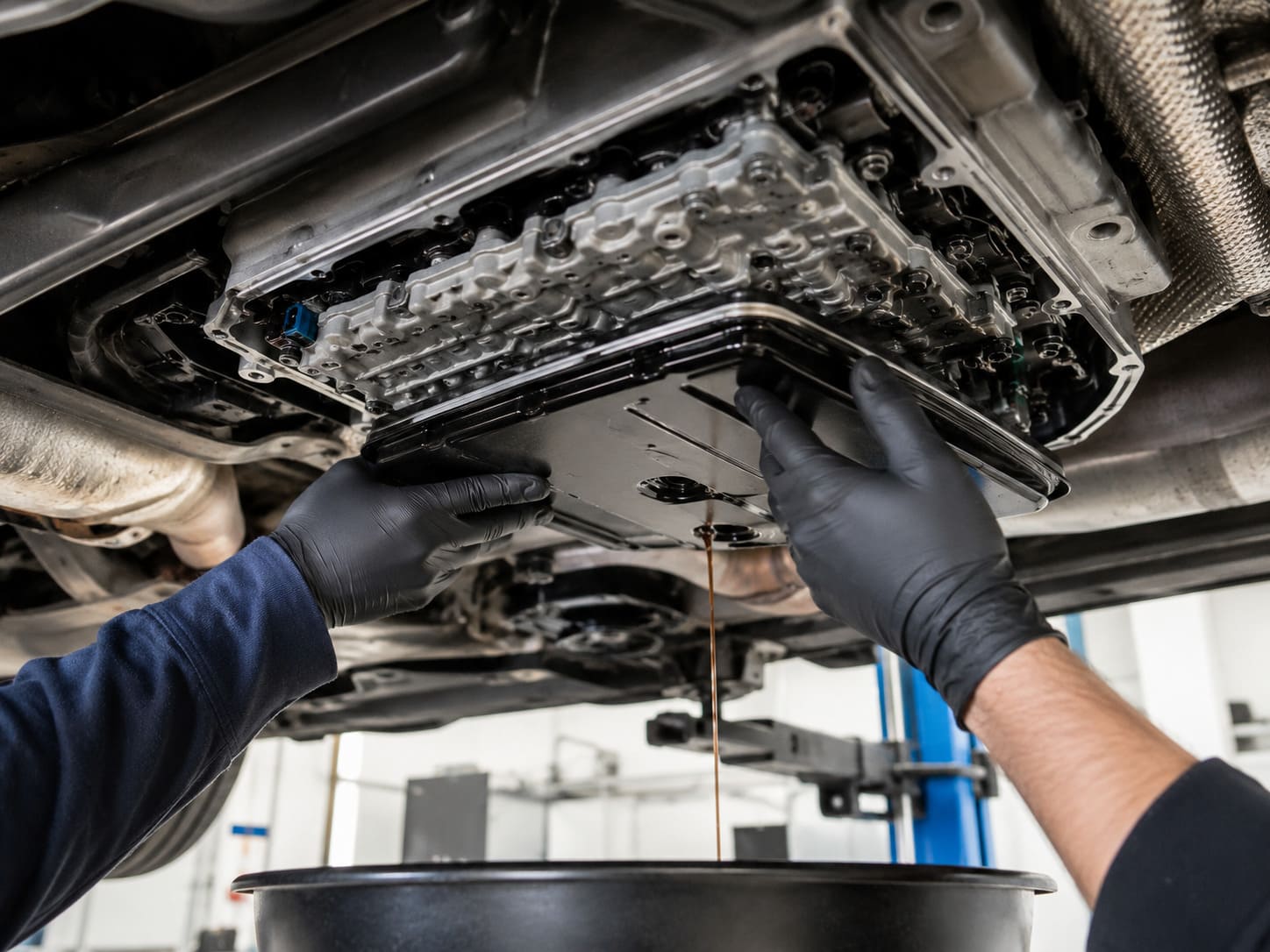
Hard or delayed shifts most often come from fluid that is low or past its service life, a transmission computer that needs a software update or relearn, or a worn engine or transmission mount that makes normal shifts feel like a bang. Start with the fluid and a code scan, because many shift complaints are fixed with software or service rather than parts.
A modern automatic is controlled by a computer that adjusts fluid pressure on every shift. When it works, you barely feel the gear change. When pressure arrives too late, too early, or too strong, you feel a delay, a bang, or a flare in RPM. A shift problem is different from a slip: the gear does eventually hold, it just arrives in the wrong way.
Many complaints about harsh shifting are not mechanical at all. Most transmissions learn your driving style and adjust shift pressure over time, and that learned data can drift or be wiped by a battery disconnect. Manufacturers also release updated shift software when owners complain. That is why a scan and a check for service bulletins should come before anyone quotes a rebuild.
Rough shifts still deserve attention. Hard engagement shocks the driveline, joints and mounts, and a late shift often signals that fluid pressure is falling, which can lead to slipping if it continues.
Symptoms
- A noticeable clunk or jolt when moving the shifter from Park to Drive or Reverse
- A pause of two seconds or more before the car engages after you select a gear
- Upshifts that bang in firmly, especially from first to second
- Late upshifts where the engine revs high before the next gear arrives
- A harsh downshift as you slow to a stop at a light
- Shifts that are rough when cold and smooth out after 10 to 15 minutes
Likely causes and what they cost
1. Fluid low, old, or the wrong type
$180-$400 for a fluid service, $60-$150 for a level check and top-off on sealed unitsShift quality depends on fluid that flows at the expected rate and carries the right friction additives. Old fluid that has thickened or lost its additives makes clutches grab, so shifts feel abrupt. Low fluid delays engagement because the pump needs extra time to build pressure. Using a universal fluid in a transmission that calls for a specific formula can cause the same symptoms.
The fix: Check and correct the level, then service the fluid with the exact specification listed in the owner's manual.
2. Shift software or adaptive learning
$100-$300, sometimes free under a bulletin or extended warrantyThe transmission computer stores learned shift pressures. After a battery replacement, a fluid change, or simply over time, those values can be wrong and the computer has to relearn. Many models also have factory software updates that soften specific shifts. A delayed or harsh 1-2 shift is a frequent target of these updates.
The fix: A software reflash and an adaptive relearn procedure with a factory-level scan tool. Some relearns require a specific test drive pattern.
3. Worn engine or transmission mount
$200-$650 per mount, depending on accessRubber mounts hold the engine and transmission in place and absorb the torque of each shift. When a mount cracks or collapses, the whole powertrain rocks when the gear engages, and you feel a clunk that seems to come from the transmission. The shift itself may be perfectly normal.
The fix: Replace the failed mount. Many shops recommend checking all mounts at once because a broken one overloads the others.
4. Sticking solenoid or dirty valve body
$350-$800 for a solenoid, $800-$1,700 for a valve bodyDebris or varnish can make a shift solenoid or a valve in the valve body move slowly. The computer commands a shift, but fluid arrives late, so the gear change is delayed and then lands hard. This often shows up only when the transmission is cold or only on one particular shift.
The fix: Replace the affected solenoid or the valve body assembly, followed by a fluid service and relearn.
5. Sensor or wiring fault
$150-$450The computer needs accurate input and output speed, throttle position and fluid temperature to time shifts. A failing speed sensor or a corroded connector feeds it bad data, and it may shift at odd times or switch to a fixed backup gear. These faults usually leave a stored code.
The fix: Diagnose the circuit, then replace the sensor or repair the wiring and connector.
6. Internal wear or a failing torque converter
$3,000-$7,500 on most cars and SUVsWhen clutches are worn or seals are hardened, pressure leaks internally and engagement slows. At that point the computer can no longer compensate, and delayed engagement often progresses into slipping.
The fix: Rebuild or replace the transmission, usually with the torque converter.
Costs are typical South Florida ranges for parts and labor, for budgeting only.
What you can check yourself
- 1Time the engagement
With the engine warm, your foot firmly on the brake, and the area around the car clear, shift from Park to Drive and count. Engagement within about one second is normal. Do the same for Reverse. A long delay in one direction only narrows the cause for a technician.
- 2Compare cold and warm behavior
Notice whether the rough shifts happen only in the first few minutes of driving. Cold-only symptoms often point to fluid condition or a sticky valve, while problems that get worse as the car heats up point to low fluid or internal leakage.
- 3Watch the engine during a shift
Have a passenger stand to the side of the open hood, never in front of the car, while you hold the brake and shift between Drive and Reverse. If the engine jumps or rocks noticeably, a broken mount is a likely cause of the clunk.
- 4Think about recent work
A new battery, a disconnected battery, or a recent fluid service can reset learned shift values. Tell the shop about any of these, because the fix may be a relearn rather than a repair.
- 5Look up bulletins and extended coverage
Search your VIN for recalls on the NHTSA site and ask a dealer service desk whether your transmission has a software update or warranty extension. Several manufacturers have extended coverage on transmissions with known shift complaints.
When to take it to a shop
- The check engine or transmission warning light is on
- Engagement takes more than two seconds or the car lurches when it catches
- Shifts are harsh at all temperatures, not just when cold
- You see red or brown fluid under the car
- The problem started after a battery replacement and has not settled after a week of normal driving
The Florida factor
Stop-and-go traffic is where shift problems show up first. Federal Highway through Boca has a light every few blocks, and each stop means a downshift to first and a fresh 1-2 upshift. A car that does a dozen of those per mile wears its fluid and exposes a bad 1-2 calibration much faster than a car on rural highways. If your complaint is mainly at low speed in town, mention that pattern to the shop.
Parking-lot heat soak affects the cold-start shift too. A transmission that has sat in a 140 degree interior all afternoon is not cold, but its fluid temperature sensor and learned values can make the first few shifts feel odd. A shift that is harsh only after the car has baked in the sun, then settles, is worth describing exactly that way.
Many South Florida cars get new batteries every two to three years because heat shortens battery life. Each battery swap can clear the transmission's adaptive memory on some models, which is why a harsh shift that appears right after a new battery is so common here. It often fixes itself after a few days of mixed driving, or with a relearn at a shop.
Notes for specific makes
- Chevrolet: GM 8-speed automatics (8L45 and 8L90) in many 2015 to 2019 trucks, SUVs and cars developed a shudder and harsh shift complaint. GM issued a bulletin calling for a full fluid exchange with a reformulated Mobil 1 LV ATF HP fluid, and that fix applies to GMC and Cadillac models with the same transmissions.
- Ford: Focus and Fiesta models with the PowerShift dual-clutch automatic are known for hesitation and judder from a stop. Ford extended clutch coverage to 7 years or 100,000 miles on 2014 to 2016 Focus and 2014 to 2015 Fiesta, and covered the control module for 10 years or 150,000 miles. F-150 owners with the 10-speed have also reported harsh or erratic shifts, often addressed with software.
- Jeep: The 9-speed automatic used in the Cherokee and Renegade drew many complaints about rough and delayed shifts in its early years. Most fixes were software updates, so a dealer check for the latest calibration is the first step.
- Volkswagen: DSG dual-clutch transmissions can feel jerky at parking-lot speeds by design, but a sudden increase in harshness can point to the mechatronic unit. They also have a fixed fluid service interval that is easy to miss, so check the maintenance records.
Transmission Repair shops near Boca Raton
- Transmission Doctor7548 West McNab Road, Coconut Creek, FL, 33068
Frequently asked questions
Is a clunk into Drive normal on some cars?
A light, consistent bump is normal on many trucks and rear-drive cars. A jolt that is new, getting stronger, or that rocks the whole car is not, and should be checked for mounts and fluid first.
Can disconnecting the battery fix hard shifting?
Sometimes, because it wipes the learned shift data and lets the computer start over. It can also make shifts worse for a while, and on some models it requires a scan tool relearn. Do not rely on it as a repair.
Will a fluid flush fix my shifting?
If the fluid is old or the wrong type, a service often improves shift quality noticeably. If the cause is software, a mount or a sensor, fluid alone will not help. A diagnosis first saves paying for the wrong fix.
Why does my car shift fine on the highway but rough in town?
Highway driving uses only the top gears with few shifts. In town you use the lower gears constantly, and the 1-2 and 2-3 shifts are the ones most affected by fluid condition and calibration.
Related guides
More on this job: Transmission Repair in Boca Raton, costs and how to choose a shop
- GM TechLink: TCC shudder and new Mobil 1 fluid exchange
- Kelley Blue Book: Ford extends Focus and Fiesta powertrain coverage
- AAA: Automatic transmission fluid service
- RepairPal: Transmission fluid change cost
General information, not a diagnosis. A car problem can have causes a guide cannot see, so have anything safety-related inspected in person. Read our editorial policy.