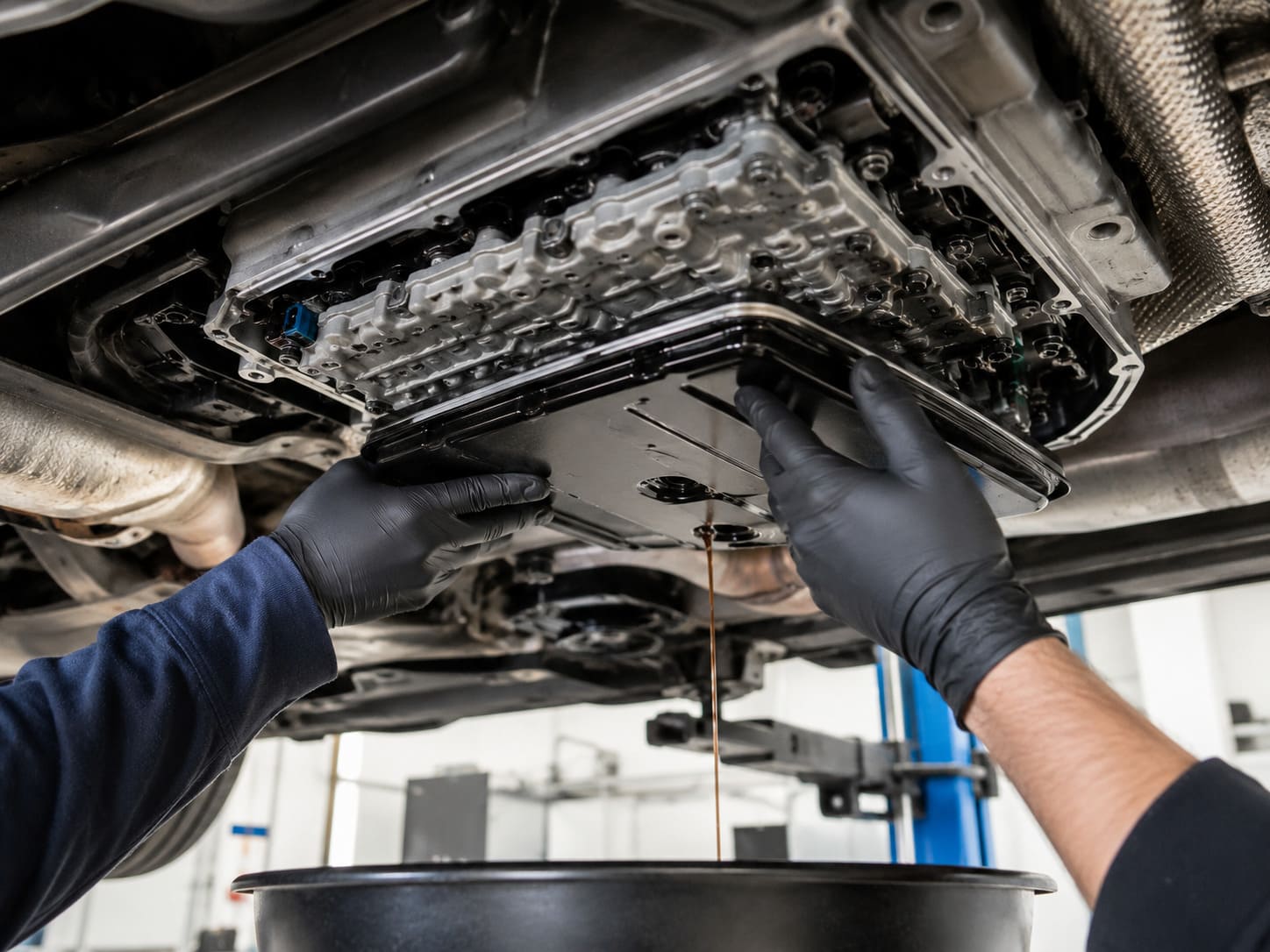
A CVT that shudders when pulling away or whines louder as you speed up usually has worn fluid, outdated control software, or wear on the belt, pulleys or bearings inside. Get the fluid and software checked first, and look up your VIN for extended CVT warranties, because several automakers have paid for these repairs well past the normal warranty.
A continuously variable transmission has no fixed gears. Instead, a steel belt or chain runs between two pulleys that change width to vary the ratio smoothly. That design saves fuel, which is why it is common in Nissan, Subaru, Honda and Toyota cars and small SUVs, but it depends on the fluid and the computer working exactly right.
Two complaints dominate. Shudder, sometimes called judder, is a vibration under light throttle, often caused by the torque converter lockup clutch or by the belt and pulley surfaces not gripping evenly. Whine comes from the belt, pulleys or internal bearings, and usually grows as wear increases. Some CVT sound is normal, so the useful question is whether the noise is new or getting louder.
CVTs are generally replaced rather than rebuilt at most shops, so the cost difference between catching a fluid or software issue and needing a new unit is large. That makes early diagnosis and a warranty check worth the time.
Symptoms
- Shudder or vibration when accelerating gently from a stop or at 20 to 40 mph
- A whine or droning that gets louder and higher pitched with road speed
- The engine revs but acceleration lags, like a rubber band stretching
- A sudden jerk or surge while cruising at a steady speed
- A warning light with the car limited to low speed or low RPM
- A hum that changes when you lift off the gas, separate from tire noise
Likely causes and what they cost
1. Degraded CVT fluid
$160-$400CVT fluid is a specialized formula that lets the belt grip the pulleys while protecting the metal surfaces. As it ages and heats up, it loses that friction balance and the belt can slip microscopically, which you feel as judder. Many manufacturers do not list a CVT fluid change in the normal schedule, so a lot of cars run their original fluid for 80,000 miles or more.
The fix: Drain and refill with the exact manufacturer fluid, sometimes twice, followed by a fluid temperature check and computer relearn.
2. Control software needing an update
$100-$250, often free under a bulletin or extended warrantyThe CVT computer controls belt clamping pressure and torque converter lockup. Manufacturers have released many software updates aimed at judder and harsh engagement. On older calibrations, the converter may lock up too early at low speed and cause a shudder.
The fix: Reprogram the transmission control module with the latest software and perform the required learning procedure.
3. Torque converter lockup clutch wear
$900-$2,000Most CVTs use a torque converter for smooth takeoff and lock it at cruising speed for efficiency. If the lockup clutch surface is glazed or worn, it grabs and releases unevenly as it engages, which feels like driving over rumble strips at 20 to 45 mph.
The fix: Replace the torque converter. On some models the shop will recommend replacing the CVT assembly at the same time if internal wear is found.
4. Worn belt, pulleys or bearings
$3,800-$8,000 depending on model and whether the unit is new or remanufacturedOver time the steel belt and pulley faces wear, and the bearings that support the pulleys can fail. That produces a whine that rises with speed, followed by slipping or a sudden loss of drive. Metal debris then contaminates the fluid and the valve body.
The fix: Replacement of the CVT with a new or remanufactured unit, since internal parts for many models are not sold separately to independent shops.
5. Overheated CVT or blocked cooler
$250-$900CVTs are sensitive to heat. A clogged external cooler, low coolant, or long periods of slow climbing with a load make the fluid run hot, and the computer may cut power to protect the unit. Repeated overheating accelerates belt and fluid wear.
The fix: Clean or replace the CVT cooler and lines, repair any cooling system fault, and service the fluid.
6. Noise that is not the CVT
$100-$180 for diagnosis, repair variesA wheel bearing or worn tires can make a hum that rises with speed and is easily blamed on the transmission. A loose heat shield or failing engine mount can mimic shudder. Ruling these out first prevents an expensive misdiagnosis.
The fix: Road test and inspection to isolate the noise, then repair the actual source.
Costs are typical South Florida ranges for parts and labor, for budgeting only.
What you can check yourself
- 1Pin down when it happens
Note the speed, how hard you press the gas, and whether the car is cold or warm. Judder that appears only under light throttle around 20 to 40 mph points toward the converter lockup or software. A whine that tracks road speed whether you are on or off the gas can be a wheel bearing instead.
- 2Test the noise while coasting
On a quiet, empty road, safely shift into Neutral briefly while coasting at moderate speed and listen. If the hum stays the same, the source is likely a wheel bearing or tires. If it changes or disappears, the CVT is a stronger suspect. Shift back into Drive before slowing and do this only where it is safe.
- 3Find your service history
Check records for any CVT fluid change. If there has never been one past 60,000 miles, mention it to the shop, and ask for the manufacturer's own fluid, not a generic multi-vehicle CVT fluid.
- 4Search recalls, bulletins and warranty extensions
Enter your VIN on the NHTSA recall site and ask a dealer about warranty extensions for your CVT. Bring documentation of your symptoms, since extensions usually cover the CVT only when a qualifying fault is confirmed.
- 5Check the coolant level
With the engine cold, confirm the coolant is between the marks in the overflow tank. On many cars the CVT is cooled through the same system. Never open the cap on a hot engine.
When to take it to a shop
- A whine or grinding that is louder than it was a month ago
- The car has entered a reduced-power mode or shows a transmission warning
- Shudder persists after a fluid service and software update
- You lose acceleration or the car surges at steady speed
- Your car may be covered by an extended CVT warranty, which requires a dealer diagnosis to claim
The Florida factor
South Florida summers are tough on CVT fluid. The unit cools itself through a small heat exchanger, and that system is working against outside air that sits above 90 degrees for months at a time. Stop-and-go driving with constant gentle takeoffs, typical on Glades Road, Palmetto Park Road and Yamato Road at rush hour, is exactly the light-throttle range where judder shows up first. If you drive mostly in town, ask a shop whether a CVT fluid change around 30,000 to 50,000 miles makes sense for your model.
Hurricane evacuations add a specific stress. A loaded small SUV crawling north on I-95 or the Turnpike for hours, A/C on full, can push CVT fluid to temperatures it rarely sees otherwise. If your CVT started shuddering after a long, slow trip like that, the fluid was likely overheated and should be checked even if the car seems fine afterward.
Many Boca drivers buy used small crossovers from out of state. A CVT that spent its first years in a cold climate is not a problem in itself, but its fluid history matters more here. Ask for records before buying, and treat an unknown history on a car past 60,000 miles as a reason for a pre-purchase inspection.
Notes for specific makes
- Nissan: Nissan CVTs are the best known for judder and whine. Class action settlements extended powertrain coverage to 84 months or 84,000 miles on 2012 to 2017 Versa, 2014 to 2017 Versa Note, 2013 to 2017 Sentra and 2013 to 2016 Altima. Nissan has also issued CVT judder diagnostic bulletins for 2013 to 2015 Altima and 2014 to 2016 Rogue. Many of these extensions have now expired by time, so check the exact dates for your VIN.
- Honda: Honda recalled about 143,000 2014 to 2015 Civic and 2015 Fit models to update CVT software after drive pulley shafts could break under high pressure. Honda has also issued software bulletins for CVT judder at low speed on several models.
- Subaru: Subaru has extended Lineartronic CVT coverage to 10 years or 100,000 miles on many Legacy, Outback, Forester, WRX and other models across several model years. The exact years and terms vary by bulletin, so ask a Subaru dealer to check your VIN.
- Toyota: Newer Toyota models use a CVT with a physical launch gear for pulling away, which reduces belt load at takeoff. Complaints are less common, but Toyota still specifies its own CVT fluid, so do not accept a generic substitute.
Transmission Repair shops near Boca Raton
- Transmission Doctor7548 West McNab Road, Coconut Creek, FL, 33068
Frequently asked questions
Is some CVT whine normal?
A light, steady whine under acceleration is normal on many CVTs. What matters is change. A noise that gets louder over weeks, appears at new speeds, or comes with judder or slipping should be diagnosed.
Can a CVT be rebuilt?
Some specialists rebuild certain CVTs, but most general shops and dealers replace the whole unit because internal parts are limited. A remanufactured unit with a warranty is the most common repair.
Do CVTs need fluid changes if the manual says lifetime?
Lifetime usually means the life of the warranty under normal conditions. For hot climates and stop-and-go driving, many technicians recommend changing CVT fluid between 30,000 and 60,000 miles. It is inexpensive compared to a replacement.
Should I buy a used car with a CVT?
Many CVTs last well with proper fluid service. Before buying, check for fluid service records, look up warranty extensions by VIN, and have a shop road test it for judder and whine.
Will a CVT shudder go away on its own?
Rarely. Shudder caused by fluid or software usually improves only after service or an update. Shudder from mechanical wear tends to get worse.
Related guides
More on this job: Transmission Repair in Boca Raton, costs and how to choose a shop
- BBB National Programs: Nissan CVT class action settlement
- AutoGuide: Honda Civic and Fit recalled for CVT issue
- NHTSA: Nissan CVT judder diagnostic bulletin
- NHTSA: Subaru CVT warranty extension bulletin
General information, not a diagnosis. A car problem can have causes a guide cannot see, so have anything safety-related inspected in person. Read our editorial policy.