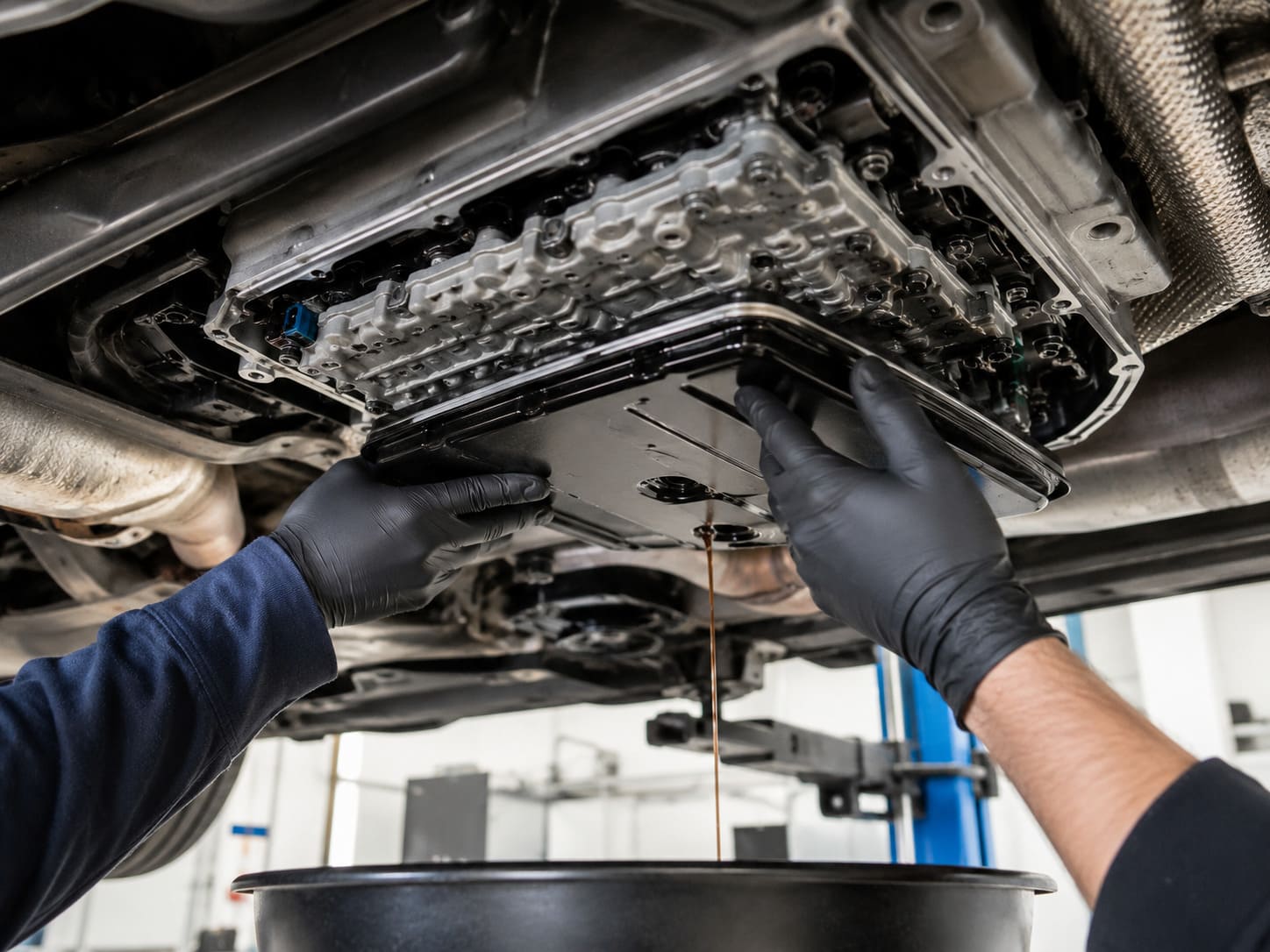
Red, pink or brown oily drips under the middle or front of the car are usually transmission fluid, most often from a pan gasket, cooler line or axle seal. Most leaks are cheap to fix if caught early, but driving on low fluid can ruin the transmission, so confirm the source and the fluid level within a few days.
Transmission fluid lives in a sealed loop. It circulates through the transmission, out to a cooler in or near the radiator, and back. Nothing in that loop is meant to use up fluid, so any drop in level means it is escaping. Because most automatics hold only 8 to 14 quarts, losing even one quart can change how the transmission behaves.
Identifying the fluid is the first job. New automatic transmission fluid is usually dyed red, but some brands use other colors, and old fluid turns brown. Power steering fluid can also be red, and some coolants are pink. Position, smell and feel help separate them, and the checks below walk through that.
The good news is that the most common leak points are seals and gaskets on the outside of the transmission. Fixing them rarely involves opening the unit, and the bill is usually a few hundred dollars. The risk is ignoring the drips until the level drops far enough to cause internal damage.
Symptoms
- Red, pink or reddish brown spots under the center or front of the car
- An oily film on the transmission pan or around the front axles
- A burnt oil smell after driving, sometimes with light smoke from under the car
- The fluid level on the dipstick dropping between checks
- Late or rough shifts that started around the same time as the drips
- Pink, milky fluid in the coolant reservoir or on the dipstick
Likely causes and what they cost
1. Transmission pan gasket or drain plug
$180-$400 including fluidThe pan on the bottom of the transmission is sealed with a gasket that hardens and shrinks with age and heat. Bolts can also loosen, and a drain plug washer that was not replaced at the last service can seep. The leak shows as fluid wetting the pan edges and dripping from its lowest corner.
The fix: Replace the pan gasket and drain plug washer, usually along with a filter if the transmission has one, then refill with the specified fluid.
2. Cooler lines or fittings
$180-$500Two lines carry fluid to the cooler, often through a mix of metal tube and rubber hose. Crimped connections, quick-connect fittings and rubber sections wear, and lines near the front of the car can corrode. Leaks here drip toward the front and may be worse when the transmission is hot and pressurized.
The fix: Replace the leaking hose section or the full line assembly, or reseal the fitting at the radiator.
3. Axle or output shaft seal
$200-$450 per side, $450-$900 if the axle is replaced tooOn front-wheel-drive cars, each drive axle enters the transmission through a lip seal. Worn axle joints let the shaft wobble and wear the seal, and the leak shows up as fluid slung around the inner axle joint and inside the wheel well.
The fix: Remove the axle and replace the seal. If the axle joint is worn, replacing the axle at the same time avoids a repeat leak.
4. Electrical connector or shifter shaft seal
$150-$450 for the seal, more if wiring is contaminatedWiring and the shift linkage pass through the transmission case, each with a small seal or O-ring. These seep slowly and are easy to miss because the fluid spreads along the case. On some models fluid can wick inside the wiring harness itself.
The fix: Replace the seal or connector sleeve. If fluid has traveled up the harness, the wiring and sometimes the control module need attention.
5. Front pump seal or torque converter seal
$700-$1,500A seal between the engine and transmission keeps fluid in around the torque converter. When it fails, fluid drips from the gap where the engine and transmission bolt together. The seal itself is cheap, but reaching it means removing the transmission.
The fix: Remove the transmission, replace the seal and inspect the converter hub and bushing.
6. Failed cooler inside the radiator
$700-$1,300 if caught early, far more if the transmission is damagedMany cars cool transmission fluid with a small heat exchanger built into the radiator tank. If it cracks internally, coolant and transmission fluid mix. You see a pink milky fluid instead of a drip, and coolant in a transmission can destroy its clutches within weeks.
The fix: Replace the radiator, flush both the cooling system and the transmission repeatedly, and assess the transmission for damage.
Costs are typical South Florida ranges for parts and labor, for budgeting only.
What you can check yourself
- 1Do the cardboard test
Park on a level surface and slide a large piece of white cardboard under the engine and center of the car overnight. In the morning, note where the spots are relative to the wheels and take a photo. Spots in the center or toward the front often indicate transmission fluid. Spots right under the radiator often indicate coolant.
- 2Touch, smell and compare
Dab a spot with a paper towel. Transmission fluid feels slick like oil and smells petroleum-like, or burnt if it has overheated. Coolant feels watery and smells sweet. Wash your hands afterward, and keep pets away from any coolant spot because it is toxic.
- 3Check the level the right way
If your car has a transmission dipstick, follow the owner's manual procedure, which is often hot, engine running, on level ground. Keep clear of the fan and belts. Sealed transmissions without a dipstick need a lift and fluid temperature readout, so do not try to add fluid through a vent.
- 4Look without lifting the car
With the engine off and cool, use a flashlight to look under the car from the side and behind the front wheels. Look for wet, shiny areas on the pan or around the inner axle joints. Never get under a car held up only by a jack, and do not touch the exhaust, which stays hot long after driving.
- 5Check the coolant reservoir
With the engine completely cool, look at the coolant in the overflow tank. Pink, milky or oily coolant suggests the transmission cooler has failed. Never open a radiator cap on a hot engine.
When to take it to a shop
- The spot is larger than a coin each morning, or the level drops between checks
- Fluid is dripping on or near the exhaust, or you see smoke from under the car
- Coolant or transmission fluid looks milky or pink and mixed
- Shifts have changed since the leak began
- Your transmission has no dipstick and you cannot confirm the level
The Florida factor
Rubber hoses and gaskets age faster in South Florida's heat. A car parked on open asphalt in July has an underbody that bakes for hours each day, and transmission cooler hoses are often the first rubber parts to crack. On cars older than eight or nine years, inspect those hoses at every oil change.
Salt air matters too. Owners who live east of the Intracoastal or park near the beach in Boca, Highland Beach or Deerfield see faster corrosion on steel cooler lines and their crimped fittings. A rusty line can weep fluid for months before it fails, so ask for a look at the lines during routine service if you live near the water.
There is also a fire risk that rises with the temperature. Fluid that drips onto a hot exhaust pipe after a long crawl on I-95 can smoke and, in rare cases, ignite. If you smell burning oil and see smoke from under the car after highway driving, pull over somewhere safe, switch the engine off and look before continuing.
Notes for specific makes
- BMW: Many BMWs with ZF 6-speed and 8-speed automatics use a plastic pan with an integrated filter and gasket. Leaks at the pan are common with age, and the fix is a new pan assembly and fluid. BMW originally called the fluid lifetime, but many independent specialists recommend changing it around 60,000 to 80,000 miles.
- Mercedes-Benz: The electrical connector on the side of several Mercedes automatics is a known seep point. Fluid can wick up the harness toward the control module, so a leak at that plug is worth fixing promptly.
- Chevrolet: On Silverado and similar GM trucks and SUVs, transmission cooler lines at their radiator fittings are a frequent leak point. Replacement line assemblies are widely available.
Transmission Repair shops near Boca Raton
- Transmission Doctor7548 West McNab Road, Coconut Creek, FL, 33068
Frequently asked questions
Can I just keep topping it off?
For a very slow seep, topping off with the correct fluid can buy time while you schedule a repair. It is risky on sealed transmissions where the level is hard to verify, and overfilling causes foaming and its own shifting problems.
Do stop-leak products work for transmissions?
They can swell dried rubber seals slightly and slow a minor seep. They will not fix a cracked line, a loose bolt or a torn seal, and some manufacturers advise against additives. Use one only after a shop has identified the leak.
What color should transmission fluid be?
Fresh fluid is usually red or pink. Reddish brown is normal aging. Dark brown or black, a burnt smell, or a milky look mean the fluid or the transmission needs attention.
Is a transmission leak covered by warranty?
Seals and gaskets on the transmission are usually covered under the powertrain warranty while it applies, and some manufacturers have extended coverage on specific transmissions. Check your warranty booklet and ask the dealer with your VIN.
Related guides
More on this job: Transmission Repair in Boca Raton, costs and how to choose a shop
- AAA Club Alliance: Leaking transmission fluid, 3 sure-fire signs
- AAA: Automatic transmission fluid service
- RepairPal: Transmission fluid change cost
General information, not a diagnosis. A car problem can have causes a guide cannot see, so have anything safety-related inspected in person. Read our editorial policy.