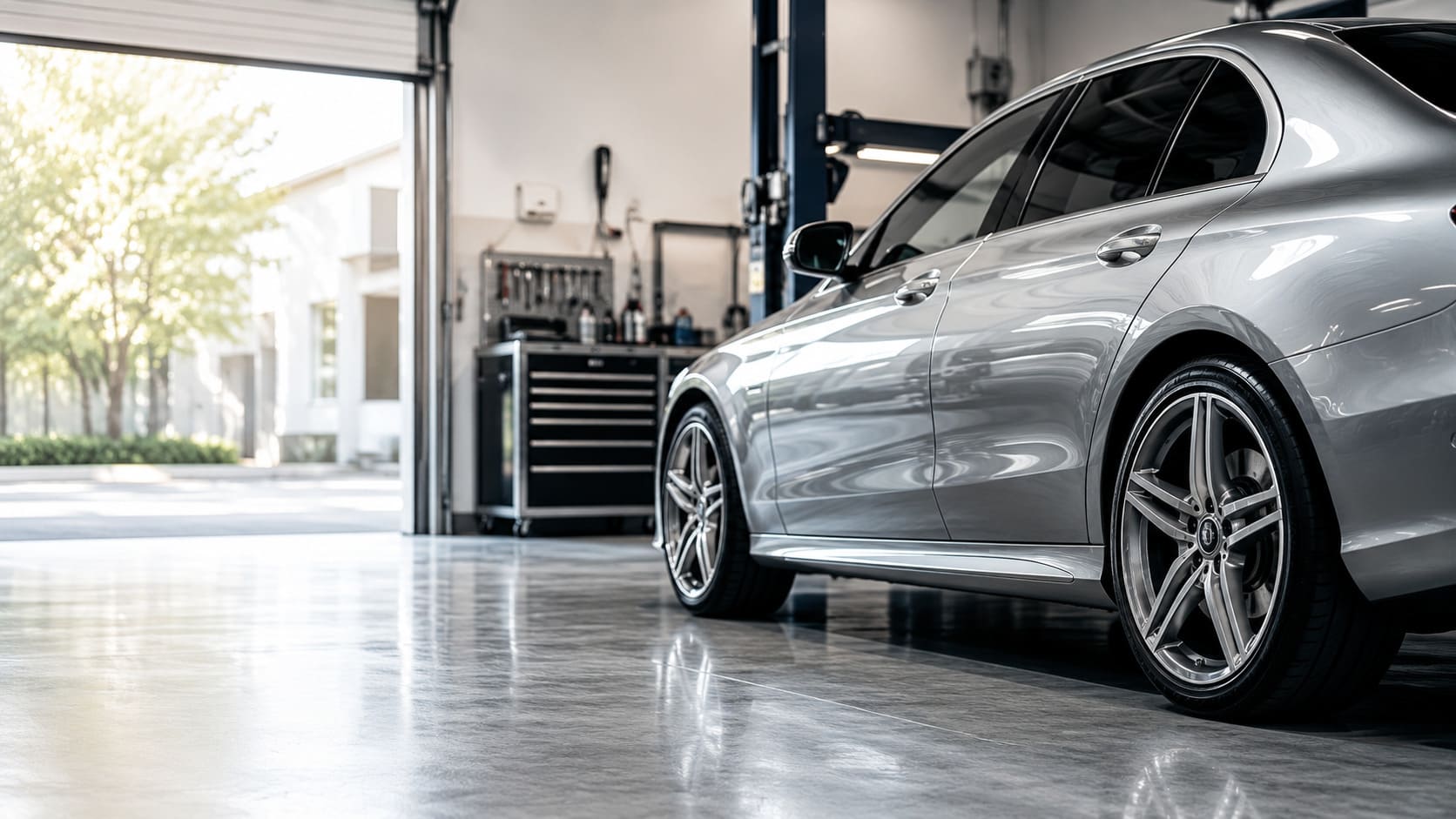
A well-kept E-Class routinely passes 150,000 miles, and its problems cluster by generation: the 2010-2016 W212 has Takata air bag recalls, a fragile V6 intake part and 7-speed electronics, the 2017-2023 W213 had early shift lever and power steering recalls, and the 2024 and newer W214 is working through 48-volt wiring and software campaigns. Air suspension, where fitted, is the biggest single bill on older cars.
The E-Class is the car many Boca Raton retirees buy once and keep for a decade, so the local used market has an unusual number of low-mileage, garage-kept sedans. That is good news for buyers, with one catch: rubber, seals and batteries age with time, not miles, and a 2012 E350 with 40,000 miles can still need bushings, mounts and an A/C service.
RepairPal gives the E350 3.5 out of 5, 12th of 30 luxury fullsize cars, with average yearly repair spending near $788, below the $976 average for its class. About 0.6 unscheduled visits a year and a 13 percent chance that a repair is severe put it slightly better than its segment.
Every US E-Class since 2017 uses a 9-speed automatic, and the base engine moved from a V6 to a 2.0-liter turbo four at that point. The bigger six-cylinder E400 and E450 remain popular here for highway merging on I-95, and they bring their own maintenance list.
Mercedes-Benz E-Class generations
Sixth generation (W214)
2024-presentSedan and All-Terrain wagon only; the coupe and convertible moved to the CLE. Heavy on software, with large screens and over-the-air updates.
Fifth generation (W213)
2017-2023Facelifted for the 2021 model year in the US. Coupe and cabriolet versions ran through 2023. Air Body Control air suspension was optional on sedans and standard on the All-Terrain wagon.
Fourth generation (W212)
2010-2016Restyled for 2014 with a single-piece headlight design. Durable mechanically. Early sedans and most coupes and convertibles are covered by Takata air bag campaigns.
Known Mercedes-Benz E-Class problems by year
Takata air bag inflators, driver and passenger
Several Takata recalls (16V-081 for driver inflators, plus 16V-363, 17V-017, 18V-043 and 19V-010 for passenger inflators) cover W212 E-Class cars, and Florida registration put the passenger campaigns in the first wave. Inflators that degrade in heat and humidity can rupture and spray metal. This is the first thing to check on any W212 for sale.
Guide: What should a pre-purchase inspection check on a used car?Intake manifold runner lever on the early V6
The plastic lever that moves the intake runner flaps breaks, setting a check engine light and taking a little low-speed torque. Mercedes only lists a complete manifold at $1,100-$1,600 installed; a metal lever kit at an independent is $250-$450 and fixes the failed part.
Guide: Check engine light on but the car drives fine: what does it mean?7-speed transmission electronics and limp mode
A failing speed sensor on the gearbox's internal conductor plate drops the car into a single fixed gear, often after a rough 2-3 shift as the first warning. Repair runs $1,300-$2,000 with programming. Fluid changes on a 40,000- to 60,000-mile rhythm, while not on the factory schedule, are what most specialists recommend.
Guide: Why is my transmission slipping?Air suspension sagging or compressor failure
On cars equipped with air springs, a corner that sits low after an overnight park is the classic symptom; a hardworking compressor that runs constantly comes next. A single air strut or spring costs $1,200-$2,400 installed and a compressor $900-$1,600. Many owners of older cars convert to conventional springs for $1,800-$3,000.
Guide: What's that clunking noise when I go over bumps?Shift lever module and steering assist recalls
Recall 17V-078 covered 2017 E300 cars whose column-mounted shift lever module could be damaged inside, so moving the lever would not select a gear. On the W212, recall 16V-899 covered power steering control units with poorly soldered contacts that could cut steering assist. Both were dealer fixes; confirm them on any used car.
Guide: Why does my car shift hard or late?Musty A/C odor
Every E-Class from 2010 through 2019 is named in the Mercedes HVAC odor settlement. The cure ranges from an evaporator cleaning and new cabin filter ($150-$300) to evaporator replacement, which requires dashboard removal and costs $2,000 or more.
Guide: Why does my car A/C smell musty, like mildew or old socks?12-volt and 48-volt ground connections
Recall 25V-240 covers 12-volt and 48-volt ground connections in the wiring harness that may not be secured, which can overheat. Separately, recall 24V-688 fixed MBUX software that could deactivate driver assistance functions such as cross-traffic braking. Electrical warnings on a new W214 are a dealer visit, not a parts-store scan.
Guide: Why does my car battery keep dying? Finding the real causeNotable recalls
- 16V-081 (2010-2011 E350 4MATIC and E350 Coupe, 2011 E350 Cabriolet): Takata driver frontal air bag inflators that can rupture in a crash. The dealer replaces the driver air bag module.
- 19V-010 (2014 E350 Coupe, E350 4MATIC Coupe and E350 Cabrio registered in Florida, plus earlier years in other zones): Takata passenger frontal inflators that can explode after long exposure to heat and humidity. Florida is in the highest-risk Zone A.
- 16V-899 (2014-2016 E350, 2015-2016 E400): Improperly soldered contacts in the electric power steering control unit can lose connection and switch off power assist.
- 17V-078 (2017 E300 and E300 4MATIC): The steering-column shift lever module can be damaged internally, so moving the lever does not select a gear. Dealers replace the module.
- 18V-850 (2018-2019 E300 rear-wheel drive, plus E400 and E450 coupes and cabriolets): A steering rack locknut can break under high load, possibly leaving the steering stuck in one position. Dealers replace the rack.
- 24V-941 (2025 E350, E350 4MATIC, E450 4MATIC and All-Terrain): The camber strut bracket may be improperly welded to the rear axle carrier and can separate, affecting handling. The remedy is free at a dealer.
Recall repairs are free at any franchised Mercedes-Benz dealer. Check your VIN at nhtsa.gov/recalls, since this list is not complete.
Maintenance that matters
| Every 10,000 miles or yearly | Service A or B by the dash reminder. If the car sits for months while you travel, do the service on the calendar date even if the mileage is low; oil and brake fluid age regardless. |
| Every 40,000-60,000 miles | Transmission fluid and filter on both the 7-speed and the 9-speed, spark plugs on the gasoline engines per the booklet, and an air suspension leak check on cars so equipped. |
| Every 5-6 years regardless of miles | Inspect engine and transmission mounts, front control arm bushings and the rubber parts of the suspension. On low-mileage retiree cars these crack from age and heat long before they wear out. |
| Every 3-4 years | Main 12-volt battery, plus the small auxiliary battery used on many W212 and W213 cars. A failing auxiliary battery triggers an 'auxiliary battery malfunction' message that owners often ignore. |
Confirm against your owner's manual or maintenance minder for your exact year and engine.
Typical Mercedes-Benz E-Class repair costs
| Job | Typical cost | Notes |
|---|---|---|
| Service B at an independent | $450-$750 | Includes brake fluid and cabin filter. |
| Air strut or air spring, one corner | $1,200-$2,400 | Fronts cost more. Aftermarket units can save 30-40 percent. |
| Airmatic or Air Body Control compressor | $900-$1,600 | Replace the relay with it. |
| Intake manifold lever kit, 2010-2011 E350 | $250-$450 | Full manifold $1,100-$1,600. |
| Transmission conductor plate, 7-speed | $1,300-$2,000 | With programming and fluid. |
| Engine mounts, pair | $600-$1,000 | Common on 2010-2016 cars past 10 years old. |
| Auxiliary battery | $150-$300 | Small battery under the dash or in the engine bay on many models. |
Typical South Florida ranges for parts and labor, for budgeting only. Your quote depends on the vehicle and the shop.
Buying a used Mercedes-Benz E-Class
- The 2019-2023 E-Class is the most trouble-free group to shop: the early 2017 shift lever and steering recalls are behind it, and the 2020 and newer E350 uses the updated 2.0 turbo. An E450 with the facelift inline-six is the pick for buyers who want six cylinders.
- A late W212, 2014-2016 E350, is a strong value if every Takata and power steering recall is closed and it has steel springs rather than air suspension. Ask for the dealer's recall history printout by VIN.
- Avoid 2010-2011 E350s with no service history unless the price allows for the intake lever, a transmission conductor plate and mounts. They are not bad cars, but the bills stack up.
- On any car with air suspension, park it overnight before buying and check that all four corners sit level in the morning. A sagging corner is a $1,200-plus negotiation point.
The Florida factor
Garage-kept E-Class sedans in Boca condos often look perfect and still have Florida-specific aging: sun-baked rubber door seals, cracked engine mounts and A/C components that ran hard every summer. Low miles do not mean new parts. Budget for rubber and fluids on any car older than eight years, regardless of the odometer.
The Takata recalls weighed heavily on Florida because inflators degrade fastest with heat and humidity cycling, and the state sits in the first-priority zone. An E-Class that came down from New York with a snowbird owner may have been in a later wave, so check by VIN rather than assuming it was done.
Air suspension and Florida heat do not get along. Rubber air springs dry out in parking lots that reach 150 degrees at ground level, and compressors work harder in humid air because they also pull in moisture. A car stored all summer should be started and allowed to level itself before driving.
Repair shops near Boca Raton
- Boca Auto Fix4301 Oak Circle, Boca Raton, FL, 33431
- Element, Pickup trucks and trailer repair3120D Northwest 16th Terrace, Pompano Beach, FL, 33064
- Europen Auto Service CentreParkland, FL
- Ferrari of Boca Raton6403 W Rogers Cir, Boca Raton, FL, 33487
- FirestonePompano Beach, FL
- Firestone1259 North Federal Highway, Boca Raton, FL, 33432
Mercedes-Benz E-Class FAQ
Which E-Class engine is most reliable?
The 3.5-liter V6 in the 2012-2016 E350 and the 2.0-liter turbo in the 2020-2023 E350 both have good track records. The inline-six in the later E450 is newer and smoother but has more complex 48-volt hardware.
Is it worth fixing air suspension on an older E-Class?
On a car you plan to keep, a quality strut or compressor is worth it. On an older car with several failing corners, a conversion to coil springs can be cheaper long term, at the cost of some ride quality.
What does 'auxiliary battery malfunction' mean?
Many E-Class models carry a small second battery that supports the start-stop system and electronics. The message means it has weakened. Replacement is usually under $300 and stops the warning.
How long does an E-Class last?
With on-time service, many reach 150,000-200,000 miles. Age-related parts such as mounts, bushings and air springs decide the long-term cost more than the engine does.
Guides for Mercedes-Benz E-Class owners
More for Mercedes-Benz owners: Mercedes-Benz owner's guide
- Wikipedia: Mercedes-Benz E-Class (W213), engines by model
- NHTSA recall 16V081: Takata driver air bag inflators
- NHTSA recall 17V078: E300 shift lever module
- RepairPal: Mercedes-Benz E350 reliability and repair costs
- Lieff Cabraser: Mercedes HVAC odor settlement covered models
General information, not a diagnosis. A car problem can have causes a guide cannot see, so have anything safety-related inspected in person. Read our editorial policy.