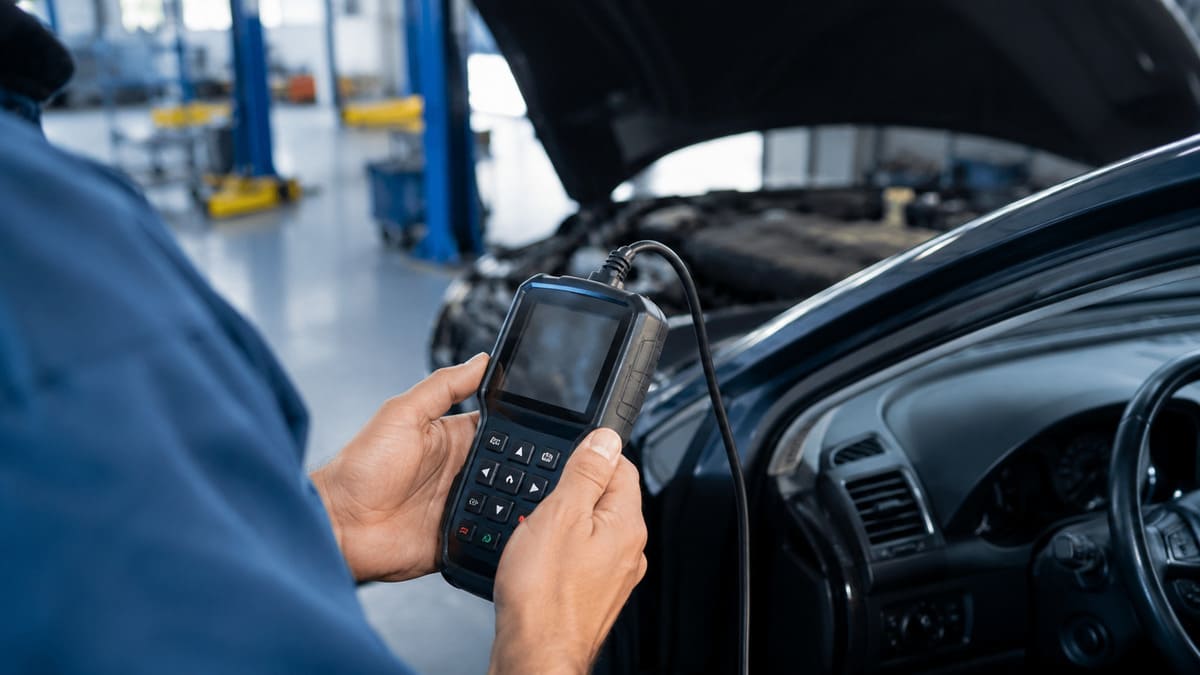
Yes, a flashing check engine light means the engine is misfiring badly enough that raw fuel is reaching the exhaust, and you should ease off the throttle and get off the road as soon as it is safe. Keep driving and the catalytic converter can overheat within minutes, which turns a $200 coil or plug repair into a $1,500 or larger bill and, in rare cases, starts an underbody fire.
The engine computer watches crankshaft speed many times per revolution. When one cylinder fails to fire, the crank slows for a moment, and the computer counts it. A few misfires set a steady light. When the misfire rate climbs high enough to damage the catalytic converter, the computer switches the light to blinking. That blink is the most specific warning the check engine light can give: it is not a sensor guess, it is an active problem happening right now.
The damage comes from unburned gasoline. Fuel that does not burn in the cylinder gets pumped into the converter, which is already running several hundred degrees hot. The fuel burns there instead, and the ceramic honeycomb inside can melt or crack. That is why a few extra minutes of driving matters so much more with a flashing light than with a steady one.
Symptoms
- Check engine light blinks roughly once per second
- Engine shakes or stumbles, worst at idle or under acceleration
- Sudden loss of power climbing an on-ramp
- Strong raw fuel or sulfur smell from the tailpipe
- Popping or chuffing sound from the exhaust
- Light blinks only under load, then goes steady when you coast
Likely causes and what they cost
1. Failed ignition coil
$150-$400 for one coil installed, $400-$900 if a shop replaces all coils on a V6Most modern engines use one coil per cylinder. When a coil's internal insulation cracks, usually from heat cycling, that cylinder stops firing under load. The code is typically P0301 to P0308, with the last digit naming the cylinder.
The fix: Swap the suspect coil to another cylinder to confirm the misfire follows it, then replace the coil and usually the spark plug on that cylinder.
2. Worn or fouled spark plugs
$180-$800 depending on how buried the plugs arePlugs wear their electrodes until the gap is too wide for the coil to jump under high cylinder pressure. Oil or fuel fouling has the same effect. Several worn plugs can cause a random multi-cylinder misfire, code P0300.
The fix: Replace the full set of plugs with the type in the owner's manual.
3. Stuck or leaking fuel injector
$350-$1,200, direct-injection injectors are at the top of that rangeAn injector that sticks closed starves one cylinder, and one that sticks open floods it. On direct-injection engines a failing injector can also wash oil off the cylinder wall. Either way the cylinder misfires under load.
The fix: Test injector balance and resistance, then replace the faulty injector and its seals.
4. Water in the ignition or a damaged coil connector
$100-$400Driving through deep standing water or a car wash that soaks the engine bay can short a coil or plug well. The misfire often appears suddenly after rain and sometimes clears as things dry, but it can leave carbon tracks that keep misfiring.
The fix: Dry and inspect the plug wells and connectors, replace any coil or boot with carbon tracking.
5. Mechanical problem: valve, lifter, head gasket or timing
$1,500-$5,000 or more, sometimes an engine replacementIf a cylinder has low compression, no amount of spark will fix it. Collapsed lifters, a burnt valve, a leaking head gasket that lets coolant into a cylinder, or a stretched timing chain all cause misfires that do not move when you swap coils.
The fix: Compression and leak-down tests to locate the fault, then the specific engine repair.
Costs are typical South Florida ranges for parts and labor, for budgeting only.
What you can check yourself
- 1Get out of traffic, then lighten the load
Signal, move to the right lane or shoulder, and avoid hard acceleration. On I-95 that means taking the next exit rather than trying to make it home at 70 mph.
- 2Check for other warnings
If the temperature gauge is high or the oil light is on as well, shut the engine off immediately. A misfire plus overheating can point to a head gasket.
- 3Restart once and watch the light
After a few minutes off, restart. If the light now stays steady and the idle is smooth, the misfire may be intermittent and a short, gentle drive to a nearby shop is a judgment call. If it blinks again or the car shakes, call a tow.
- 4Look under the hood without touching hot parts
With the engine off, look for a coil connector that has popped loose, a chewed wire or wet plug wells. Do not touch the exhaust manifold or converter area, which can cause serious burns for a long time after shutdown.
- 5Read the code if you have a reader
A cylinder-specific code such as P0302 is good news because it points to one coil, plug or injector. A P0300 random misfire calls for a broader diagnosis.
- 6Smell and look at the tailpipe area
A strong fuel smell or a glowing red shimmer under the car means the converter is overheating. Do not park over dry grass or leaves, which can ignite.
When to take it to a shop
- Every time the light flashes. Even if it stops, the misfire code and freeze-frame data should be read and the cause found before the converter takes more damage.
- The engine shakes hard, loses power or will not idle. Arrange a tow instead of driving.
- The misfire stays on the same cylinder after you swapped coils, which points to an injector or a mechanical fault that needs testing equipment.
- You see white smoke with a sweet smell, or the coolant level is dropping, alongside the misfire.
The Florida factor
Most flashing lights in South Florida show up in two situations. The first is right after a summer downpour, when drivers push through water on low stretches of Federal Highway or flooded parking lots, and water reaches the coils. The second is under heavy load in the heat: merging onto I-95 at full throttle with the A/C running, when a coil that is already cracked finally breaks down. A coil that fails only when hot will often run fine the next cool morning, which tricks people into thinking the problem fixed itself.
An overheating converter is a fire risk anywhere, but dry swale grass and mulch beds along Boca Raton streets in the spring dry season make it worse. If the light is flashing, stop on pavement, not on the grass shoulder. A tow from inside Boca Raton to a nearby shop typically runs $90-$175, which is cheap next to a converter.
Notes for specific makes
- Chevrolet: GM V8 trucks and SUVs with cylinder deactivation (AFM or DFM) are known for lifter failures that cause a misfire on one cylinder, often with a ticking noise. Swapping coils will not move it. The 2021 to 2024 6.2L L87 is also under recall 25V274 for bearing damage that can start with engine noise and a check engine light.
- GMC: Sierra and Yukon models share the GM V8 lifter and L87 recall concerns. Check the VIN on NHTSA's recall lookup before paying for engine work on a 2021 to 2024 6.2L.
- BMW: BMW coils are a frequent wear item on inline-six engines, and many shops replace the plug at the same time because both live in the same well. Oil leaking from the valve cover into the plug wells also causes misfires.
- Toyota: The 2022 to 2024 Tundra and some Lexus LX and GX models with the gas-only V35A twin-turbo V6 have been recalled for machining debris that can damage the engine. Rough running or knocking on these trucks should go to a dealer under the recall.
- Ford: Some Ford 1.5L and 1.6L EcoBoost engines have had coolant leaking into a cylinder, which shows up first as a misfire on a cold start and a slowly dropping coolant level.
Diagnostics shops near Boca Raton
- Ferrari of Boca Raton6403 W Rogers Cir, Boca Raton, FL, 33487
- Tire Kingdom23193 Sandalfoot Plaza Drive, Boca Raton, FL, 33428
Frequently asked questions
Can I drive a short distance with a flashing check engine light?
Only as a last resort, gently, and for a mile or two to reach a shop or a safe parking spot. Every minute adds converter heat. If the car is shaking or losing power, tow it.
The light flashed, then went steady. Am I fine now?
Not necessarily. It means the misfire rate dropped below the damage threshold for the moment. The underlying fault is still there and usually gets worse, so have it diagnosed soon.
Can bad gas cause a flashing light?
It can, but it is far less common than a coil or plug. Water in the fuel or very low fuel in a hot tank can cause a misfire. If you just filled up at an unfamiliar station and the problem started right after, mention it to the shop.
Did the flashing light already ruin my catalytic converter?
Not always. A converter can survive a brief episode. After the misfire is fixed, a technician can check converter efficiency with the oxygen sensors and a temperature test. If it rattles or a P0420 code appears, it was damaged.
Does roadside assistance cover a tow for this?
Usually yes. Many car insurance policies, new car warranties and auto club memberships include a set number of free miles. Check your insurance app before paying out of pocket.
Related guides
More on this job: Diagnostics in Boca Raton, costs and how to choose a shop
- Kelley Blue Book: P0300 random/multiple cylinder misfire
- Kelley Blue Book: Why is my check engine light on?
- RepairPal: Check engine light on, steady vs flashing
- Motor1: GM recalls nearly 600,000 vehicles with the 6.2L L87 V8
General information, not a diagnosis. A car problem can have causes a guide cannot see, so have anything safety-related inspected in person. Read our editorial policy.